
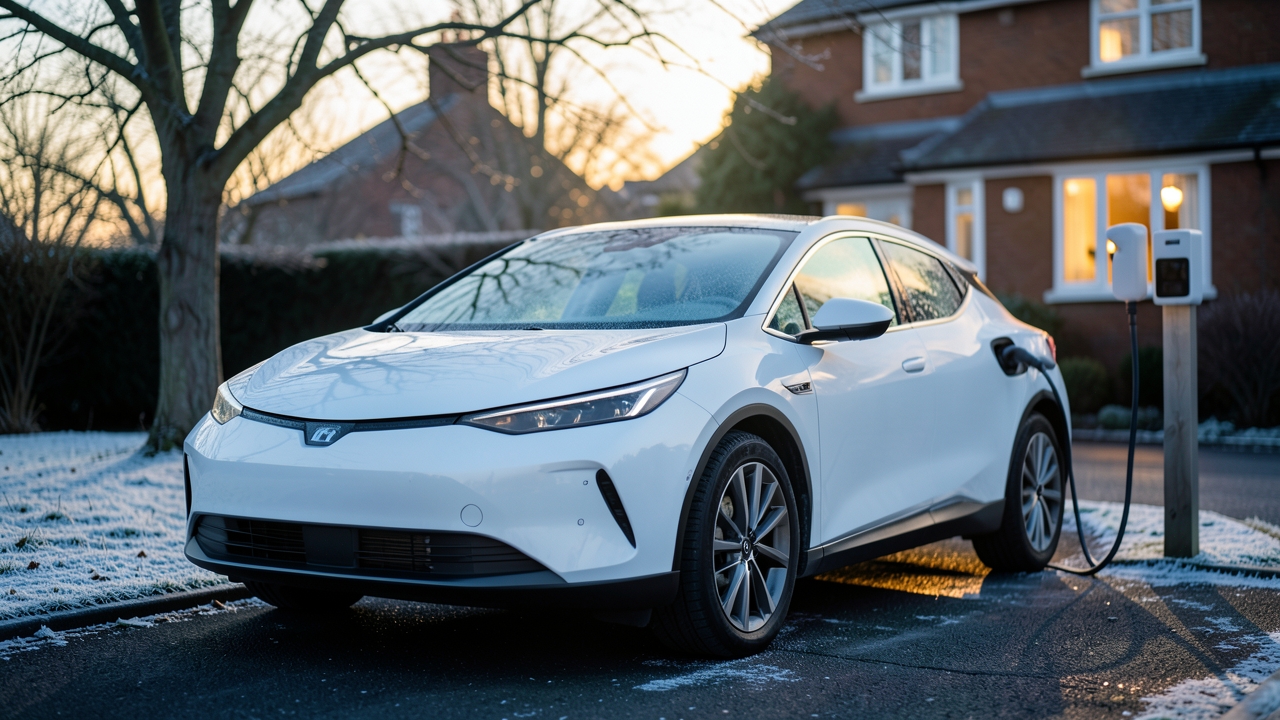
If your EV winter range UK figures look alarming on a frosty November morning, you are not imagining it. Independent 2026 testing shows a typical electric car loses between 25% and 32% of its usable range at 0°C. However, roughly a third of that loss comes from settings you can change today.
This guide uses real 2026 model data to quantify the damage at 0°C, 5°C and 10°C. Furthermore, it walks through five concrete settings that recover measurable miles per charge, from cabin pre-conditioning to tyre pressure.
How much EV winter range UK drivers really lose
Official WLTP range is measured at 23°C in a laboratory. Consequently, it tells you almost nothing about a January commute from Manchester to Leeds. Real-world winter testing is far less flattering.
Across six popular 2026 models, the pattern is consistent. Losses stay modest at 10°C, become noticeable at 5°C and turn severe at 0°C.
Real 2026 model data at 0°C, 5°C and 10°C
The figures below come from mixed urban and motorway testing, climate control set to 21°C, compared with a summer baseline measured at 20°C. Which? publishes comparable winter tests each year for anyone wanting a second opinion.
- Hyundai Ioniq 5, 84 kWh: 318 miles in summer, 293 at 10°C (−8%), 267 at 5°C (−16%), 226 at 0°C (−29%)
- Kia EV3 Long Range, 81.4 kWh: 331 miles, 305 (−8%), 278 (−16%), 235 (−29%)
- Tesla Model 3 Long Range AWD: 381 miles, 351 (−8%), 320 (−16%), 270 (−29%)
- Renault Scenic E-Tech, 87 kWh: 330 miles, 303 (−8%), 277 (−16%), 234 (−29%)
- Vauxhall Corsa Electric, 51 kWh: 208 miles, 190 (−9%), 172 (−17%), 146 (−30%)
- MG4 Long Range, 77 kWh: 245 miles, 224 (−9%), 201 (−18%), 168 (−31%)
These are best-case winter numbers. Repeated short trips from cold are worse, often 35–40% down, because the cabin and battery are heated from scratch every single time.
Why cold weather drains an electric car so quickly
Lithium-ion chemistry slows down
At 0°C, internal resistance inside the pack rises sharply. As a result, the battery delivers less energy and accepts less regenerative braking. Some cars disable regen completely for the first few miles of a journey.
Cabin heating is the biggest single draw
A resistive cabin heater pulls 1.5–3 kW. Meanwhile, a heated seat uses roughly 50–100 W. On a 20-mile commute, that gap alone is worth several miles of range.
Denser air and softer tyres
Cold air is about 7% denser than mild air, which lifts aerodynamic drag at motorway speeds. Furthermore, tyre pressures fall by around 0.07 bar for every 5°C drop in temperature.
Setting 1 — Pre-condition the cabin while still plugged in
This is the single easiest win. Use your car app to warm the cabin and defrost the glass for 10–15 minutes before you leave, while the charging cable remains connected. The energy comes from the grid, not the battery.
On a typical 20-mile winter commute, pre-conditioning recovers 5–9 miles of indicated range. It also means you drive away with a clear screen instead of burning range on a defroster.
One caveat: a 2.3 kW granny cable barely covers a 3 kW heater. A dedicated 7 kW unit makes the routine far more effective, and our guide to the best home EV chargers in the UK explains exactly what to look for.
Setting 2 — Confirm your car actually has a heat pump
A heat pump moves heat rather than generating it. At 0°C it typically runs at a coefficient of performance of 2 to 2.5, so it uses 0.6–1 kW to do the work of a 1.5–3 kW resistive heater.
In practice, that is worth 8–12 miles on a cold motorway run. Yet plenty of UK buyers never check whether the option is fitted before signing.
- Volkswagen ID.3 and ID.4: factory option, around £1,000–£1,100
- Renault Scenic E-Tech and Megane E-Tech: optional on lower trims, roughly £900
- Kia EV3 and Hyundai Ioniq 5: standard on upper trims, optional elsewhere
- Tesla Model 3 and Model Y: heat pump fitted as standard since 2021
Retrofit is rarely possible, so check the specification carefully before buying used. If you are ordering new, the option pays for itself over four or five winters for most high-mileage drivers.
Setting 3 — Schedule charging to finish just before you leave
A battery that has just finished charging is warm, and a warm pack performs noticeably better. Use the car or charger schedule so charging completes 30–60 minutes before departure.
You gain 4–7 miles from improved efficiency and immediate regenerative braking. In addition, the same session can run entirely on a cheap overnight tariff, which cuts your cost per mile dramatically.
For daily use, charge to 80% rather than 100%. The exception is a long winter journey, where a full pack is worth the small trade-off in battery care.
Setting 4 — Check tyre pressures monthly through winter
This is the setting most drivers ignore. A 0.3 bar drop, common when the temperature falls from 15°C to 0°C, adds roughly 1–2% to energy consumption and dulls steering response.
Check pressures when the tyres are cold, at least once a month from November to March. Most EVs run 2.5–2.9 bar, but always follow the door pillar sticker rather than the tyre wall.
Correct pressures recover 3–5 miles per charge. They also reduce uneven wear, which matters because EV-specific tyres are expensive to replace.
Setting 5 — Eco mode, heated seats and an honest 65 mph
Eco mode usually remaps the throttle and caps heater output. Pair it with seat and steering wheel heating, which warm you directly for a fraction of the energy.
Speed matters just as much. Dropping from 75 mph to 65 mph on a motorway cuts energy use by around 15–20%, because drag rises with the square of speed.
Together, these habits are worth 10–15 miles on a longer winter run, and they cost nothing to adopt.
A bonus habit for longer winter journeys
On a rapid-charging stop, a cold battery at 0°C may accept only 30–50 kW instead of the 130 kW it manages in summer. Consequently, a 20-minute splash becomes a 45-minute wait.
Use the satnav to route to the charger so the car preconditions the pack on the way. This does not add range directly, but it protects your journey time and your patience.
How many miles can the five settings realistically recover?
Add the gains up and the picture changes. On the Kia EV3 above, the 0°C figure of 235 miles moves considerably closer to the summer baseline.
- Cabin pre-conditioning on mains power: 5–9 miles
- Heat pump versus resistive heating: 8–12 miles
- Scheduled charging for a warm pack: 4–7 miles
- Correct tyre pressures: 3–5 miles
- Eco mode and a 65 mph motorway pace: 10–15 miles
A 0°C range of 235 miles becomes a realistic 255–270 miles without changing a single journey. That is roughly half of the winter loss clawed back for free.
The rest is physics. No setting warms a battery to 23°C on a frosty morning, and no app removes the drag penalty of dense cold air.
What winter charging actually costs in 2026
Winter efficiency typically falls to around 3.0 miles per kWh, against 3.8–4.0 in summer. However, the cost gap depends almost entirely on when you charge.
Off-peak rates sit near 7p per kWh on time-of-use tariffs. The standard variable rate is around 24.5–26.5p per kWh following the 2026 price cap.
- 60 kWh car charged from 20% to 80%: 36 kWh
- Off-peak session: about £2.52
- Peak-rate session: about £9.00
- Winter cost per mile, off-peak: roughly 2.3p
- Winter cost per mile, peak: roughly 8.3p
Home charging hardware is the other cost to plan for. A standard 7 kW unit costs £800–£1,200 fitted, and our breakdown of