
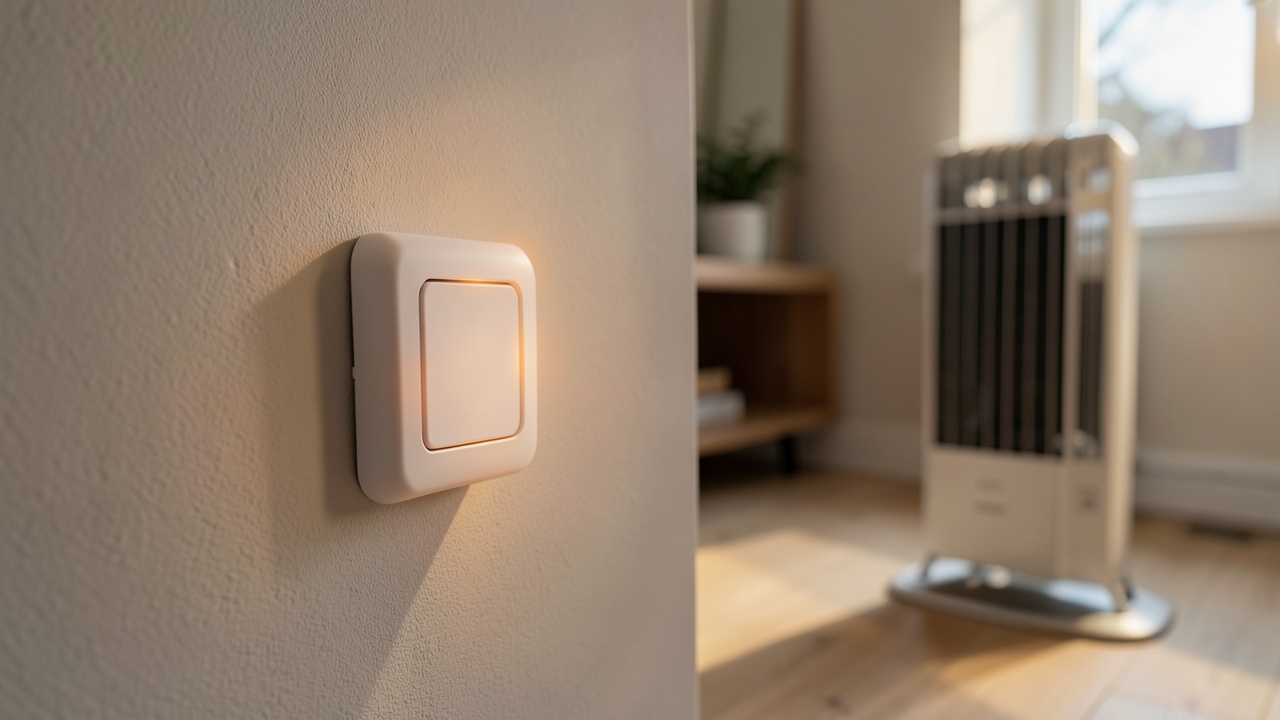
Every winter, someone plugs a 3kW fan heater into a budget smart plug and later notices the plug body is warm to the touch. The cause is simple: the smart plug load limit is lower than the box suggests. UK smart plugs advertise 13A, yet the instruction leaflet usually caps continuous use at 10A. A 3kW fan heater pulls around 13A from the moment it switches on.
That gap between marketing and reality matters. Below, we explain what 13A and 10A really mean, which appliances are safe, and how to spot a plug heading for thermal shutdown before it gets there.
What the smart plug load limit actually means
A UK ring main runs on 2.5mm² cable, protected by a 32A breaker. The weakest link in that circuit is rarely the cable. It is the plug. Every smart plug contains a relay, a current sensor, a small PCB and a fuse, all squeezed into a sealed plastic shell.
The 13A figure comes from BS 1363, the standard covering UK three-pin plugs and the BS 1362 fuse inside them. It describes the maximum current the assembly should survive. The 10A figure comes from the manufacturer’s own derating, because heat builds quickly in a housing with no airflow.
Peak rating versus continuous rating
A peak rating assumes a short burst followed by a cooldown. A continuous rating assumes hours of steady draw in a socket behind a sofa, where ambient temperature can easily hit 35°C. Consequently, most reputable brands certify 13A peak but recommend 10A continuously — roughly 2,300W at 230V.
- 13A peak: about 2,990W, short duration, tested in open air
- 10A continuous: about 2,300W, hours of use, tested in a warm enclosure
- 13A fuse: carries 13A indefinitely and may take an hour to blow at 20A
The maths: why a 3kW fan heater sits right on the edge
Divide the wattage by the voltage and the problem appears. A 3,000W heater at 230V draws 13.04A. UK supply often sits closer to 240V, so the same unit can pull 3,100W and 12.9A. In practice, most 3kW heaters measure between 12.5A and 13.5A on a clamp meter.
That is 30% above a 10A continuous limit, sustained for hours. A 2kW heater is safer at 8.7A, though it still leaves little headroom. A 1.5kW model at 6.5A is comfortable. For context, running a 3kW heater for one hour costs roughly 75p at 25p per kWh — so people run them for long stretches, which is exactly the scenario a 10A limit guards against.
A plug rated at 13A is not a licence to draw 13A for six hours. It is a ceiling, not a target.
Which appliances push a smart plug into thermal shutdown?
The deciding factor is not just wattage. It is wattage multiplied by time. A 3kW kettle is risky for four minutes; a 2.5kW oil radiator is riskier because it runs for four hours.
| Appliance | Typical UK draw | Amps at 230V | Verdict |
|---|---|---|---|
| 3kW fan heater | 3,000W | 13.0A | Avoid |
| 2kW fan heater | 2,000W | 8.7A | Short bursts only |
| Oil-filled radiator | 2,500W | 10.9A | Avoid |
| Immersion heater | 3,000W | 13.0A | Never |
| Vented tumble dryer | 2,500W | 10.9A | Avoid |
| Heat pump tumble dryer | 800–1,000W | 3.5–4.3A | Safe |
| 3kW kettle | 3,000W | 13.0A | Borderline |
| Air fryer | 1,500–2,000W | 6.5–8.7A | Short bursts only |
| E-bike charger | 100–300W | 0.4–1.3A | Safe |
| Dehumidifier | 300–600W | 1.3–2.6A | Safe |
High-risk appliances to keep off smart plugs
Anything that heats a room or a tank for an hour or more belongs on a direct socket or a dedicated circuit. That includes fan heaters above 2kW, panel heaters, oil-filled radiators and immersion elements. Electric showers are hardwired for good reason and should never be adapted to a plug.
Borderline appliances: fine in short bursts
Kettles, toasters, hair dryers, irons and air fryers all push 6–13A, but only for a few minutes. On a genuine 13A-rated plug with a well-ventilated socket, they usually cope. However, repeated heating cycles gradually oxidise relay contacts, so a three-year-old plug on kettle duty is not the one to trust with a heater.
Safe appliances: comfortably under 10A
Heat pump tumble dryers sit around 800–1,000W. Dehumidifiers, TVs, lamps, routers, slow cookers and phone chargers are all far below the limit. E-bike chargers are a good match too, drawing only 100–300W — see our guide to e-bike conversion kits if you are planning a build and want to schedule charging overnight.
What actually happens inside an overloaded smart plug
Heat is the first sign. As the relay contacts warm up, their resistance rises, which creates more heat. Good firmware cuts the load at around 15–16A using a current sensor and a thermal fuse. Cheaper units simply cook.
Worst case, the relay contacts weld shut. The plug then stays live even when the app reports off, and the only way to isolate the heater is the socket switch. Meanwhile, the faceplate may discolour and you may notice a hot bakelite smell.
Your 32A MCB will not trip, because 13A is well within circuit rating. A 13A fuse will not blow either. That leaves the smart plug itself as the component that fails first.
How to check your smart plug is genuinely 13A rated
- Look for the UKCA mark and a UK importer address on the plug or box — the GOV.UK guidance on UKCA marking explains what a valid label must show
- Check the stated maximum load in watts on the rating label, not just the fuse rating
- Confirm a BS 1362 13A fuse sits inside the plug, not a 5A or 3A fuse borrowed from another appliance
- Look for standards references such as EN 60669-2-1 or BS 5733 alongside the Radio Equipment Regulations 2017
- Avoid marketplace bargains that quote 16A, which is a European Schuko rating adapted to UK pins
Weight is a rough guide too. A plug with proper brass terminals and a chunky relay feels solid. Featherweight units usually mean thin copper and a tiny contact gap.
Safe appliance checklist for smart plugs
- Keep continuous loads under 10A (about 2,300W)
- Never run a 3kW heater, immersion heater or vented dryer through a smart plug
- Plug directly into the wall socket, never into an extension lead or another adaptor
- Avoid daisy-chaining two smart plugs together
- Leave space around the socket so heat can escape
- Feel the plug after an hour of use — anything hot enough to flinch from is a warning
- Retire any plug with a discoloured casing, a buzzing relay or a burning smell
- Prefer resistive loads (heaters, kettles) over motor loads with high inrush current
- Use energy monitoring to confirm the real draw rather than trusting the label
Best high-load smart plugs in the UK for 2026
Even 13A-rated models still recommend 10A continuous, so choose one with proper certification and real energy monitoring. Expect to pay £12–£35.
- TP-Link Tapo P110 — 13A rated, 2,990W maximum, live energy monitoring, around £16
- TP-Link Tapo P100 — same body without metering, around £12
- Meross MSS310 — 13A rating, HomeKit support, around £15
- Shelly Plug S Gen3 — 2,500W cap and local control, around £22
- Eve Energy — Thread and Matter, 13A rated, around £35
- Aqara Smart Plug UK — compact body, 13A rated, around £25
Energy monitoring pays for itself quickly. Watching a heater’s hourly consumption in the app is far more persuasive than any label. Pair that data with balcony solar panels and you can shift heavy draws into daylight hours, or use the same scheduling tricks we cover in our home EV charger installation guide. The Energy Saving Trust also has useful figures on what heating actually costs per hour.
Smart plug load limit: common questions
Can a smart plug handle a 3kW fan heater?
No. A 3kW heater draws about 13A continuously, which exceeds the 10A derated limit most smart plugs carry. Use the wall socket instead, or fit a dedicated heater circuit.
What about a 2kW fan heater?
At 8.7A it sits inside a 10A limit, but the margin is thin. Choose a 13A-rated model, keep the socket ventilated, and check the plug temperature after the first hour.
Do energy monitoring plugs have a lower limit?
Not usually. The metering chip adds negligible resistance. However, cheaper metering plugs sometimes use thinner PCB traces, so certification matters more than the feature list.
Can I put a smart plug on an extension lead?
Avoid it. Extension leads add another set of terminals and trap heat. If you must, use a fully unwound 13A-rated lead and keep the total load well below 10A.
The rule of thumb is simple: match the appliance to the plug, not the plug to the appliance. Have you checked what your own smart plug is carrying right now — and would you be happy leaving it on overnight?