
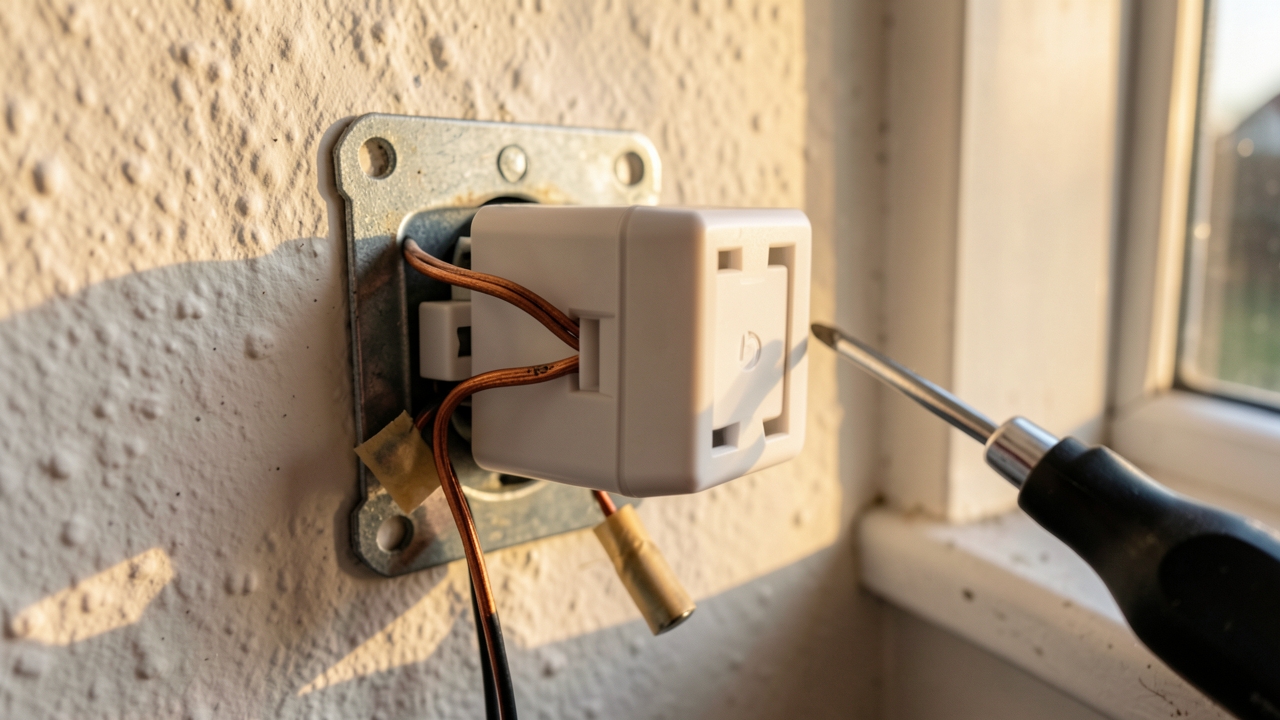
Most UK lighting circuits send a permanent live down to the switch and return a switched live to the ceiling rose. There is no neutral at the switch plate. That single quirk of British wiring is why the no-neutral smart switch UK market exists — and why thousands of buyers order a smart dimmer online, then find it will not power up.
We spent six weekends testing seven modules from Shelly, Sonoff, Aqara, Lightwave and Lutron in a 1978 three-bedroom semi near Sheffield. Here is what worked, what failed, and what Part P actually requires in 2026.
Why most UK lighting circuits have no neutral at the switch
British lighting is usually wired on the loop-in, or three-plate, system. The permanent live, neutral and earth all meet at the ceiling rose. Only the switched live travels down the wall to the switch.
In a 1970s house you will typically find twin-and-earth cable with red and black cores, or brown and blue in anything rewired after 2006. Either way it is two conductors plus a bare earth in a green-and-yellow sleeve. That is two conductors doing the job of three.
The consequence is simple. A smart switch with no neutral must power its radio by leaking a tiny current through the lamp itself. It is clever engineering, but it comes with conditions.
- A minimum load is needed, or the module drops out and reboots
- LED lamps may glow faintly when the switch is off
- Cheap drivers can flicker or buzz at low dim levels
- Two-way switching becomes significantly harder
How we tested seven modules in a 1970s semi
Our test house has a lighting circuit in 1.0mm² twin-and-earth on a 6A RCBO, with the consumer unit replaced in 2019. Crucially, every switch box had an earth. Many 1960s homes do not, which rules out metal faceplates entirely.
We tested against five real loads: six 5.5W dimmable GU10s in the kitchen, four 4W candle LEDs in the lounge, a 12W LED batten in the garage, two 7W filament-style LEDs in the hall, and one 60W incandescent in the loft as a control lamp.
For each module we measured start-up time, standby leakage, flicker at 10%, 50% and 90% output, the minimum load before drop-out, and behaviour on a two-way circuit. We also checked app response and how well each one behaved when the Wi-Fi dropped.
If you are planning a wider system, our guide to the best smart lighting for UK homes covers bulbs, strips and full-room setups.
The seven no-neutral smart switch UK options we tested in 2026
| Module | Typical price | Neutral needed? | Dimming | Hub required? |
|---|---|---|---|---|
| Shelly 1L | £18 | No | No | No (Wi-Fi) |
| Shelly Dimmer 2 + Bypass | £37 | No | Yes | No (Wi-Fi) |
| Sonoff ZBMINI-L2 | £14 | No | No | Yes (Zigbee) |
| Aqara H1 No Neutral, 1-gang | £32 | No | No | Yes (Zigbee) |
| Aqara H1 No Neutral, 2-gang | £38 | No | No | Yes (Zigbee) |
| Lightwave Smart Dimmer L21 | £85 | Yes | Yes | Yes (Link Plus) |
| Lutron RA2 Select Dimmer | £135 | Yes | Yes | Yes (RA2 hub) |
1. Shelly 1L — the cheapest route to a smart switch
At around £18, the Shelly 1L is the value pick. It hides behind your existing switch plate, connects over Wi-Fi and needs no hub at all. Add a £4 Shelly Bypass capacitor if the total lamp load is under roughly 20W.
In our lounge it drove four 4W candles with no flicker and no ghosting. Response was near-instant, and local control kept working when the internet went down. The downside is that you keep your old plastic switch — there is no touch panel to show off.
2. Shelly Dimmer 2 — the best no-neutral dimmer we tested
At £33 plus a £4 bypass, the Shelly Dimmer 2 dimmed our 5.5W GU10s smoothly down to about 1% with no visible flicker. The only issue was a faint buzz at around 20% on the cheaper candle lamps.
It is a two-wire device, so it relies on leakage current. That means the lamp must stay connected at all times — if you fit a physical double-pole isolator upstream, the module loses power. Worth knowing before you plan the wiring.
3. Sonoff ZBMINI-L2 — the budget Zigbee workhorse
At £14 this is the cheapest no-neutral module we tested. It is Zigbee 3.0, so you need a coordinator — a Sonoff ZBDongle-E at about £20 or an iHost hub around £70.
It fits comfortably into a 25mm back box and switched instantly every time.