
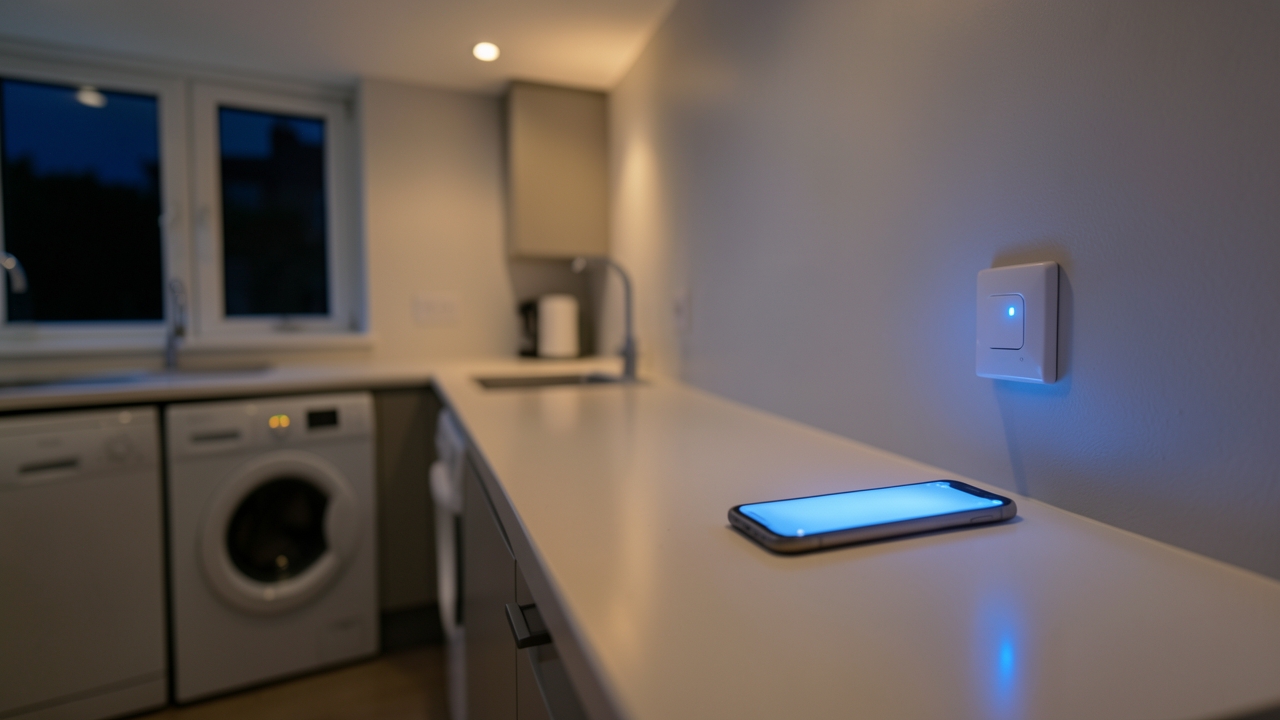
Half-hourly electricity pricing has turned energy bills into a genuine hobby for thousands of UK households. Even so, the real money sits in the slots that dip below 10p per kWh — or go negative and actually pay you to use power. That is exactly where Octopus Agile smart plug automation earns its keep. This guide covers which appliances can realistically be shifted into cheap slots in 2026, and where smart plugs quietly fall over.
What Octopus Agile actually pays in late 2026
Agile tracks wholesale market prices every half hour. Octopus publishes the next day’s 48 slots at around 16:00, which gives any automation a full evening to plan ahead. Rates swing hard, so the spread matters far more than the headline average.
- Negative slots: typically -2p to -12p per kWh, most common on windy weekend afternoons in spring and autumn
- Bargain slots: 4p to 10p per kWh, usually between 00:30 and 04:30 or during high wind and solar output
- Evening peak: 22p to 35p per kWh between 16:00 and 19:00
- Daily cap: around 35p per kWh, though this varies by region and tariff version
Be realistic about frequency. Most regions see perhaps 20 to 40 negative half-hours across a whole year. Therefore, chasing negatives alone is a weak strategy. The consistent win comes from soaking up the sub-10p band that appears almost every night.
In addition, the Market-wide Half Hourly Settlement programme is changing how suppliers see your meter. As a result, half-hourly tariffs are multiplying, and price-aware devices are becoming the norm rather than a niche hobby.
Which appliances can realistically be shifted?
Not every appliance tolerates a plug that kills its power. Three tests matter: does it restart after an outage, does it need a button press, and how much current does it pull? Our round-up of the best smart plugs for UK homes covers the hardware side in detail.
Washing machines
A 60°C cotton wash uses roughly 1.0 to 1.3 kWh. Peak draw sits near 10A while the heater is on, which stays comfortably inside a 13A plug’s rating.
However, cutting power mid-cycle is a bad idea. The drum stays full, the door stays locked, and some machines log a fault that needs a engineer visit to clear.
Instead, set the machine’s own delay-start timer so the cycle finishes inside the cheap window. Alternatively, use a plug that switches on before you press start and then leaves the machine alone.
Dishwashers
An eco cycle on a modern 14-place machine uses around 0.8 to 1.0 kWh. That makes it a near-perfect flexible load, and the running-cost maths is laid out clearly by the Energy Saving Trust.
On the other hand, most dishwashers hate losing power mid-wash. Water sits in the sump, and the drain pump may not restart cleanly on the next cycle.
Use the delay-start function where you can. A smart plug still works, provided it only supplies power at the very start of the cycle and nothing interrupts it afterwards.
Immersion heaters
This is the appliance people get wrong most often. A 3kW immersion element draws about 12.5A at 240V. That sits right at the 13A limit of a BS 1363 plug, and continuous loads at that level cook plug tops.
Furthermore, immersion heaters are normally wired to a dedicated 16A radial circuit with a 20A double-pole isolator. Therefore, do not bung one onto a smart plug and hope for the best.
Use a smart relay or contactor instead — a Shelly Pro module, a MyEnergi Eddi diverting surplus solar, or a dedicated smart immersion controller. If you are generating your own power, our guide to balcony solar panels in the UK explains how much you can realistically divert.
Additionally, never skip the weekly 60°C legionella cycle. Cheap automation that leaves a tank sitting at 45°C is a genuine health risk, not a clever saving.
Dehumidifiers
A 20-litre compressor dehumidifier pulls 300 to 450W, so a two-hour run is roughly 0.7 kWh. Switching it at the plug is electrically safe and needs no special wiring.
However, check for power-loss memory before you buy. Models with a physical rocker switch simply resume when power returns. Touch-panel models usually sit waiting for a button press, which defeats the whole point.
Tumble dryers — with a caveat
A heat-pump dryer uses around 1.5 to 2 kWh per cycle, which makes it tempting. Unfortunately, most have electronic controls that forget their state after a power cut.
More importantly, running a 55°C appliance overnight while you sleep is a fire risk. On balance, leave this one out of your automation plan.
The automation limits of popular smart plugs
Here is where the marketing meets reality. Most smart plugs are excellent timers and thoroughly mediocre decision-makers.
Cloud schedules read the clock, not the price
The schedule you build in the Tapo, Meross or Wiz app fires at a fixed wall-clock time. It has no idea what Agile is doing. Consequently, a 01:00 start is only correct if 01:00 happens to be cheap that night.
Stale price tables
Several third-party apps cache tomorrow’s Agile prices and refresh once per day. If Octopus reissues a slot, the cached plan is quietly wrong. Meanwhile, your dishwasher runs straight through a 28p peak.
Negative prices break sloppy triggers
This is the classic failure and the one nobody warns you about. Many IFTTT and Zapier applets ask for a threshold such as ‘price below 10p’. Try entering -5p and some forms reject the minus sign, silently convert it to 0, or trigger constantly because every price is technically ‘above’ the comparison.
Therefore, always test your trigger with a negative value before you trust it with a live appliance. A rule that never fires is frustrating; a rule that fires at the wrong moment is expensive.
Countdown timers drift
Countdown-based plugs start a fixed duration and hope the window matches. If the cheap block ends at 03:30 and you kicked off a three-hour countdown at 01:00, the final half hour lands in a 20p slot.
In addition, a Wi-Fi dropout at 02:00 leaves the plug in its default state. Usually that means off, which gives you cold water and a half-finished wash by morning.
Octopus Agile smart plug automation: what actually works in 2026
The reliable pattern is a local brain plus a simple plug. Keep the decision-making somewhere that can read the Octopus API directly, and let the plug do nothing more than switch.
- Home Assistant with the Octopus Energy integration: exposes current price, next cheap slot and next peak as sensors. Automations can compare price against 0.10 and hold state for 30 minutes.
- Octopus API plus Node-RED: pulls all 48 half-hourly rates, sorts them, then picks the cheapest window that fits your appliance’s run time.
- IFTTT applets: workable for simple price-under-X rules, but test negatives first and expect cloud latency of a few seconds.
- Shelly scripting: runs locally with no cloud dependency, and the relays handle heavier loads than a plug-top device.
- Matter, Apple Home and SmartThings: excellent for reliability, useless for price awareness on their own.
Whatever you build, add three guardrails. First, clamp the run time so a three-hour appliance never starts inside a 30-minute window. Second, add a manual override so a guest can run the washing machine without a lecture. Third, log every switch so you can audit the savings properly.
The settlement rules behind all this are worth a skim on the NESO website, particularly the Demand Flexibility Service, which pays households to shift load away from peak windows each winter.
A smart plug that switches on at 2am is a timer. A smart plug that switches on when the wholesale price goes negative is a business case.
The numbers: what can you actually save?
Take a household running one wash and one dishwasher load a day, plus a 30-minute immersion boost. Assume a 26p evening rate against an 8p overnight slot.
- Washing machine: 1.2 kWh shifted at an 18p delta = 21.6p saved per wash
- Dishwasher: 0.9 kWh shifted at the same delta = 16.2p per run
- Immersion boost: 1.5 kWh shifted = 27p per day
- Dehumidifier: 0.7 kWh per run = 12.6p
That totals roughly 60p to 70p a day, or somewhere between £220 and £250 a year. It excludes the handful of negative-price half-hours where Octopus pays you instead. Add a smart plug cost of £12 to £25 and the payback is measured in weeks, not years.
However, be honest about the effort involved. A badly written automation that misfires twice a week will wipe out the entire gain, and probably annoy everyone in the house.
Safety, wiring and the fine print
A handful of UK-specific rules are worth keeping in mind before you start rewiring your routine.
- Check the rating: 13A and 3,000W is the ceiling for a BS 1363 smart plug, and heaters deserve a 10% margin on top
- Never put an EV charger on a smart plug — a proper 7kW wallbox is the only sane option, and our guide to Octopus Intelligent charging schedules explains how to time those instead
- New fixed wiring falls under Part P of the Building Regulations in England and Wales
- Follow the manufacturer’s instructions on unattended operation, because your insurer may care after a claim
Remember that a smart plug is a switch, not a safety device. It will not protect a failing heating element, a blocked condenser or a frayed cord.
Final thought
Chasing negative prices is entertaining, but the steady money lives in the boring sub-10p slots that appear almost every night. Get those right first, then treat negative events as a bonus rather than a strategy.
So which appliance in your house would you hand over to an automation first — and would you genuinely trust it to run while you sleep? Let us know in the comments below.