
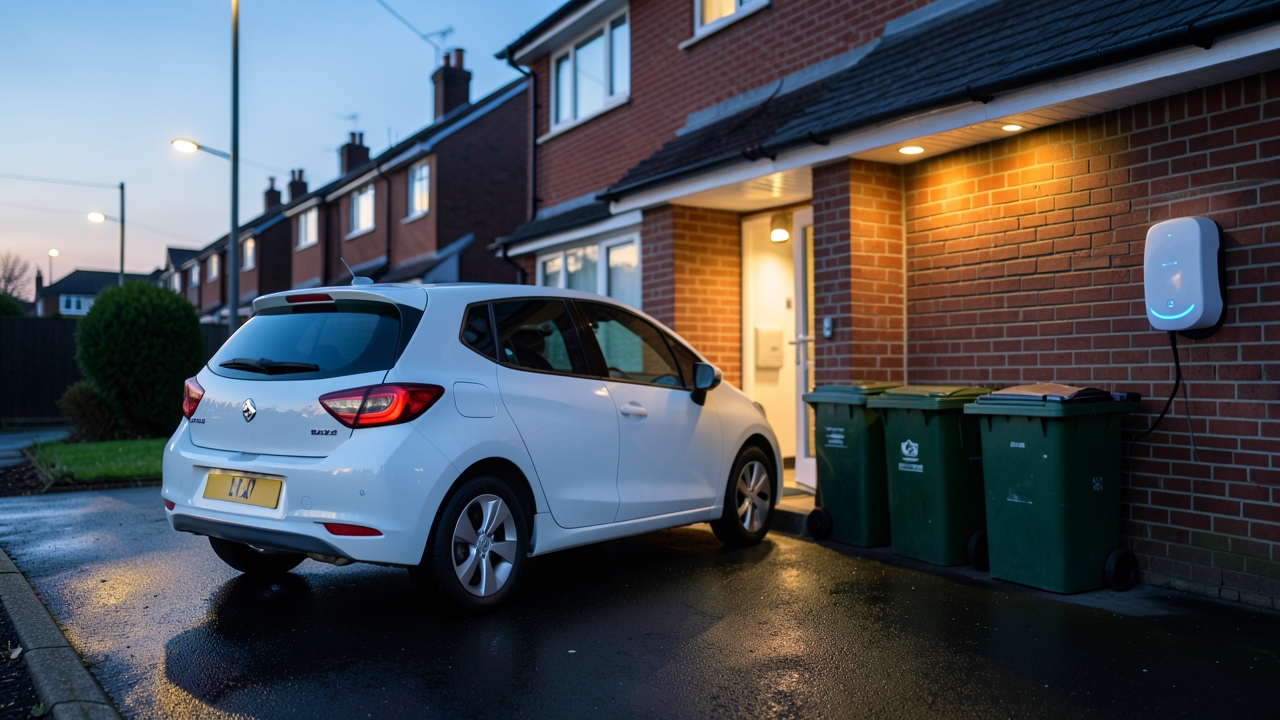
If you are weighing up an Ohme vs Wallbox cost comparison, the number on the shop page is the least useful figure you will see. Over three years, the electricity you push through a home charger costs two to three times the hardware itself.
This guide compares the three most-installed smart chargers in Britain: the Ohme Home Pro, the Wallbox Pulsar Max and the Pod Point Solo 3. We cover unit price, tethered versus untethered installation, and modelled charging costs on Intelligent Octopus Go and OVO Charge Anytime.
Then we run a full three-year worked example for a driver covering 10,000 miles a year. All prices are typical UK fitted prices as of November 2026, including VAT. Tariffs move, so confirm the current rate before you order.
Why total cost of ownership beats sticker price
A 7kW home charger costs between £750 and £1,100 fully fitted. Meanwhile, the electricity for 30,000 miles of driving will cost somewhere between £940 and £2,500, depending on your tariff.
Therefore a £100 saving on hardware is small change next to a 3p per kWh gap in charging rate. For example, 3p on 9,400 kWh of metered electricity is £282 over three years.
Hardware is a one-off. A tariff is a habit. And the habit always costs more.
That is the lens we use throughout: purchase price, plus installation extras, plus three years of real charging cost.
The three chargers at a glance
- Ohme Home Pro — 7kW tethered (5m or 8m), built-in colour LCD, native control from Octopus and OVO, around £549–£599 for the unit.
- Wallbox Pulsar Max — 7kW tethered or untethered, very compact, built-in power sharing, around £599–£649 for the unit.
- Pod Point Solo 3 — 7kW tethered or untethered, sold mainly as an installed package, around £799–£899 fitted.
All three are 7kW single-phase units, which adds roughly 25–30 miles of range per hour to a typical family EV. Warranty cover varies between two and five years depending on model and installer, so read the small print.
Ohme vs Wallbox cost: what you actually pay on day one
The Ohme Home Pro and the Wallbox Pulsar Max have almost identical list prices. The gap opens up on the installation invoice, because one is tethered as standard and the other can be bought either way.
Pod Point does things differently. It sells the Solo 3 as a fitted package, so the headline price already includes a standard installation. That makes budgeting easier, but trimming harder.
Standard vs tethered installation: the hidden £200
A tethered charger has the Type 2 cable permanently attached. An untethered unit has a socket, and you supply your own cable.
- Untethered: cheaper box, but a decent 32A Type 2 cable costs £110–£190. The total often lands within £50 of tethered.
- Tethered: more convenient, better weather sealing, and no cable dragging through puddles.
- Resale: a tethered unit stays with the house and is a small selling point when you move.
In practice, most drivers doing 10,000 miles a year should buy tethered. The cable saving rarely survives the first winter.
Typical fitted prices in 2026
- Ohme ePod, untethered: £429 unit, £899–£949 fitted
- Ohme Home Pro, tethered 8m: £599 unit, £1,029–£1,099 fitted
- Wallbox Pulsar Max, untethered: £599 unit, £979–£1,049 fitted
- Wallbox Pulsar Max, tethered 5m: £649 unit, £1,049–£1,129 fitted
- Pod Point Solo 3, untethered: £799–£849 fitted
- Pod Point Solo 3, tethered 5m: £849–£899 fitted
Extra installation costs to budget for
A standard installation usually means up to 10 metres of surface-mounted cable run from the consumer unit, with no complications. Anything beyond that is chargeable.
- Additional cable run: £40–£65 per metre
- Earth rod for a TT supply: £150–£250
- New way in the consumer unit or a small sub-board: £120–£300
- Surge protection device: £90–£130
- DNO fuse upgrade to 100A: £150–£400
- Reinstating gravel, block paving or plasterboard: £80–£200
In addition, the EV Chargepoint Grant still offers up to £350 towards a charger for flat owners and renters, although the old homeowner scheme closed years ago. Check your eligibility on GOV.UK before you accept a quote.
Smart tariff compatibility is where the real money sits
Every home charger sold in the UK since June 2022 must meet the Electric Vehicles (Smart Charge Points) Regulations 2021. That means default off-peak schedules, randomised delays and no unencrypted data. So all three of our chargers are legally smart.
However, smart is not binary. Intelligent Octopus Go works by handing control of the charging session to Octopus. That needs either a supported charger or a supported car.
Ohme and Wallbox both appear on Octopus’s native charger list and on OVO’s approved hardware list. Pod Point’s Solo 3 generally relies on car-side integration instead. If your car is not listed, you cannot access the full Intelligent tariff.
Compatibility lists change regularly. Check the Octopus and OVO pages on the day you order, not the day you read this article.
Modelled charging costs on two UK EV tariffs
Intelligent Octopus Go
Around 7p per kWh for six hours overnight, usually 23:30 to 05:30, plus extra cheap slots when the grid is especially green. The day rate is roughly 27p per kWh.
Because Octopus can schedule charging outside the fixed window, most drivers land between 80% and 90% of annual miles at the cheap rate. You can see how it stacks up against rivals in our guide to the best EV tariffs in the UK.
OVO Charge Anytime
A flat rate of around 10p per kWh for charging scheduled through the OVO app, on top of a normal day rate of about 26p. It is simpler and more predictable, but slightly dearer per kWh.
Standard variable tariff
Roughly 26p to 27p per kWh at any hour. Convenient, and the most expensive way to run an EV by a wide margin.
For an independent view of how home charging compares with public charging, the Energy Saving Trust publishes regularly updated guidance.
Worked example: 10,000 miles a year for three years
Take a typical family EV with real-world efficiency of 3.5 miles per kWh. That is 2,857 kWh at the wheels each year, or 8,571 kWh across three years.
Add about 10% for charging losses and standby draw, and you meter roughly 9,400 kWh over the period. Here is how that splits.
- Miles driven: 10,000 per year, 30,000 over three years
- Energy at the wheels: 2,857 kWh per year, 8,571 kWh in total
- Metered energy: about 3,130 kWh per year, 9,400 kWh in total