
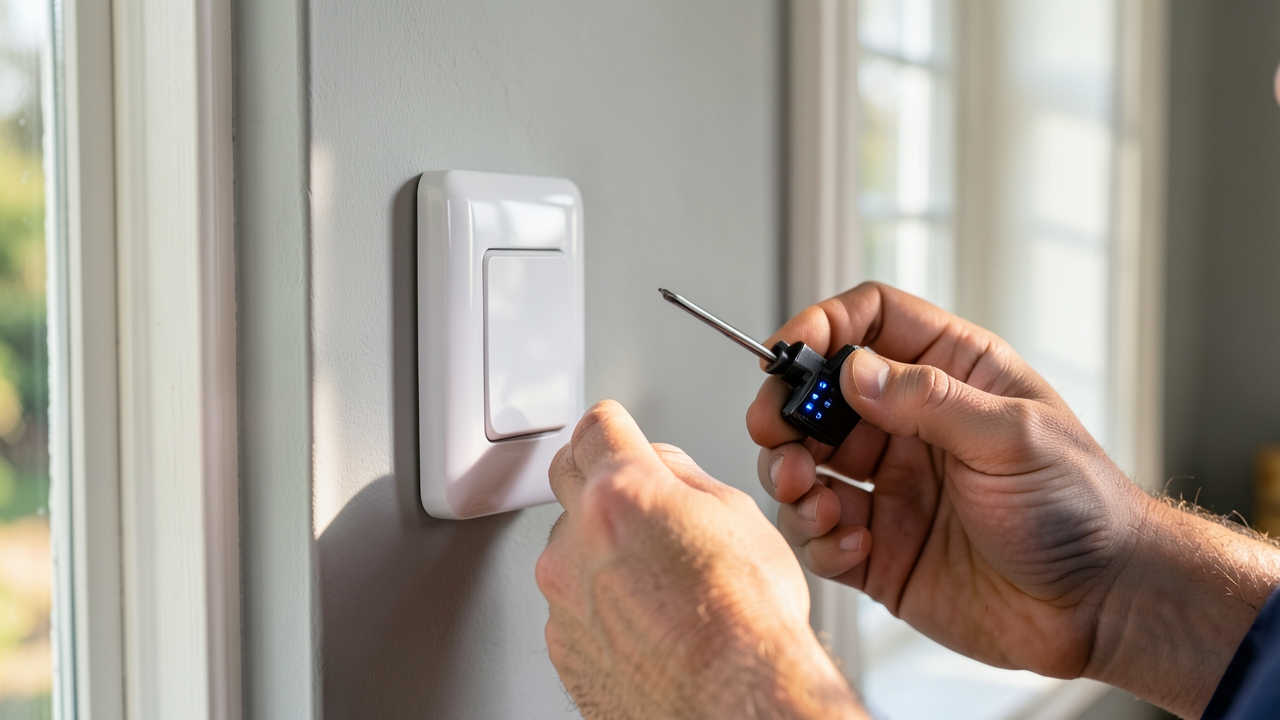
Around two-thirds of British homes still use loop-in ceiling rose wiring. In that layout the neutral stops at the ceiling and never reaches the wall switch. Therefore anyone hunting for a smart light switch no neutral UK solution faces the same problem: two wires, one live and one switched live, with no obvious way forward.
The good news is that 2026 is a far better year for retrofits than 2019 was. Three families of product now work reliably in a British two-wire box: two-wire dimmer modules, no-neutral relays and battery-free kinetic switches. Meanwhile, plenty of cheap imports still fail the test entirely.
This guide covers what works, what buzzes and what it costs.
Why British switch boxes have no neutral
The three-plate ceiling rose became standard practice here in the 1960s. All three conductors — permanent live, neutral and earth — meet at the rose itself.
Only the switched live drops down to the switch. As a result, the wall box holds two cores plus earth, and nothing more. Most of mainland Europe loops the neutral through the switch box instead, which is why imported smart switches assume one is present.
Five checks before you buy anything
- Back box depth. Many older boxes are only 25mm. Most modules need 35mm, and a few need 47mm.
- Earth conductor. Metal faceplates must be earthed. If your box has no earth, choose a Class II plastic plate.
- Total load. Add up the wattage of every lamp on the circuit. No-neutral modules need a minimum load, usually 10W to 25W.
- Lamp type. Non-dimmable LEDs flicker badly on two-wire dimmers. Check dimmability first.
- Hub or no hub. Zigbee and Z-Wave modules need a hub. Wi-Fi modules talk straight to your router.
Smart light switch no neutral UK options that actually work
Three approaches survive real British wiring. Each suits a different budget and a different level of ambition. If you are still weighing up bulbs against plates, our guide to smart bulbs versus smart switches explains the trade-offs.
1. Two-wire dimmer modules (best for dimming)
These sit behind your existing switch plate and draw a tiny current through the lamp to power themselves. The Fibaro Dimmer 2 is the veteran of the group. It costs around £50 and needs a Z-Wave hub. Furthermore, it usually needs a Fibaro Bypass 2 (about £15) on loads under 50W.
The Aeotec Nano Dimmer costs around £55 and performs similarly. The Shelly Dimmer 2 is the budget pick at roughly £28 and works over Wi-Fi without a hub. All three dim smoothly once the load is right. Get the load wrong and you will hear about it.
2. No-neutral relays (on and off only)
Relays are simpler and cheaper. The Shelly 1L sells for about £18, while the Sonoff ZBMINI-L2 costs around £16.
Neither dims. However, both let you keep a normal rocker switch and add app, voice and schedule control. They also cope with two-way circuits, which two-wire dimmers often struggle with.
3. Move the module to the ceiling rose
This is the trick most installers use. The neutral already exists at the rose, so fit a relay there rather than at the switch. A Shelly Plus 1 or a Zigbee relay costs £15 to £25.
Pair it with a retractive switch, or with a kinetic switch, and the wall box stays untouched. Consequently you dodge every minimum-load headache. You do need access above the ceiling, though.
Battery-free kinetic switches: the neatest answer
Kinetic switches generate their own power from the press. No neutral, no battery and no wires to the switch at all. The UK leader is Quinetic, sold through electrical wholesalers. A switch and receiver bundle costs £35 to £60.
The receiver sits in the ceiling rose and switches the live. The wall plate simply sticks or screws anywhere convenient. EnOcean-based switches use the same technology for commercial installs.
The trade-off is ecosystem lock-in. Most kinetic systems use proprietary radio, so they will not appear in Apple Home or Home Assistant without a bridge. For a hallway or landing, that is often a fair swap.
Why some modules buzz with LED lamps
The hum is real, and it is not your imagination. Most two-wire dimmers use leading-edge TRIAC control, which chops the mains waveform. LED drivers contain capacitors, and those capacitors draw sudden inrush current. The resulting vibration makes both the lamp and the module hum.
Modules most likely to hum
- Unbranded no-neutral modules from marketplace sellers — the worst offenders by a wide margin.
- Shelly Dimmer 2 without a bypass on loads below 20W — audible ticking at low dim levels.
- Fibaro Dimmer 2 crammed into a 25mm box with five mixed-brand lamps.
- Any leading-edge dimmer driving a capacitive LED driver with no minimum load present.
Fixes that genuinely work
- Fit the manufacturer’s bypass capacitor. At £10 to £15 it solves most flicker complaints.
- Raise the load to at least 25W, or swap two lamps for higher-wattage dimmable LEDs.
- Use lamps from one brand and one batch. Mixed batches behave differently.
- Choose trailing-edge dimming where budget allows. It is quieter with LED loads.
- Fit a deeper back box so cables are not compressed against the module.
For wider product comparisons, see our round-up of the best smart lighting for UK homes.
What it costs in 2026
- Shelly Dimmer 2 plus bypass: £38
- Fibaro Dimmer 2 plus Bypass 2: £65
- Shelly 1L relay: £18
- Sonoff ZBMINI-L2: £16
- Quinetic switch and receiver: £45
- Electrician labour: £60 to £90 per switch, or £250 to £350 per day
- Consumer unit check, if needed: £80 to £120
A typical living room retrofit lands at £100 to £160 supplied and fitted. By contrast, chasing a new neutral into the wall often costs £300 or more once plastering is included. That gap is why two-wire modules dominate the market.
Regulations, certificates and safety
Replacing a light switch is non-notifiable minor work in England and Wales. Nevertheless, it must still comply with Building Regulations Approved Document P and BS 7671.
Anything involving a new circuit is notifiable, as is work in a special location such as a bathroom. Ask for a Minor Electrical Installation Works Certificate. It matters at resale and for insurance claims.
Scotland works under separate Building Standards, so check with your local authority first. Unsure about your wiring? Use a registered electrician through NICEIC or SELECT. It is £60 well spent.
If energy bills are driving the upgrade, the Energy Saving Trust notes that LED lamps use up to 90% less energy than halogen equivalents.
Which option fits your home?
- Want dimming and own a hub: Fibaro Dimmer 2 or Shelly Dimmer 2 with a bypass.
- Want the simplest on/off retrofit: Shelly 1L or Sonoff ZBMINI-L2.
- No earth at the switch, or a solid brick wall: Quinetic kinetic switch and receiver.
- Access above the ceiling: relay in the rose plus a retractive switch.
One last point on hubs. If you plan to expand later, check Zigbee versus Wi-Fi before committing to a protocol you cannot add to.
Two-wire lighting no longer means living without smart control. It simply means choosing the right module and accepting a few compromises on minimum load.
Have you retrofitted a smart switch into a British two-wire box? Tell us in the comments which module you used — and whether it buzzes with your LEDs.