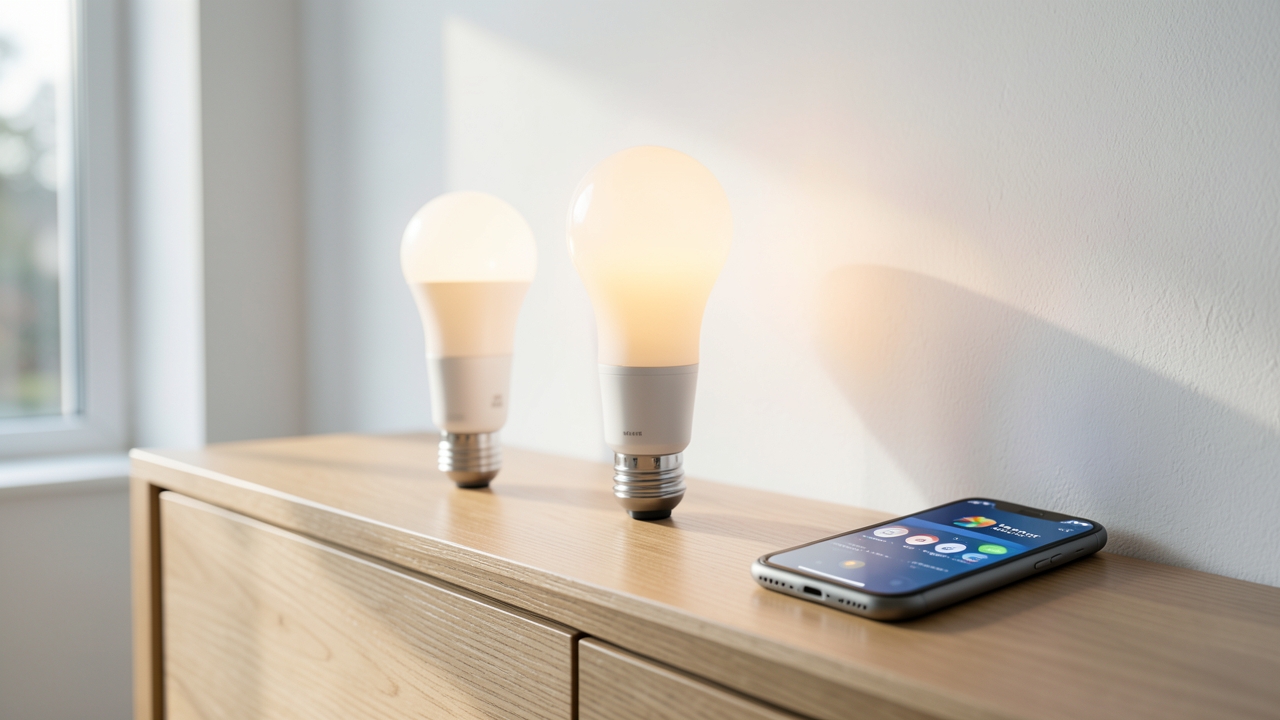
Matter smart bulbs UK shoppers can now pick up for under £15 promise one big thing. A single bulb should work with Alexa, Google Home and Apple Home at the same time. On paper, that is exactly what the standard delivers. In practice, our three-month test of TP-Link Tapo, IKEA Trådfri and Philips Hue found three very different experiences.
We paired every bulb with all three platforms, timed 50 commands each, forced firmware updates and unplugged hubs mid-scene. Here is what the spec sheets leave out.
What Matter actually changes for smart bulbs
Matter is an application-layer standard, not a radio. It lets one device join several ecosystems at once using features called fabrics and multi-admin. In theory, a single bulb can sit in Apple Home, Google Home and Alexa simultaneously.
However, the transport layer still matters. Tapo bulbs run Matter over Wi-Fi. IKEA and Hue bulbs use Zigbee and rely on a hub to bridge into Matter. That one difference explains most of the quirks we found.
Furthermore, Matter 1.4 improved multi-admin and the setup flow. It did not fix ecosystem-specific features. Adaptive lighting, for example, remains an Apple Home and Hue speciality. If you are still weighing up a hub, our Thread border router guide explains what you actually need.
The three contenders and what they cost in November 2026
- TP-Link Tapo L530E (E27, colour, Matter over Wi-Fi) — around £12.99 for one bulb, £29.99 for a four-pack. No hub required.
- IKEA Trådfri LED bulb E27 1055lm (Zigbee, Matter via DIRIGERA) — £12 per bulb, plus £60 for the DIRIGERA hub if you do not own one.
- Philips Hue White and Colour Ambiance E27 (Zigbee, Matter via Bridge) — £49.99 per bulb, plus £59.99 for the Hue Bridge.
In addition, some setups need a Thread border router. Smart speakers such as the HomePod mini or Nest Hub act as one. Tapo bulbs skip that step because they connect straight to your router. For a wider shortlist, see our round-up of the best smart bulbs in the UK.
How we tested Matter smart bulbs across Alexa, Google and Apple Home
We built a rig in a two-bedroom Manchester flat with a 500 Mbps FTTP line and a Wi-Fi 6 mesh system. Then we added 12 bulbs — four of each brand — to see how each ecosystem coped with a realistic load.
Each bulb was commissioned into all three ecosystems at once. We then measured:
- Time from tap to light at 100 per cent brightness
- Dimming and colour temperature accuracy
- Behaviour after a router reboot
- Firmware reliability across 12 weeks
- State sync when two people changed the same bulb
We repeated every test three times. The figures below are averages, rounded to the nearest tenth of a second.
How to add one bulb to three platforms
- Pair in your fastest app first — usually Alexa.
- Generate a new pairing code inside that app rather than using the sticker.
- Open Google Home, choose Add Matter device and paste the code.
- Repeat in Apple Home, keeping the phone within two metres of the bulb.
- Rename the bulb last, once all three platforms are joined.
Matter smart bulbs UK results: pairing, response and firmware
Tapo L530E: cheapest route to Matter, with a Wi-Fi tax
The Tapo was the only bulb here that needed no hub at all. Pairing with Alexa took 40 seconds. Google Home took just under a minute. Apple Home was the fiddliest, mostly because the QR code needs decent light.
Response was quick at 0.4 seconds locally. However, the Wi-Fi tax is real. Twelve Tapo bulbs added 14 clients to our router and pushed standby draw to about 1.2W each.
Firmware was the weak point. Two updates arrived without warning and briefly reset colour temperature to 2,700K. As a result, evening scenes looked warmer than planned for roughly an hour.
IKEA Trådfri with DIRIGERA: the quiet workhorse
IKEA’s bulb looks dull on paper and feels dependable in the room. Zigbee kept latency at 0.7 seconds through the DIRIGERA hub. Standby draw measured just 0.3W.
Multi-admin worked, although the hub exposes a trimmed feature set. You get brightness and colour, but not the full scene library from the IKEA Home smart app.
Meanwhile, firmware updates were silent and stable. Twelve weeks produced zero dropouts, which is the best result in this test.
Philips Hue: the most polished, and the priciest
Hue won on speed and colour accuracy. Response averaged 0.3 seconds and dimming tracked our requests within 1 per cent.
On the other hand, a £59.99 Bridge and £49.99 bulbs mean a four-room setup costs far more than Tapo for a whole house. Adaptive lighting also only works properly inside Apple Home.
Firmware arrived twice in 12 weeks. Both updates ran cleanly, although the Bridge restarted twice during the second one.
The quirks manufacturers do not advertise
- Multi-admin rarely means equal admin. Removing a bulb from one app can orphan it in another until you re-share it.
- Apple Home needs a home hub. Without an Apple TV or HomePod, remote access and automations simply fail.
- Alexa exposes fewer controls. Voice colour temperature commands often jump in fixed steps of about 500K.
- Duplicate Thread networks happen. Two border routers in one home can trigger unreachable warnings on some bulbs.
- Wi-Fi bulbs do not mesh. Twenty Tapo bulbs means 20 router clients, so plan your channel width.
- A factory reset wipes every fabric. You then re-pair the bulb across all three platforms from scratch.
Matter fixed the interoperability problem. It did not fix the support problem — firmware quality still decides whether a cheap bulb feels good in year three.
Running costs, standby drain and UK rules
Smart bulbs save money through LED efficiency, not clever apps. A 9W LED at 800 lumens replaces a 60W incandescent and uses around 85 per cent less power. The Energy Saving Trust notes that lighting makes up roughly 11 per cent of a typical UK electricity bill.
Standby matters more than people expect. At 24.5p per kWh, 1W running all year costs about £2.15. Therefore a Wi-Fi bulb costs roughly £2.60 a year on standby, against £0.65 for a Zigbee model.
In addition, the Product Security and Telecommunications Infrastructure regime has applied since April 2024. It bans easy default passwords and requires public vulnerability reporting. Consequently, firmware support is now a legal expectation, not a bonus. For more detail, read our guide to smart lighting energy savings in the UK.
Buying in bulk? Independent lab testing from Which? has long shown that cheap LEDs vary widely on brightness claims. Check the firmware history before you commit to twenty bulbs.
Which Matter smart bulb should you buy in 2026?
- Best for most people: Tapo L530E four-pack at £29.99. Cheapest Matter entry point, no hub, fast response.
- Best for large homes: IKEA Trådfri with DIRIGERA. Zigbee mesh, lowest standby, rock-solid updates.
- Best for polish: Philips Hue. Fastest and most accurate, but budget triple the outlay.
Matter has finally made cross-platform bulbs genuinely usable. It has not made them identical. If you already live inside Apple Home, Hue still feels smoother. If you want 20 bulbs on a budget, IKEA quietly wins. Which ecosystem are you running at home, and which bulb gave you the fewest headaches? Tell us in the comments and we will share our full latency results.