
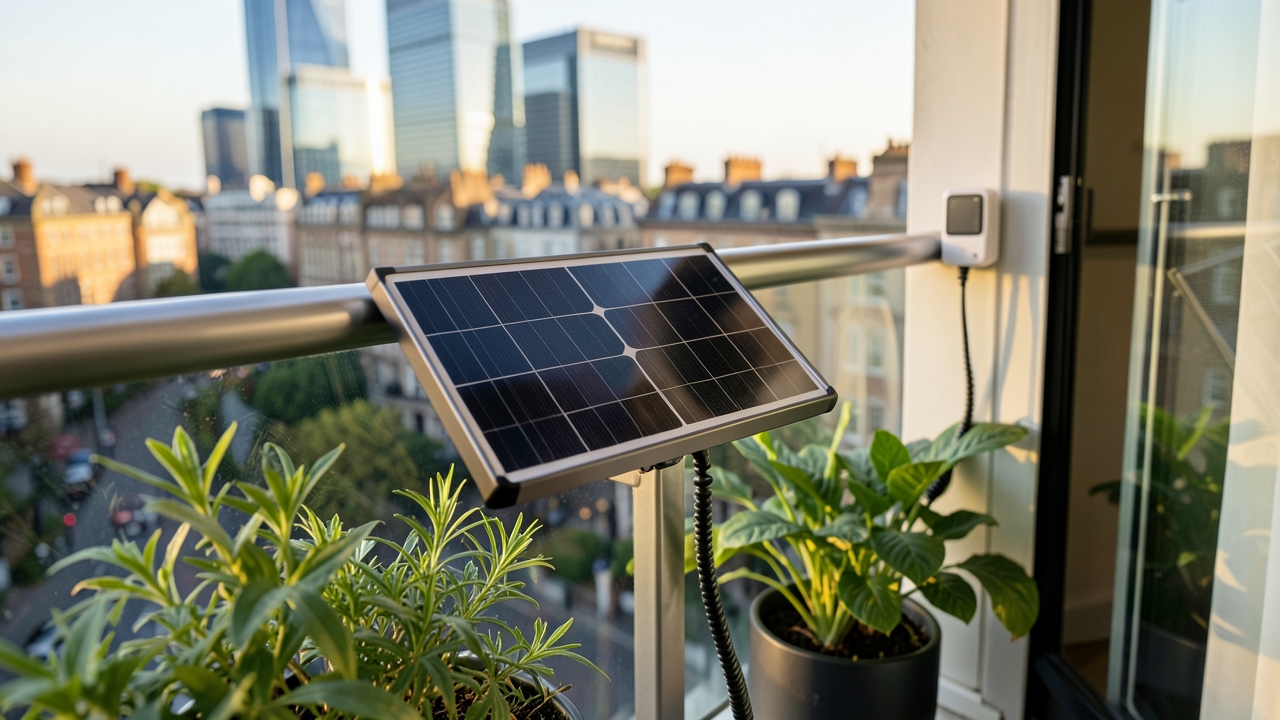
Thinking about rented flat balcony solar? You are not alone. Plug-in solar kits have become one of the cheapest ways for UK renters to cut electricity bills. However, installing panels on a balcony you do not own raises real legal questions. This guide explains your rights in 2026, what the 2026 Housing Act changes, and how to get written permission without risking your deposit.
What Is Rented Flat Balcony Solar and Why Is It Booming?
A plug-in solar kit is a small photovoltaic system that clamps to a balcony railing or wall. A microinverter converts the DC power, and you feed it into your flat through a standard socket. No roof access is needed, and no drilling is usually required.
For renters, that is the whole appeal. Rented flat balcony solar lets you generate your own power without touching the building fabric. Furthermore, an 800W kit can shave £150 to £185 off an annual electricity bill at 2026 prices. If you are new to the technology, our balcony solar panels UK guide explains how the kits work in detail.
Rented Flat Balcony Solar: The Legal Position in 2026
Here is the blunt answer. You have no automatic legal right to install solar panels on a rented balcony. Permission is a contractual matter, not a statutory one.
Your tenancy agreement almost certainly contains an alterations clause. Many say you must not make changes without written consent, and some ban anything fixed to the exterior. Check your agreement before you spend a penny on a kit.
However, the law does protect you in other ways. The 2026 Housing Act gives renters far more security than the old regime. As a result, landlords can no longer end a tenancy without a valid legal ground.
Assured and Periodic Tenants
If you rent from a private landlord or a housing association, you hold an assured tenancy. After the 2026 reforms, all such tenancies became periodic. That means you can stay put until you choose to leave or a court orders otherwise.
This matters for solar. A landlord is far less likely to approve a £600 kit if you might move out in three months. On the other hand, a rolling tenancy with strong rights makes a written permission agreement practical for both sides.
Leaseholders, Shared Owners and Sub-Tenants
If you own a leasehold flat, you answer to the freeholder or managing agent, not a landlord. Your headlease usually requires consent for anything that alters the external appearance of the building.
In addition, high-rise blocks bring fire safety rules. The Building Safety Act 2022 and the Fire Safety (England) Regulations 2022 mean many managing agents restrict what can sit on a balcony. Glass panels on a twentieth-floor balcony are a very different risk from a ground-floor terrace.
What the 2026 Housing Act Actually Changes for Renters
The Act reshaped the private rented sector. These are the changes that matter when you request permission.
- Section 21 no-fault evictions are abolished, so a landlord must prove a legal ground to regain possession.
- All tenancies are periodic, with rent rises limited to once a year and challengeable at a tribunal.
- The Decent Homes Standard now applies to private rentals, including damp and mould duties under Awaab’s Law.
- A landlord database and a new ombudsman give tenants a complaints route that avoids court.
What the Act does not do is create a right to alter your home. There is still no statutory right to solar for tenants in 2026. Consequently, written consent remains essential for every installation.
Planning Permission and Building Rules for Balcony Panels
Flats rarely benefit from permitted development rights, so planning is normally the freeholder’s concern. A listed building or a flat in a conservation area may need consent even for small panels.
Electrically, a plug-in kit must comply with BS 7671, the UK wiring regulations. Many insurers and managing agents now insist on a competent person signing off the work. Therefore, budget £80 to £150 for an electrician’s safety check.
Also tell your contents insurer before you plug anything in. Some policies exclude damage from unapproved alterations, and one phone call avoids a nasty surprise at claim time.
How to Ask Your Landlord for Permission: Step by Step
Treat the conversation like a business case, not a favour. Landlords worry about damage, liability and mortgage conditions. Answer those worries before they are raised.
- Read your tenancy agreement and quote the exact alterations clause in your email.
- Put the request in writing so you hold a dated record of everything.
- Attach the kit specification, its weight and the microinverter safety certificate.
- Offer clamps or a weighted base instead of screws and wall plugs.
- Propose a signed agreement to remove the panels and make good at checkout.
Free Permission Request Letter Template
Copy this template and adapt the bracketed sections.
Dear [Landlord name],
I am writing to request permission to install a plug-in solar panel kit on the balcony of [address]. The kit weighs about 12 kg and clamps to the railing without drilling or fixing to the building fabric.
The system is a [brand and model] 800W kit with a certified microinverter, checked and certified by a qualified electrician. I have attached the specification sheet, the safety certificate and a photo of the proposed position.
I am happy to sign a written agreement confirming that I will remove the panels and restore the balcony to its current condition before the tenancy ends. I will also add the kit to my contents insurance.
I would be grateful for your written response within 14 days.
Yours sincerely,
[Your name]
Send the letter to the letting agent as well as the landlord. Keep the reply, even if it is a two-line email saying yes.
What a Rented Flat Balcony Solar Kit Costs in 2026
Prices have fallen sharply over the past two years. Here is what UK buyers pay today.
- 400W single-panel kit: £280 to £400
- 800W two-panel kit with microinverter: £550 to £800
- Railing clamps or weighted ballast base: £40 to £90
- Electrician safety check and certificate: £80 to £150
- Optional 1kWh battery add-on: £500 to £900
An 800W south-facing kit in southern England generates roughly 650 to 750 kWh a year. At an Ofgem price cap rate of around 24.5p per kWh, that is £160 to £185 of avoided import. However, you only save on power you use immediately, so daytime-heavy households do best.
Payback usually lands at three to five years. Compare the numbers in our plug-in solar panel cost breakdown before you commit. For independent generation figures, check the Energy Saving Trust solar panel advice.
Avoiding Deposit Disputes: Practical Tips
Deposit adjudicators see the same mistakes repeatedly. Unauthorised wall plugs, cable clips and rust stains are the usual culprits.
- Photograph the balcony on the day the kit goes up and again when it comes down.
- Never drill into render, brickwork or balcony soffits.
- Route cables behind furniture or through removable conduit only.
- Keep every receipt, certificate and email in a single folder.
- Clean the railing before fitting so no shadow marks develop.
Under GOV.UK tenancy deposit protection rules, your deposit must sit in a government-approved scheme. If a deduction is proposed, ask for the check-out report and itemised costs in writing.
What If Your Landlord Says No?
Respect the decision, then negotiate. Ask whether a smaller 400W panel, a ground-floor spot or a temporary weighted base would be acceptable. In addition, a written promise to remove the kit at checkout often unlocks a yes.
A refusal is not retaliation in itself. Nevertheless, if you face eviction after a legitimate complaint, the 2026 Housing Act gives you stronger grounds to challenge it. Our round-up of the best balcony solar kits is a good starting point once permission is agreed.
Quick Checklist Before You Buy
- Tenancy clause read and quoted in your email
- Written permission received and saved
- Contents insurer notified
- Electrician booked for a BS 7671 check
- Before photos taken and dated
- Removal and make-good plan agreed
Is Rented Flat Balcony Solar Worth the Paperwork?
In most cases, yes. A well-sited 800W kit pays for itself in three to five years, and written permission protects you from deposit deductions and mid-tenancy disputes. The 2026 Housing Act has made renting more secure, but it has not removed the need for consent.
Start with a short, polite email, attach the certificates, and offer to make good at checkout. Most reasonable landlords say yes to a renter who has clearly done the homework.
Have you fitted panels on a rented balcony, or has your landlord refused? Share your experience in the comments below and help other UK renters decide.