
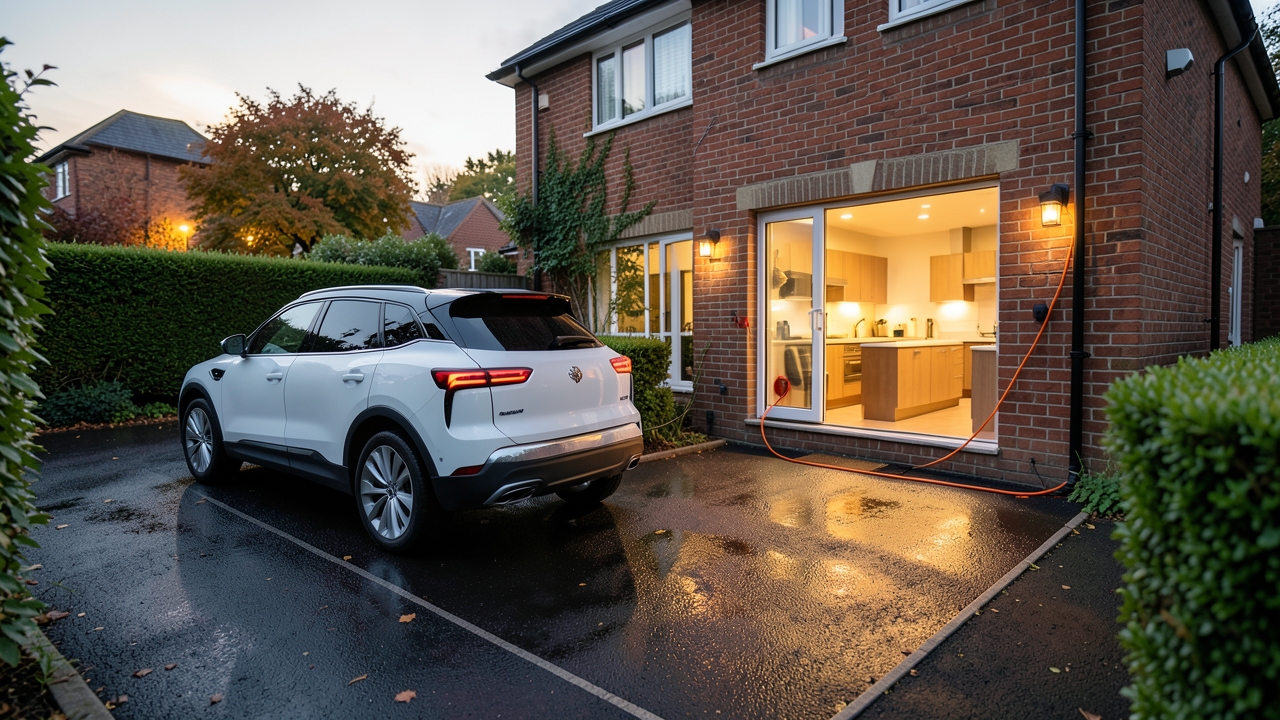
V2L UK homes are having a moment. In 2026, more than a dozen electric cars on British forecourts can run a kettle, a fridge, or even a ring main straight from the charge port. However, the gap between a marketing photo of a campsite and a legally installed, DNO-approved home backup is wide. This guide compares real usable output, cost per kWh, cable and earthing rules, and what actually happens when the grid goes down.
What V2L, V2H and V2G actually mean
The three acronyms get muddled constantly in showroom conversations. They describe very different levels of engineering, paperwork and cost.
V2L: a socket on wheels
Vehicle-to-load turns the car into a very large power bank. Electricity leaves the traction battery through an onboard inverter and arrives at a standard 230 V socket. In 2026, most V2L cars sold in the UK deliver between 2.2 kW and 3.6 kW continuously. That is enough for a fridge, lighting, a router and a boiler pump running together.
V2H: wiring the car into the house
Vehicle-to-home needs far more than a long cable. You need a bidirectional charger, an automatic transfer switch, an earthing arrangement approved by the manufacturer, and a DNO application. Only a small number of V2H charger models have completed UK type testing by late 2026. Consequently, most drivers who say they have V2H actually have a V2L adapter and an extension lead.
V2G: exporting to the grid
Vehicle-to-grid pushes power back through the meter and pays you for it. It requires a G99 connection agreement, a licensed supplier scheme and hardware that supports export. The UK fleet remains tiny, although trials continue with several distribution network operators.
Usable output from V2L cars on sale in the UK
Quoted outputs vary between models and trim levels, so always check the handbook before you plan a circuit. These are the figures you will see in UK dealerships this winter.
- Hyundai Ioniq 5 and Ioniq 6: 3.6 kW (16 A) via an external adapter or the interior socket.
- Kia EV6, EV9 and Niro EV: 3.6 kW with the optional V2L adapter.
- MG4 and MG ZS EV: around 2.2 kW, plenty for a fridge and lighting.
- BYD Atto 3, Dolphin and Seal: roughly 3.0 kW through a supplied adapter.
- Polestar 3 and Volvo EX90: up to 3.6 kW with the optional outlet kit.
The arithmetic surprises most people. A 3.6 kW output for one hour delivers 3.6 kWh. Take an Ioniq 5 with a 77 kWh pack, parked at 80% and stopped at a 20% floor. That leaves roughly 46 kWh of usable energy, or about 42 kWh at the plug after inverter losses.
Meanwhile, a typical essentials load is smaller than you would guess. A fridge-freezer uses about 1.5 kWh a day, a gas boiler and pump 1 kWh, lights 0.5 kWh, router and TV 1 kWh, and cooking 1.5 kWh. Call it 6 kWh daily. As a result, a single V2L car can carry a household through five to seven days.
V2L UK homes vs a 5 kWh home battery: head-to-head
A 5 kWh battery is the smallest sensible home unit on the UK market in 2026. Here is how it compares with the car already sitting on your drive.
- Usable capacity: 4.5-5 kWh for the battery; 40-55 kWh for the car.
- Continuous output: typically 3.6 kW for both, so neither will run an 8.5 kW electric shower.
- Runtime on a 6 kWh daily load: about 20 hours for the battery, five to seven days for the car.
- Installed cost: £3,000-£4,500 for the battery; £250-£500 for V2L adapters, or £1,200-£2,500 for a proper inlet and changeover switch.
- Cost per kWh of storage: £650-£900 for the battery; effectively zero for a car you already own.
- Cycle life: around 6,000 cycles for a lithium iron phosphate home battery; the car pack has 1,500-3,000 full cycles across its whole life.
- Grid services: the battery can earn export or flexibility payments; V2L cannot.
- Availability: the battery stays put; the car leaves at 8am.
For a fuller breakdown of charger hardware, see our guide to the best EV chargers for UK homes. Bidirectional units sit in a different price bracket entirely.
Cost per kWh: the numbers that actually matter
Off-peak tariffs make both options cheap to run. In early 2026, smart EV tariffs offer overnight rates around 6.5-8p per kWh. The Ofgem price cap keeps standard unit rates near 24-25p per kWh for most households.
A home battery charging at 7p and discharging at 90% round-trip efficiency delivers stored power at roughly 8p per kWh. If it replaces 24p grid electricity, the saving is about 16p per kWh. Therefore, a 5 kWh battery used daily saves around 80p a day, or £290 a year. That gives a payback of 10 to 13 years without solar.
Home batteries also benefit from 0% VAT on supply and installation until 31 March 2027, according to GOV.UK guidance on energy-saving materials. Those figures already reflect the relief.
V2L looks free by comparison, and it is not. Every extra cycle adds wear to a pack that costs £8,000-£12,000 to replace. Use 55 kWh of V2L energy a week for a decade and the hidden degradation works out at around 15-20p per kWh. On the other hand, an occasional three-day outage costs almost nothing in real terms.
Charging at a public rapid charger and then using V2L at home is the worst of both worlds. At roughly 79p per kWh, you would pay three times the standard rate for the privilege. Pairing a car with balcony solar panels makes far more sense for daytime top-ups.
Cables, earthing and the rules nobody mentions
Choose the right cable, not the cheap one
A manufacturer V2L adapter costs £150-£400 and terminates in a 13 A socket or a 16 A commando plug. That is the safe, warranty-friendly route. Never buy a male-to-male lead to back-feed a ring main. It leaves live pins exposed and can kill a network engineer working down the street.
Earthing and RCD protection
V2L inverters often produce a floating, unearthed supply. A standard RCD will not trip reliably without a reference earth, so the installation may need an earth electrode or a neutral-earth bond per the manufacturer’s instructions. Furthermore, Type A RCDs can be blinded by DC residual current. Ask your electrician for Type B protection or a dedicated RDC-DD.
BS 7671:2018+A3:2024 now covers prosumer installations in detail, including multi-mode power sources. A competent electrician must design and certify the arrangement. DIY back-feeding breaches the wiring regulations and voids most home insurance policies.
DNO approval is not optional
Any system that can run in parallel with the grid needs notification. Connections up to 16 A per phase go through G98; larger ones use G99, with G100 for export limitation. Applications typically take four to twelve weeks. Some operators now fast-track V2H, but approval is never instant.
For the charger side of the equation, our home EV charger installation cost guide covers the grant and wiring basics. The Energy Saving Trust also explains how home batteries are sized and installed.
What actually happens during a DNO-approved outage
This is the part marketing brochures skip. Here is the sequence in a compliant V2H installation.
- The grid fails and the inverter detects loss of mains within two to five seconds.
- The transfer switch opens the grid-side contactor and creates an electrical island.
- The car’s inverter re-forms a 230 V, 50 Hz supply for the essential circuits board.
- A battery floor, usually 20%, stops the car from being drained flat.
- Load management sheds heavy appliances, because 3.6 kW will not run an oven and a kettle together.
- When the grid returns, the system waits about 60 seconds before reconnecting and resynchronising.
In most UK homes, only a dedicated essential loads board stays live. Lights, sockets downstairs, the boiler and the broadband router are typical. Upstairs sockets, the shower and the cooker usually drop out. Although whole-house backup is technically possible, it needs a larger inverter and a much bigger budget.
A V2L cable is a camping accessory. A V2H system is a fixed electrical installation with a DNO agreement, a certified transfer switch and an inspection certificate. Treat them as completely different products.
Is V2L right for your home in 2026?
It depends entirely on what you expect it to do. V2L is excellent insurance and a poor battery replacement.
- Good fit: rural homes with frequent short outages and a car that already supports 3.6 kW V2L.
- Good fit: anyone who wants backup lighting, broadband and a fridge for under £400.
- Poor fit: households wanting daily tariff arbitrage, where a 5 kWh battery earns its keep.
- Poor fit: flats and terraces with no off-street parking or nowhere to site an inlet.
- Poor fit: anyone planning to run electric heating or a heat pump from a 3.6 kW supply.
A five-point checklist before you buy
- Confirm your exact model and trim supports V2L, and check the continuous rating in the handbook.
- Decide whether you want a plug-in adapter or a fixed inlet with a changeover switch.
- Ask a registered electrician about earthing, RCD type and circuit separation.
- Budget for the DNO application if you want anything permanently wired to the house.
- Set a battery floor in the car settings so you never wake up with a flat pack.
The technology works. The paperwork and the earthing are what separate a tidy installation from a dangerous bodge. Get those right and a modern EV becomes a genuinely useful whole-home reserve.
Would you rather spend £3,500 on a 5 kWh wall battery or £400 on a V2L adapter and a good extension reel? Tell us which one your household would actually use.