
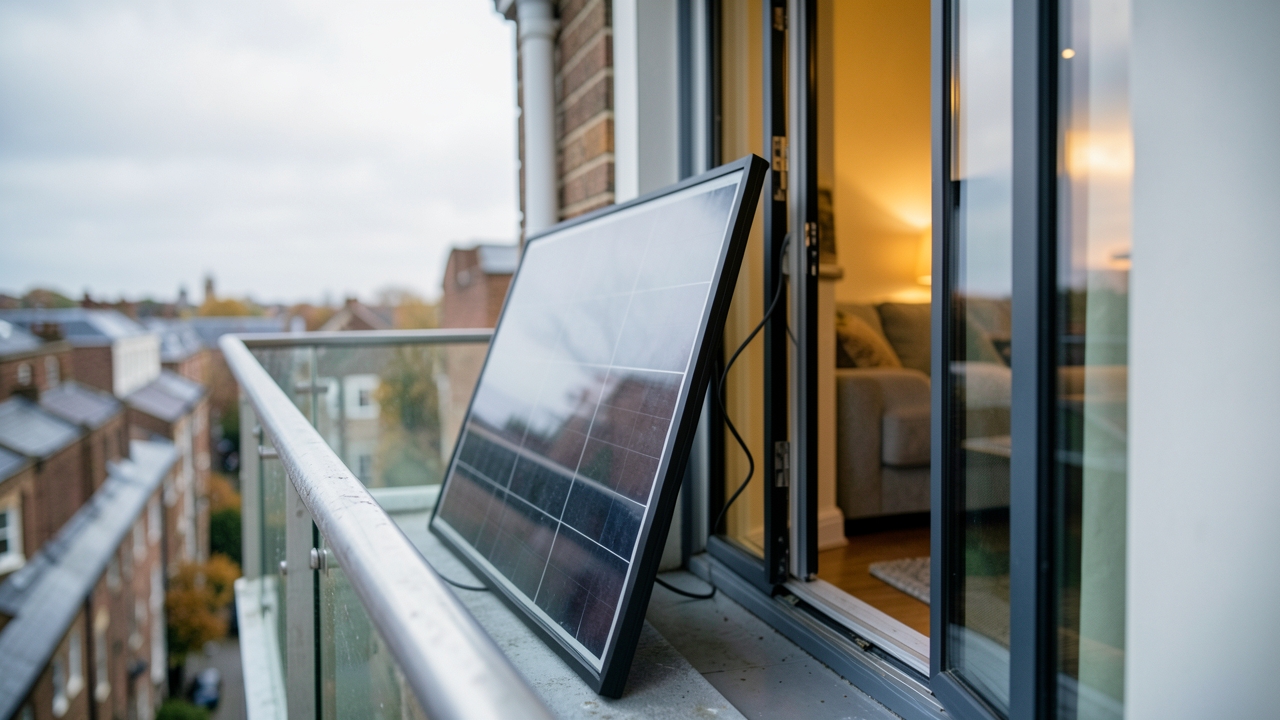
Plug-in solar UK law changed in 2026. Renters now ask a practical question: can I legally fix a balcony kit to my flat? The short answer is yes, provided three things align. The kit must meet the new technical standard, the fitting must be reversible, and you need written consent from your landlord.
Below we break down the 2026 regulations, the BS 7671 wiring rules and the tenancy side of things. We also cover costs, realistic savings and the situations where a landlord can legitimately say no.
What the 2026 plug-in solar UK law actually allows
The Department for Energy Security and Net Zero published the plug-in solar framework in 2026. It creates a legal route for households to connect a small array through a standard 13A plug. Three limits matter most.
- Inverter output is capped at 800VA per property, which keeps the kit inside the G98 notification threshold.
- The microinverter must carry UKCA marking, built-in anti-islanding protection and a moulded BS 1363 plug.
- The socket you use must sit on a circuit protected by a Type A RCD rated at 30mA.
In addition, the kit must be supplied and assembled as a single unit. Mixing your own panels and inverters falls outside the simplified route, and your DNO may reject the notification. If you are still choosing hardware, our guide to balcony solar panels in the UK explains what to look for.
BS 7671 compliance in plain English
The IET updated its guidance under BS 7671 to treat plug-in kits as microgenerators rather than fixed PV arrays. That distinction saves you money. A plug-in kit is not notifiable under Part P, because you are not altering fixed wiring.
However, the picture changes the moment you drill. If you add a dedicated radial circuit, an outdoor socket or a fused spur, the work becomes notifiable. Therefore you need a Part P registered electrician and a certificate to show your landlord.
Notification requirements for tenants
You must notify your distribution network operator within 28 days of commissioning. Most DNOs now run a short online form modelled on the existing G98 process. Furthermore, you must tell your energy supplier so your smart meter records export correctly.
Keep copies of both confirmations. They are the evidence your landlord, insurer or a future letting agent will ask for.
Planning permission and building regulations
Solar panels on a house roof usually fall under permitted development. Balconies on flats sit outside those rights, because the balcony forms part of the building envelope. As a result, ask the freeholder or managing agent before you fix anything to the structure.
Can you legally install a balcony kit in a rented flat?
Here plug-in solar UK law meets tenancy law, and the two do not always agree. Your starting point is the tenancy agreement, not the wiring regulations. Most assured shorthold tenancies contain an alterations clause, and that clause decides most cases.
Is a plug-in kit an alteration?
A freestanding panel that leans against a balcony rail is arguably a portable appliance. It leaves no holes and comes away in seconds. Brackets screwed into brickwork, render or tiles are a different matter entirely.
In practice, that single distinction decides whether you need formal written permission or just a courteous email. Be honest about your fixings. Landlords object to surprises far more than they object to panels.
What a landlord can reasonably refuse
- Drilling into brickwork, stonework, render or roof tiles
- Any fixings on a listed building, or within a conservation area
- Installations on blocks of 18 metres or more without fire risk assessment sign-off
- Kits that breach the head lease or the freeholder’s rules
- Equipment without UKCA marking or RCD protection
- Cabling that crosses a communal walkway or a fire escape
Each of these grounds is defensible. Therefore do not assume a refusal is unreasonable until you know which one applies to you.
Where the law gives tenants leverage
There is no absolute statutory right to fit solar as a tenant. However, several rules tilt the balance your way when a dispute arises.
- Many tenancy agreements state that consent must not be unreasonably withheld. A reversible, certified kit with no fixings is hard to call unreasonable.
- The implied covenant of quiet enjoyment prevents a landlord from interfering with your lawful use of the property.
- The Energy Efficiency (Private Rented Property) Regulations 2015 give tenants a qualified right to request consent for certain improvements.
- The Renters’ Rights Act 2025 phases out section 21 evictions, so asking a question is far less risky than it once was.
- New decent homes standards for the private sector push landlords towards warmer, cheaper-to-run properties.
Under the 2015 Regulations, a landlord cannot unreasonably refuse a prescribed improvement. Solar PV is not automatically on that list, though. Therefore treat the right to request as useful leverage rather than a guaranteed win. The GOV.UK guidance on private renting sets out your baseline rights.
How to get permission: a five-step process
- Read the alterations clause in your tenancy agreement before you buy anything.
- Photograph the balcony and draft a one-page method statement.
- Name the exact kit, fixings and cable route in a written request.
- Ask the freeholder’s position if your landlord is themselves a leaseholder.
- Store the consent email, the UKCA certificate and the DNO notification together.
A clear method statement does more for your case than any argument about climate targets. It shows the landlord exactly what will be fitted, where, and how it comes out again. Our round-up of the best balcony solar kits in the UK lists the models that arrive with full certification.
What it costs and what you can realistically save
Kit prices have fallen sharply since 2024, and the 2026 market is competitive. Expect to pay roughly the following for a compliant, certified system.
- 400W single-panel kit: £350 to £550
- 800W two-panel kit with microinverter: £550 to £900
- Balustrade or rail mounting: £60 to £150
- Outdoor socket and RCD spur, fitted: £180 to £300
An 800W kit in southern England generates roughly 700 to 800kWh a year. At around 24.5p per kWh, that is £170 to £195 of electricity, but only if you use it as it is generated. A flat that is empty from 9am to 6pm will capture far less.
Payback typically lands between four and six years. Meanwhile, the panels should keep producing for 20 years or more. The Energy Saving Trust publishes independent figures on realistic yields.
Size the kit to your daytime base load, not to the balcony. A 400W panel that is always working beats an 800W array that exports for free.
What you will not get: export payments
Plug-in kits do not qualify for the Smart Export Guarantee, because they carry no MCS certificate. Consequently, every unit you send to the grid earns you nothing. That is why self-consumption matters so much for renters.
Check your tariff before you buy. On the other hand, a time-of-use tariff with a cheap afternoon window can lift the value of a west-facing balcony array considerably. Our breakdown of balcony solar panel savings runs the numbers for different flat sizes and orientations.
Fire safety, insurance and high-rise blocks
If you live in a building of 18 metres or more, the Building Safety Act 2022 applies. You must not add anything to an external wall or balcony without the accountable person’s approval. Furthermore, your landlord’s building insurer may exclude unapproved external equipment.
Tell your contents insurer as well. Most policies cover portable solar equipment, but only if you declare it. Finally, photograph the balcony before and after fitting, and make good any marks before you hand back the keys.
Plug-in solar UK law: your 2026 tenant checklist
- Confirm the inverter is capped at 800VA and the kit carries UKCA marking
- Check the microinverter includes anti-islanding and a BS 1363 plug
- Verify the socket circuit has 30mA Type A RCD protection
- Get written consent naming the fixings and the cable route
- Notify the DNO within 28 days and inform your supplier
- Avoid drilling if the property is listed or in a conservation area
- Declare the kit to your contents insurer
- Keep every certificate, email and photograph in one folder
Plug-in solar UK law now gives renters a genuine route to cheaper electricity. The catch is paperwork, not technology. Get consent in writing, keep the installation reversible, and notify the right people at the right time.
Have you approached your landlord about a balcony kit yet? Tell us how they responded in the comments below.