
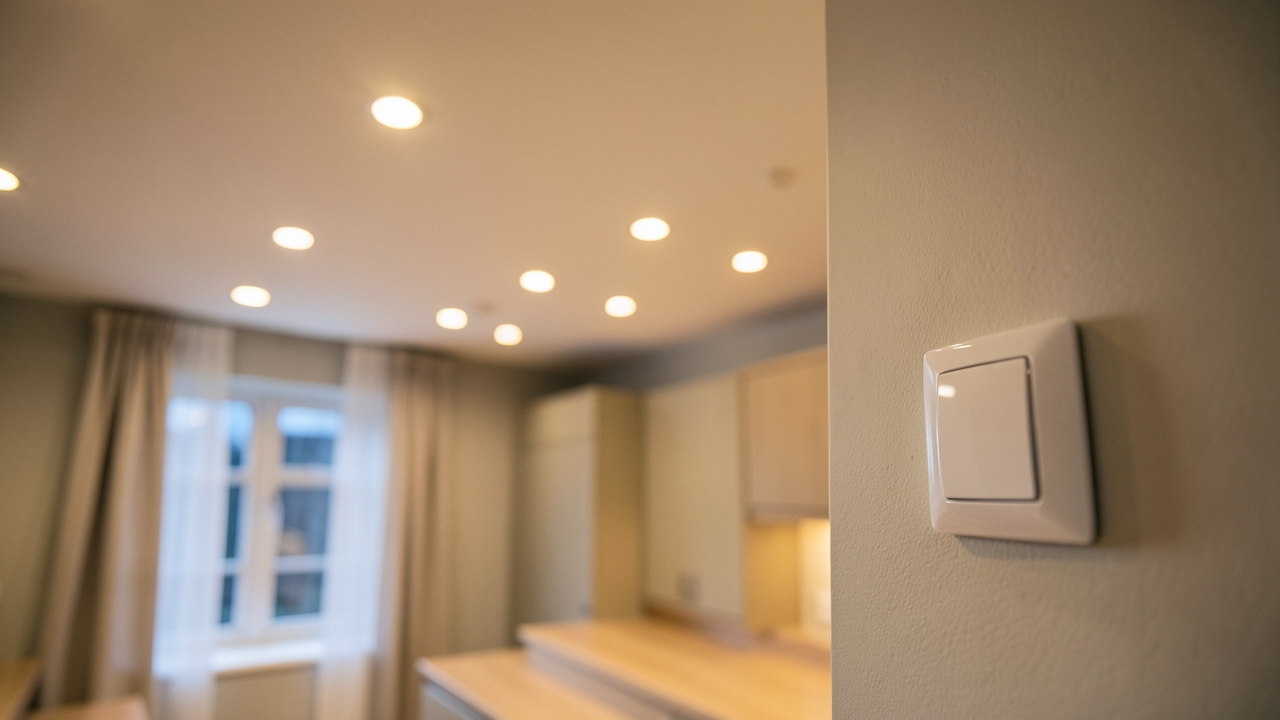
If you are weighing up smart bulbs vs smart switches for a whole house of downlights, the maths is less obvious than it first appears. For a typical UK three-bed semi with 12 GU10 downlights, smart bulbs cost roughly £216 up front and £307 over five years. A smart dimmer module setup costs about £315 up front and £447 over the same period. Therefore, bulbs are around £140 cheaper — but only if you are happy to keep replacing them.
Why downlights make the smart bulbs vs smart switches decision harder
Downlights are almost always wired in groups. One wall switch might control six kitchen downlights at once. That single fact drives nearly all of the cost difference between the two options.
With 12 GU10 fittings across three circuits, you have two realistic routes. Fit 12 smart bulbs, or fit three smart modules behind the existing switches. Both give you app control, voice control and schedules. However, they fail in completely different ways, and they leave you with very different bills.
The test house and its assumptions
To keep the numbers honest, here is the scenario I have costed. It reflects a fairly standard three-bed semi in England.
- 12 GU10 downlights in total: 6 in the kitchen on a dimmable switch, 3 on the hall and landing, 3 in the bathroom
- Electricity at 26p per kWh, so adjust the totals to match your own tariff
- Kitchen lights used around 3 hours a day, the rest around 1 hour a day
- A five-year window, using mid-range hardware rather than budget or premium brands
- Bulb and module failures based on realistic LED electronics lifespans
I have deliberately avoided both extremes. Budget Wi-Fi GU10s start around £10 each, while Philips Hue White Ambiance lamps sit nearer £35-£40. Using either end of the market would distort the comparison badly.
Upfront cost: smart bulbs vs smart switches for 12 downlights
Option A — 12 smart GU10 bulbs
Smart GU10 bulbs simply replace the lamps. You need no electrician, no certificate and no dust sheets. At £18 each, 12 bulbs come to £216.
- Budget Wi-Fi options (TP-Link Tapo L630, WiZ): £10-£15 each
- Mid-range options (Aurora Aone, Calex, Nanoleaf): £16-£25 each
- Premium options (Philips Hue White Ambiance): £30-£40 each, plus £50 for a Bridge
There are three practical snags. First, smart GU10s are often 58-60mm long, against 55mm for a standard halogen lamp. They will not fit shallow cans, so measure the depth before you order.
Second, any existing dimmer switch must be removed or locked at full brightness. Smart bulbs dim themselves, and a trailing-edge dimmer in front of them causes flicker and buzzing.
Third, Wi-Fi bulbs add 12 devices to your router. That matters if you also run smart plugs, cameras, a video doorbell and a heating system. A Zigbee or Thread hub keeps the load off your Wi-Fi network.
Option B — three smart dimmer modules
A module sits behind the existing switch, or in the ceiling void beside the first downlight. It controls the whole circuit as one unit. At around £45 each, three modules cost £135.
- Shelly Dimmer 2: £20-£25, but it needs a neutral wire
- Fibaro Dimmer 2: £45-£55, two-wire, so it works without a neutral
- Aurora Aone dimmer module: around £40
- Lightwave dimmer: £60 and above
Labour is the real cost. A competent electrician needs 30-45 minutes per point, plus testing and a minor works certificate. Budget £150-£250 for three circuits, and more if the wiring is old or the back boxes are shallow.
Here is the UK-specific problem. Most British lighting circuits loop in at the ceiling rose, which means there is no neutral at the switch. Two-wire modules solve this with a bypass capacitor. Otherwise, fit a relay in the ceiling void, where a neutral is always present.
You also lose per-lamp control. All six kitchen downlights move together, exactly as they do now. For many households that is fine. For a kitchen where you want task lighting over a worktop and softer light elsewhere, it is a genuine compromise.
Five-year running costs compared
Hardware is only half the story. Standby draw and replacement costs quietly shift the balance over five years.
| Five-year cost | 12 smart GU10 bulbs | 3 smart dimmer modules |
|---|---|---|
| Hardware | £216 | £135 |
| Installation | £0 | £180 |
| Standby electricity | £55 | £27 |
| Replacements and callouts | £36 | £105 |
| Total | £307 | £447 |
Smart bulbs draw roughly 0.4W each in standby. Twelve of them add up to 4.8W continuous, which is 42 kWh a year — about £11 at 26p per kWh. Modules draw under 1W each, so three cost nearer £5 a year.
£11 a year sounds trivial. Over five years and 12 bulbs, though, it is £55, which is a quarter of the original purchase price. Consequently, cheap smart bulbs are not quite as cheap as the shelf price suggests.
Lighting itself is only part of the picture. According to the Energy Saving Trust, lighting accounts for around 11% of a typical UK electricity bill, so the LED conversion matters far more than the smart layer on top.
What happens when one unit fails
This is where the two approaches diverge most sharply. Failure is not a question of if, but when.
A failed smart bulb
- You swap it in 30 seconds with your hands, not a screwdriver
- Replacement cost is £12-£40 depending on the brand
- Risk: discontinued models and colour mismatch between batches, so keep two spares
- If the hub dies, Zigbee bulbs usually still work as plain warm-white lamps
A failed smart module
- The whole circuit goes dark, or sticks on permanently with no switch response
- You pay £45 for the part plus £60-£90 for an electrician callout
- If the module is discontinued, you may need to replace all three to keep one app
- Your physical wall switch usually still works as a fallback
A failed bulb costs £18 and 30 seconds. A failed dimmer module costs £100 and a morning off work.
Selling the house: who inherits the smart kit?
Bulbs are the easy answer here. Unscrew them, fit plain GU10s, and take your kit to the next house. Buyers rarely query it, and nothing needs declaring on the property information form.
Modules are different, because they form part of the fixed wiring. Expect enquiries from the buyer’s solicitor, particularly if you did the work yourself. Keep the minor works certificate, the manuals and a short note explaining how the switch behaves.
You may also need to hand over app credentials or factory reset the modules before completion. In addition, some buyers find a touch panel switch off-putting. A traditional-looking smart grid switch from Click or Aurora Aone avoids that conversation entirely.
On compliance, the rules are simpler than people fear. Under Part P of the Building Regulations, replacing a switch or a lamp is not notifiable. New circuits, and most new work in kitchens and bathrooms, are. Check the GOV.UK guidance on Approved Document P before you start drilling.
The verdict: which is actually cheaper?
For 12 downlights, smart bulbs are cheaper over five years by roughly £140. They also win on flexibility, colour tuning, per-lamp control and the ease of moving house. On pure cost, bulbs take it.
Smart modules win on everything else. They survive bulb failures, keep the wall switch working for guests, and never need a phone to turn the kitchen light on. Furthermore, you can fit any GU10 lamp you like when a bulb eventually dies.
Scale changes the answer. If your house has 25 or 30 downlights rather than 12, the economics flip. Twelve bulbs is manageable; thirty is £540 of hardware and thirty devices competing for Wi-Fi bandwidth.
It is also worth checking your consumer unit before adding circuits or an EV charger. Old fuseboards often have no spare ways, which adds cost to any electrical project. Our guide to EV charger installation costs in the UK explains what an upgrade typically involves.
The hybrid approach most people end up with
In practice, many UK households mix the two. Modules go on the main circuits — kitchen, hallway, landing — and smart bulbs go into two or three feature fittings. You get reliable whole-room control plus a bit of colour where it actually matters.
Whatever you choose, buy from a brand with Matter support. It keeps your kit usable if the manufacturer’s app disappears, which happens more often than anyone admits. For a broader view, our smart lighting guide for UK homes covers protocols and hubs in more detail.
Finally, if the goal is a smaller electricity bill rather than clever lighting, spend the money elsewhere first. Balcony solar panels will cut a household bill by more than a smart dimmer ever will.
Quick answers
Can I keep my existing dimmer switch with smart bulbs?
No. Remove it or replace it with a standard rocker switch. Smart bulbs dim themselves, and a dimmer in front of them causes flicker.
Do smart dimmer modules need a neutral wire?
Some do, some do not. Check before buying. Most UK switch drops have no neutral, so a two-wire module or a ceiling relay is usually the safer route.
Will smart bulbs actually save me money?
Not really. The LED conversion does the saving. Dimming adds a little more, but the smart layer is a convenience purchase, not an efficiency one.
What is best for a rental property?
Bulbs, without question. You can take them with you, and nobody needs to touch the landlord’s wiring or ask permission.
Have you already made the switch in your own home — and did the reality match the spreadsheet? If you went with modules, I would especially like to hear how your electrician handled the missing neutral at the switch. Drop a comment below with your setup and what it cost.