
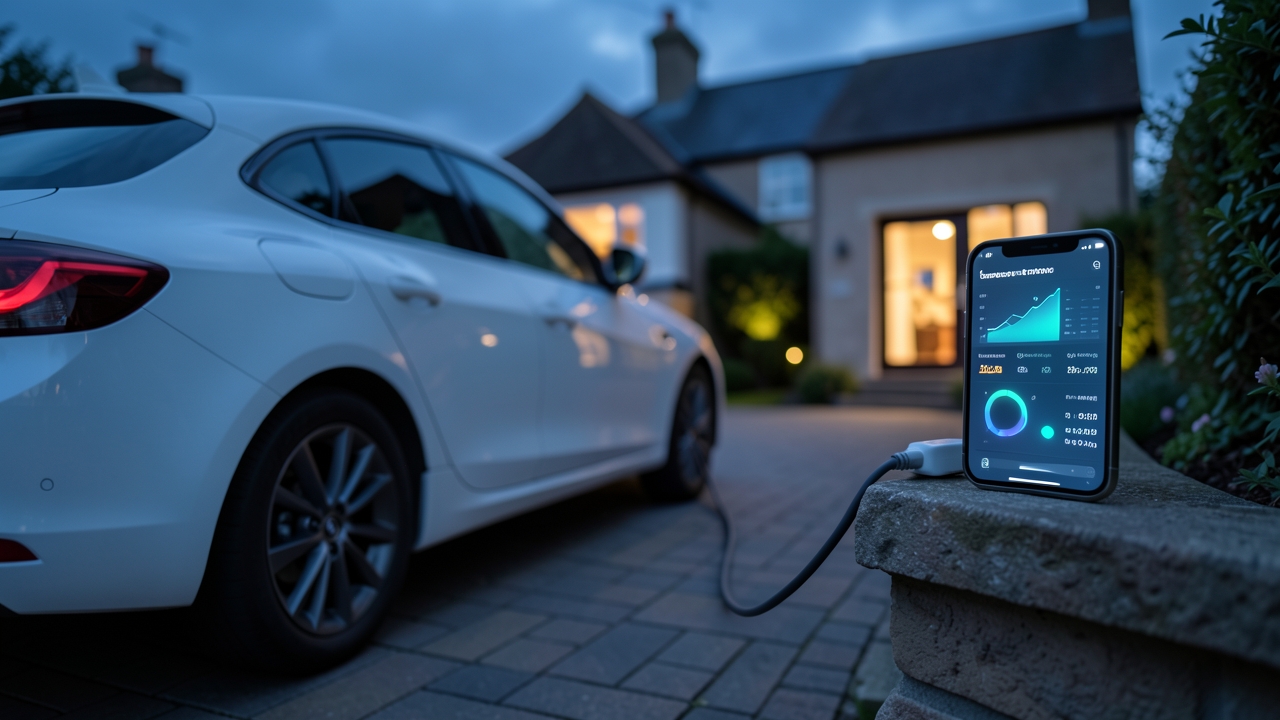
If you charge your electric car from a three-pin socket, you have probably wondered what it really costs. A smart plug EV charging setup is the cheapest way to find out. For under £25, you can log every kilowatt-hour, see the cost in pounds and prove whether your off-peak tariff is genuinely saving money.
This guide covers the hardware, the maths and, most importantly, the safety limits. Granny charging is slow but perfectly legal in the UK. However, it is not risk-free if you cut corners.
What Is a Granny Charger and How Much Power Does It Draw?
A granny charger is the three-pin cable that arrives with most new EVs. It plugs into a standard 13 amp UK socket and delivers roughly 2.3 kW. That is about ten times slower than a 7 kW home wallbox.
Because the current is low, you can plug in almost anywhere. Consequently, granny charging suits drivers who cover fewer than 40 miles a day or who can leave the car charging overnight.
- Typical output: 2.3 kW (10 A continuous)
- Range added: around 10 miles per hour
- A 60 kWh battery takes roughly 22 hours to go from 20% to 80%
- The plug and cable will feel warm in use, which is normal
Why a Smart Plug Is the Cheapest Energy Monitor You Can Buy
An energy-monitoring smart plug sits between the wall socket and the granny charger. Furthermore, it records live watts, cumulative kWh and the cost of every session. Most apps also store a 30 to 90 day history, which you can export as a CSV file.
Prices in 2026 start at about £15 for a basic Wi-Fi plug and reach £40 for models with 16 A relays and local APIs. That is far cheaper than replacing a wallbox simply to get metering. Our guide to energy-monitoring smart plugs compares the leading models.
The Safety Limits You Must Not Ignore
Here is the uncomfortable truth. Most smart plugs are rated for 13 A, but that figure assumes short bursts of use. EV charging is a continuous load that can run for ten hours or more. As a result, brands such as TP-Link and Meross explicitly warn against using their plugs with EV chargers.
Heat builds up in the plug, the socket and the cable over time. Although a granny charger pulls only around 10 A, a worn socket can still overheat. Therefore, the plug is often the weakest link in the whole chain.
Never use an extension lead, a multi-way adaptor or a coiled cable for EV charging. Plug the granny charger directly into a dedicated wall socket with RCD protection.
If you still want to monitor through a smart plug, follow these rules without exception:
- Choose a plug rated for 16 A and 3,680 W or more
- Keep the continuous draw at or below 10 A
- Check the plug and socket for warmth after the first hour
- Use an RCD-protected circuit, ideally a dedicated EV socket
- Ask a qualified electrician to inspect any socket over ten years old
- Stop immediately if you smell burning or spot scorch marks
Safer Alternatives If Your Plug Is Not Rated for Continuous Load
If your smart plug tops out at 13 A, do not gamble with it. Instead, fit a clamp-on energy monitor inside your consumer unit. Options include the Shelly EM, the Emporia Vue and CT clamps from Myenergi. These measure the whole circuit without sitting in the current path.
Better still, a smart wallbox such as a Zappi or an Ohme ePod meters every session and links to your tariff automatically. You can read more in our guide to home EV chargers.
How to Log kWh and Real Cost: Step by Step
Set-up takes about ten minutes. Firstly, plug the smart plug into the wall socket and pair it with your Wi-Fi network on the 2.4 GHz band.
- Open the app and set the tariff to your exact pence-per-kWh rate, including VAT at 5%
- Plug the granny charger into the smart plug, then into the car
- Start a charge and note the baseline reading before you walk away
- Check the live power figure — it should sit near 2.3 kW
- Review the kWh total and cost estimate the next morning
- Export the history monthly to spot patterns and faults
Meanwhile, compare the app figure with your car’s own energy display. A gap of 5% to 10% is normal because of charging losses. Anything larger suggests a problem with the cable or the socket.
Turning kWh into Pounds: UK Electricity Prices in 2026
Under Ofgem’s price cap, a typical UK household pays around 25p per kWh for electricity in late 2026, with standing charges near 60p a day. However, EV-specific tariffs are far cheaper overnight.
- Octopus Go: roughly 9p per kWh between 00:30 and 04:30
- Intelligent Octopus Go: around 7p per kWh across a longer smart window
- Ovo Charge Anytime: about 7p per kWh when you schedule a charge
- E.ON Next Drive and British Gas EV tariffs: similar off-peak rates
Always check current rates before switching, because they change every quarter. Ofgem publishes the latest cap, and the Energy Saving Trust offers independent running-cost guidance for UK drivers.
For example, the Energy Saving Trust explains how home charging compares with petrol. In addition, GOV.UK lists the smart charge point rules that apply to new hardware.
Tariff Integration and Overnight Scheduling
Most smart plug apps let you build a schedule. Consequently, you can switch the socket on at 00:30 and off at 04:30 to catch the cheapest window.
There is a catch, though. Cutting power to a granny charger mid-session is not ideal for every car. On the other hand, most EVs have their own charge timers, which are safer. Use the car’s schedule first, then treat the plug purely as a meter.
Remember the legal side too. Since 2022, all new UK charge points must include smart functionality, a default off-peak charging time and a randomised delay. That requirement comes from the Electric Vehicles (Smart Charge Points) Regulations 2021, and it does not apply to a basic three-pin cable.
What Does Granny Charging Actually Cost?
Assume your car returns 3.5 miles per kWh, which is realistic for a small hatchback in mixed UK driving.
- A 10-hour overnight charge adds about 23 kWh
- At 25p per kWh that costs £5.75 for roughly 80 miles, or about 7p per mile
- At 7p per kWh on an EV tariff the same 80 miles costs £1.61, or about 2p per mile
- Over 8,000 miles a year you would pay about £560 on a standard tariff, or £160 off-peak
Therefore, your tariff matters far more than your hardware. A £20 smart plug that proves you are charging at the wrong time pays for itself within a week.
Company car drivers should also log their kWh. HMRC’s advisory electricity rate for reimbursing business mileage sits at 7p per mile, so a clean charging record makes expense claims straightforward.
Do Solar Panels Change the Maths?
Yes, quite dramatically. If you have balcony solar panels, daytime charging can cost almost nothing. In addition, a logging smart plug shows exactly how much of your solar output goes into the car rather than the grid.
Common Mistakes to Avoid
- Using a 13 A smart plug for ten-hour charging sessions
- Daisy-chaining an extension lead to reach the driveway
- Leaving the tariff in the app set to the wrong pence rate
- Ignoring a warm plug or a discoloured socket face
- Scheduling the plug to cut power while the car is still balancing its battery
- Forgetting that charging losses add 5% to 10% to your bill
Frequently Asked Questions
Can I use any smart plug for EV charging?
No. Choose a 16 A model and keep the load at 10 A or less. Many manufacturers void support if you use their plug with an EV charger, so check the manual first.
How accurate are smart plug kWh readings?
Good quality plugs are accurate to within about 2%. That is fine for cost tracking, although it will not match a calibrated meter to the last penny.
Is granny charging cheaper than a wallbox?
The electricity costs the same per kWh. However, a wallbox is safer, faster and usually required for the best smart tariff rates, so it often wins in the long run.
The Verdict on Smart Plug EV Charging
Granny charging is slow, cheap and safe when it is done properly. A smart plug gives you the data to prove exactly what your car consumes. Just remember that the meter must never become the weak point in the circuit.
Have you measured your own charging costs this year? Tell us your pence-per-mile figure in the comments below, and share which tariff gave you the best overnight rate.