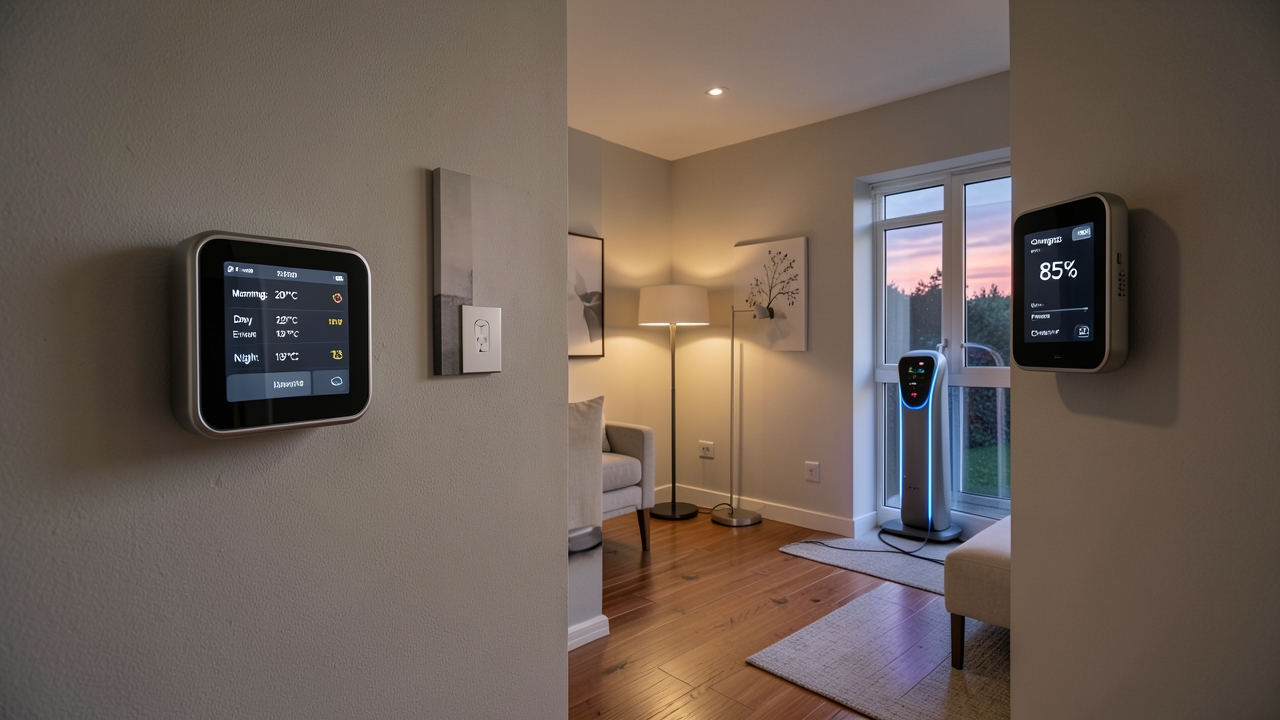
Imagine your home automatically heating up and your electric vehicle charging, all during the cheapest hours of the night. With a smart thermostat EV charger sync, this isn’t a future dream—it’s a practical reality for UK homeowners in 2026. By intelligently coordinating your largest energy draws, you can dramatically reduce your bills and carbon footprint. This guide provides a clear, step-by-step process to integrate these devices for maximum savings on current UK energy tariffs.
In 2026, the UK energy landscape continues to favour off-peak usage. With the energy price cap for a typical household on a standard variable tariff projected around 24.5p per kWh for electricity (source: Ofgem’s indicative calculations for Q3 2026), the difference between peak and off-peak rates is more significant than ever. Smart integration is key to exploiting these differentials.
Understanding the Core Components for Integration
Before you begin, ensure you have the right foundation. Successful syncing requires three primary elements working in harmony: a compatible smart thermostat, a smart EV charger, and a time-of-use (ToU) electricity tariff.
1. Your Smart Thermostat
Devices like Hive Active Heating and Tado° Smart Thermostat are excellent candidates. They offer robust APIs (Application Programming Interfaces) and are designed for integration within broader smart home ecosystems. Your thermostat must be capable of receiving external signals or schedules from a central hub or app.
2. Your Smart EV Charger
A smart charger, such as those from Ohme or Wallbox, allows you to set charging schedules via an app. Crucially, many newer models support integration with energy suppliers or home energy management systems, acting as the ‘brain’ for your coordinated schedule.
3. The Right Time-of-Use Tariff
A standard flat-rate tariff won’t yield these savings. You need a ToU tariff. In 2026, popular options include:
- Octopus Agile: Prices change every 30 minutes based on wholesale costs.
- Intelligent Octopus Go: Offers a low rate (typically 10p/kWh or less) for 6 hours overnight, which can be automatically extended to charge your EV.
- E.ON Next Drive: Provides a cheap overnight rate for a set window.
Switching to a ToU tariff is the essential first step. Use comparison sites like Uswitch or consult Energy Saving Trust for guidance.
How to Sync Your Smart Thermostat with Your EV Charger
The integration method depends on your specific devices. We’ll focus on the most common pathways: using a direct manufacturer integration or leveraging a third-party platform like Apple HomeKit, Google Home, or IFTTT (If This Then That).
Method 1: Using the EV Charger’s App as the Hub
This is often the simplest approach. Many smart EV charger apps now include a “home energy” section.
- Step 1: Open your EV charger’s app (e.g., Ohme or Wallbox).
- Step 2: Navigate to the settings for scheduling or energy management.
- Step 3: Look for an option to “Connect Smart Thermostat” or “Integrate Home Devices.”
- Step 4: Authenticate with your smart thermostat’s account (e.g., log into your Hive or Tado° account).
- Step 5: Set your desired parameters. For example: “Maintain home at 20°C overnight, but only use energy from 00:00-06:00 if my EV needs charging.”li>
The charger’s system will then prioritise using the cheap rate electricity for the EV, and once the car is full, it can direct the remaining off-peak power to your immersion heater or other devices, if compatible.
Method 2: Using IFTTT for Custom “Applets”
For greater flexibility, IFTTT acts as a powerful bridge between brands.
- Step 1: Create a free IFTTT account and connect both your smart thermostat and EV charger services.
- Step 2: Search for “applets” related to “off-peak charging” and “smart thermostat.”
- Step 3: Configure an applet. For instance: “IF [My EV charger starts a cheap rate session] THEN [Set my Hive thermostat to ‘Eco’ mode for 4 hours].”
- Step 4: Activate the applet. This ensures your heating doesn’t compete with your EV for the limited cheap-rate electricity window.
Method 3: Via Your Energy Supplier’s Portal
Suppliers like Octopus Energy are leading this field. If you have an Intelligent Octopus Go tariff, they can directly communicate with your Ohme or Wallbox charger. You can then set a “heat request” in their app.
- Step 1: Ensure your smart thermostat (e.g., Hive) is linked in your Octopus Energy app.
- Step 2: Set a heating schedule for the overnight period.
- Step 3: Octopus’s system will intelligently schedule your EV charging and use any surplus cheap-rate energy to meet your heating demand, provided the devices are compatible.
Pro Tip: For a seamless whole-home system, consider a dedicated home energy management system (HEMS). While more expensive upfront, it automates this syncing perfectly, optimising every kilowatt-hour.
Calculating Your Potential Savings in 2026
Let’s quantify the benefit. Assume you charge a typical EV with a 60kWh battery from empty to full once a week.
- Standard Tariff (24.5p/kWh): 60 kWh x 24.5p = £14.70 per charge.
- Off-Peak Rate (e.g., 10p/kWh): 60 kWh x 10p = £6.00 per charge.
- Weekly Saving on EV Charging: £8.70
- Annual Saving (52 weeks): £8.70 x 52 = £452.40
Furthermore, by shifting your high-energy heating (like an immersion heater or wet underfloor heating) to these off-peak periods, you can save an additional £150-£300 annually, depending on your usage. Therefore, a properly synchronised system can save a typical UK household over £700 per year when compared to using peak-rate electricity for these tasks.
Troubleshooting and Important Considerations
While powerful, keep these factors in mind for a smooth experience.
Heating Responsiveness
Syncing means your heating may come on at 2 AM instead of 6 AM. Ensure your system is well-insulated to retain this heat until morning. A smart thermostat with geofencing can pre-heat when you’re actually heading home, optimising comfort and cost.
Grid Capacity and Smart Charging
In 2026, the UK’s Distribution Network Operators (DNOs) actively manage local grid load. Smart chargers automatically adjust their rate to prevent strain, which might occasionally overlap with your heating schedule. This is a safety feature, not a fault.
Software Updates
Keep all devices and apps updated. Integration protocols can change, so a recent update is often the first fix for any connectivity issues.
The Future of Home Energy Integration
The synergy between smart thermostats and EV chargers is just the beginning. In the near future, your solar panels, home battery, and even your washing machine will communicate to run your home on the cheapest and greenest energy possible. By setting up your smart thermostat EV charger sync today, you’re not only saving money in 2026—you’re building the foundational logic for a fully autonomous, energy-efficient home.
Have you already connected your smart home devices for off-peak savings, or are you planning your first integration? Share your experiences or questions in the comments below—we’d love to hear which combinations are working best for UK homes this year.