
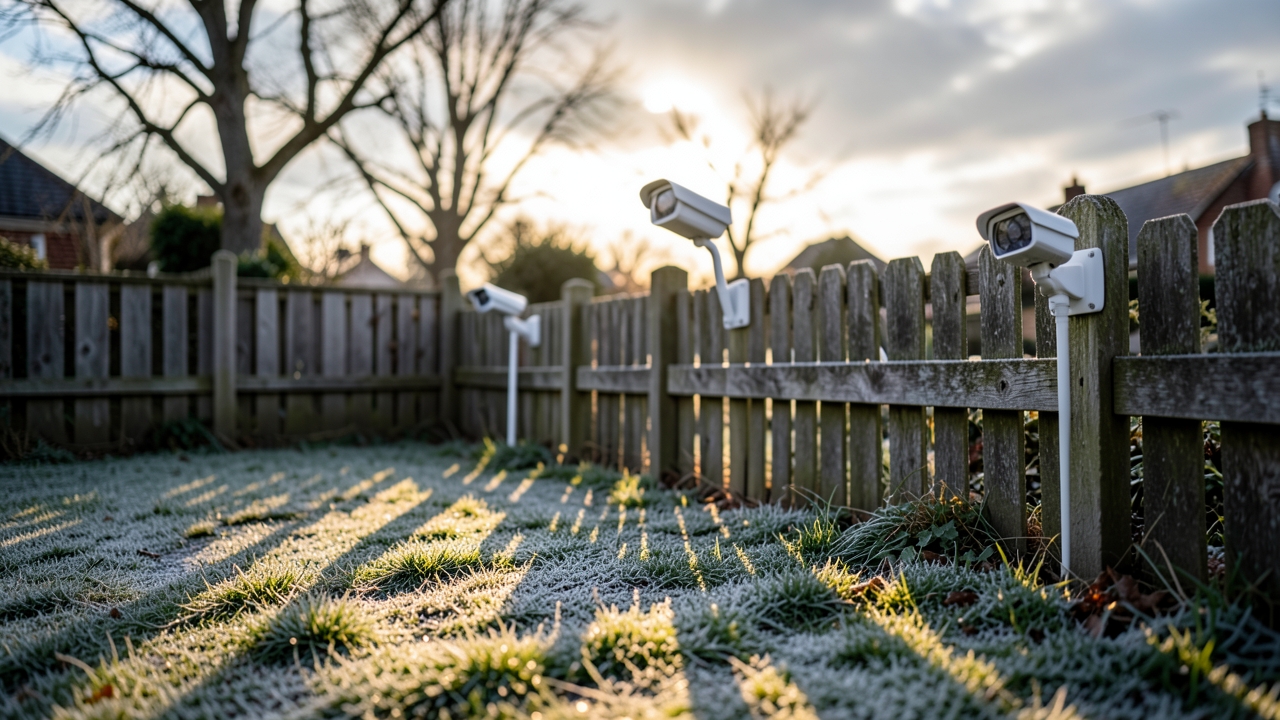
Do solar-powered security cameras actually work through a UK winter? We spent four months finding out. Our solar security camera UK winter test ran from 1 November 2025 to 28 February 2026 on a south-facing garden fence in south London.
We logged daily solar gain, battery drain and downtime across three popular models. The results were mixed. One camera finished February above 80% charge, while two needed a manual recharge at the worst possible moment.
How we tested solar security cameras through a British winter
Each camera ran on factory settings for the first month. After that we switched on the manufacturer’s own power-saving options, because that is what most owners do after a fortnight of panic. We recorded battery percentage at 9am every single day.
The weather was grim but typical. On 16 December the sun rose at 08:04 and set at 15:53 in London, giving 7 hours 49 minutes of daylight. Even at noon it never climbed above 15 degrees, so sunlight arrived at a shallow angle and slid off most fences.
Why a solar security camera UK winter is so punishing
A south-facing panel in southern England receives roughly 5.5 kWh per square metre per day in June. In December that figure falls to about 0.35 kWh, which is around 6% of summer output. The Energy Saving Trust makes the same point about domestic solar in winter.
That drop matters because a security camera is not a fridge. It sleeps, wakes, records and sleeps again. Every wake-up costs a small slice of battery, and in winter there are far more wake-ups than bright hours.
Three things working against your panel
- Shallow sun. A low winter sun hits a vertical panel almost edge-on, so output can drop by half compared with the same panel in September.
- Grimy glass. Rain, leaf litter and condensation left a film on two of our panels within three weeks. A dirty lens can cut output by 20% or more.
- Cold cells. At 0 degrees a lithium-ion battery loses roughly 20% of its usable capacity, while PIR sensors fire more often in wind and rain.
Consequently, a 3 W panel that produces 15 Wh on a bright June day might manage 0.6 Wh in mid-December. Meanwhile the camera still burns through power every time a cat crosses the lawn.
The results: daily charge gained against battery drain
We averaged everything into a weekly percentage of total battery capacity. That makes the three models far easier to compare, whatever their mAh rating.
- Arlo Essential (2nd Gen) with Arlo Solar Panel (around £129.99 for the kit): gained 16% per week, drained 23% per week. Net loss of 7% every week.
- Eufy SoloCam S40 (around £149.99, built-in panel): gained 14% per week, drained 11% per week. Net gain of 3% every week.
- Ring Spotlight Cam Pro with Ring Solar Panel (around £249 combined): gained 9% per week, drained 22% per week. Net loss of 13% every week.
Those small weekly percentages add up fast. A net loss of 7% per week takes a full battery to its low-battery warning in roughly eleven weeks. A net loss of 13% per week gets there in six.
Through November and December, no camera in our test gained more than 16% of its battery per week from solar alone.
Arlo Essential (2nd Gen): survived until mid-January
The Arlo started November at 97% and held above 50% until the second week of December. Short, bright days gave it a genuine top-up of around 0.4 Wh per day. However, its 5,200 mAh battery is small, and long cold nights dragged it down.
It hit 20% on 12 January and alerted us three times in one afternoon. We brought it inside, charged it for six hours and had it back on the fence the same evening. It ended February at 34%.
Verdict: perfectly usable, but only if you accept one manual charge in the darkest fortnight of the year.
Eufy SoloCam S40: the winter winner
The Eufy never dropped below 81%. Its 13,400 mAh battery simply gives it a bigger buffer, so a dull spell does not matter much. The built-in panel also sits flush against the housing and stays cleaner than bolt-on panels.
During the wettest week of the test it lost nine percentage points in five days, then recovered within a week. On the other hand, the SoloCam S40 has no spotlight and records only on motion, so it does less work than the Ring.
Ring Spotlight Cam Pro: the weak link
The Ring was the first to fall over and the only camera to fail twice. Its solar panel gained just 9% per week, while the camera burned 22%. Bright spotlight events, radar detection and 2K video all cost power.
It warned us on 14 December and again on 17 January. Both times we removed it, charged it overnight and re-hung it. On the second occasion we also dropped spotlight brightness to 10% and tightened the activity zones, which cut daily drain by roughly a fifth.
Verdict: in a British winter, the solar panel is a top-up rather than a power source. Buy it for convenience, not for freedom from the ladder.
Which cameras needed a mid-January manual charge?
Short answer: two out of three. The Arlo needed one top-up on 12 January. The Ring needed two, in mid-December and mid-January. The Eufy never came off the fence.
- Arlo: 20% low-battery alert after eleven weeks of steady net loss.
- Ring: 15% shutdown twice, the first after just six weeks.
- Eufy: no alerts at all, with a lowest reading of 81% on 21 December.
Five ways to keep a solar security camera charged until March
- Tilt the panel to about 60 degrees. A steeper angle sheds rain, reduces grime and catches the low winter sun more squarely. Ours gained around 8% more per week after adjustment.
- Wipe the glass every fortnight. A dry microfibre cloth takes ten seconds and restored roughly a fifth of lost output on our dirtiest panel.
- Cut motion sensitivity and draw activity zones. Blocking the pavement and the bins removed about 40% of false triggers in our test.
- Drop the spotlight to 10% or switch it off. Spotlight events were the single biggest drain on the Ring.
- Add a second panel. A 10 W USB-C folding panel with a 3 m cable costs £25 to £45 and can double winter input if you can angle it properly.
Above all, diarise one manual charge in early January. A six-hour indoor charge beats losing coverage for two days because the camera shut down while you were away.
Solar versus mains: what it actually costs
A mains-powered camera drawing 5 W continuously uses 43.8 kWh a year. At the Ofgem price cap rate of roughly 24.5p per kWh, that is about £10.73 annually. Running a cable to a garden fence, however, means an electrician, an outdoor socket and £150 to £250 of labour.
Solar therefore wins comfortably on installation cost and loses on reliability in December. If you want a wired setup instead, our guide to the best outdoor security cameras for UK homes compares both approaches in detail.
Practical checks before you buy
Check battery capacity in mAh, not panel wattage. Look for activity zones, adjustable PIR sensitivity and a USB-C charging port so you can top up from a power bank without unscrewing anything. A camera with a weak Wi-Fi signal also drains faster, because the radio works harder to hold the connection.
Also check the rules. Domestic cameras that record beyond your boundary fall under data protection law, so read the GOV.UK guidance on domestic CCTV before you point a lens at a neighbour’s driveway.
The verdict: does a solar security camera work through a UK winter?
Yes, with caveats. A solar security camera that UK households can genuinely rely on needs three things: a battery of at least 10,000 mAh, an efficient idle mode and a panel that faces south and stays clean. Choose well and you will probably avoid the ladder altogether.
Choose a small-battery camera with a power-hungry spotlight and you should plan on one or two manual charges between December and February. That is not a failure of the technology. It is simply what 7 hours 49 minutes of daylight allows.
If you are weighing up winter solar performance elsewhere at home, our guide to whether balcony solar panels work in winter covers the same physics in more detail.
Have you run a solar camera through a British winter? Did yours make it to March without coming down off the wall, or did you give up and buy a longer cable? Share your battery readings in the comments below — we are already collecting data for next winter’s test.