
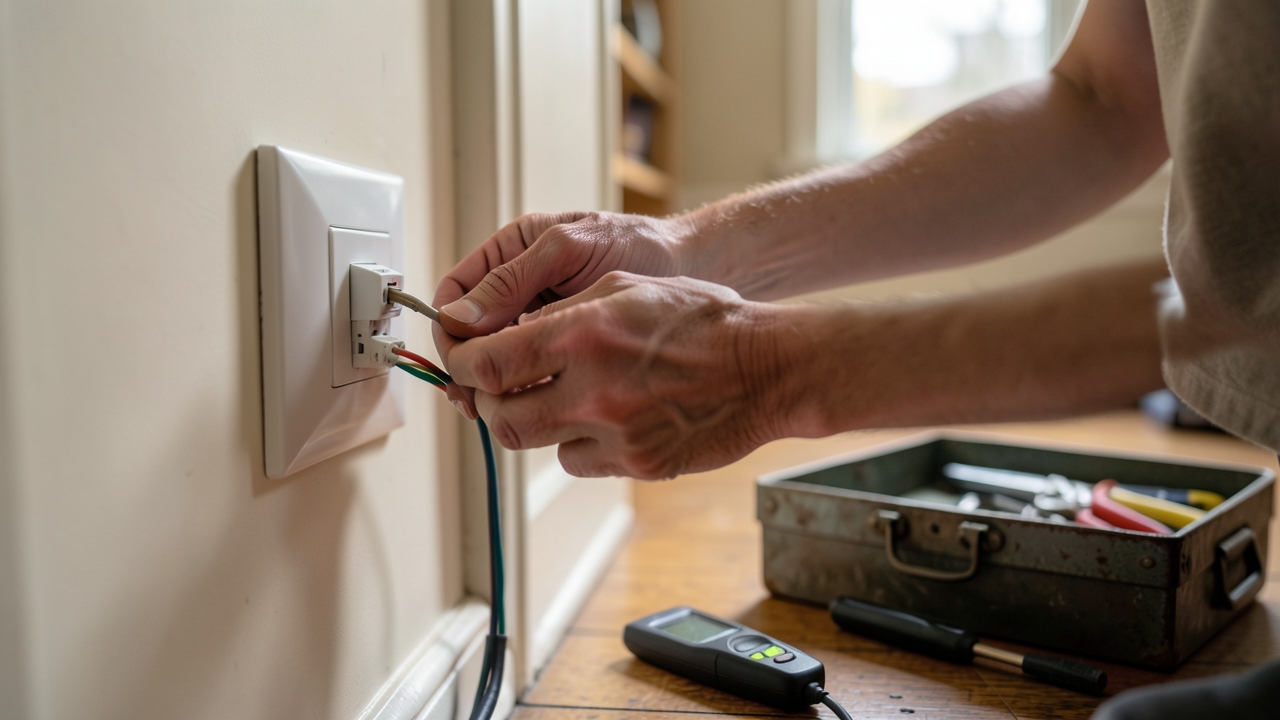
If your home went up before the 1980s, there is a strong chance your light switches have only two wires behind them. Live and switched live. No neutral. That single missing conductor rules out most smart switches sold in the UK today. However, it does not rule out smart lighting. This guide explains three proven workarounds for a no neutral smart switch UK setup, plus what an electrician will actually charge to fit them in 2026.
Why Older UK Homes Have No Neutral at the Switch
British lighting circuits usually run from ceiling rose to ceiling rose. Power reaches the light first, then a two-core switch drop cable runs down to the wall switch. The neutral stays up in the ceiling. Only the switched live comes back down.
That design is safe, cheap and perfectly legal. It simply predates smart switches. Modern smart switches need a permanent live and a neutral to power their radio and electronics. Without a neutral, those electronics have nothing to run on.
As a result, roughly half of the UK’s 30 million homes are awkward territory for smart lighting. That is around 14 million properties built before 1980. Check before you buy anything: switch off the breaker, unscrew the plate and look for a blue or black wire sitting in its own connector block. If you find just two wires plus earth, you have a two-wire circuit.
No neutral at the switch is not a fault. It is simply old wiring doing exactly what it was designed to do in 1965.
Option 1: No Neutral Smart Switch UK Models That Work on Two Wires
No-neutral smart switches draw a tiny amount of current through the lamp itself. The circuit stays complete through the bulb, even when the light is switched off. It is a clever trick, and it works well within limits. Furthermore, it keeps your existing wall plate position and look.
The catch: minimum load and flickering LEDs
Because the switch needs a trickle of current, it needs a load to trickle through. Most no-neutral switches require between 5W and 25W on the circuit. A single 5W LED often sits below that threshold. Consequently you get flickering, buzzing, or a lamp that glows faintly at night.
Two fixes exist. Fit a bypass capacitor across the lamp, which Shelly sells for about £5. Or raise the load by using higher-wattage LEDs, or keeping one halogen lamp in a multi-lamp fitting. In addition, check the manufacturer’s LED compatibility list, because cheap dimmable bulbs are notoriously fussy.
Best no-neutral switches to buy in 2026
- Shelly Dimmer 2 — £35-£40. Dims smoothly, works without a neutral when paired with a bypass. Wi-Fi, no hub required.
- Shelly 1L — around £20. Simple on/off relay, no dimming, but very reliable on old wiring.
- Aqara Smart Wall Switch H1 (No Neutral) — £40-£55. Zigbee, excellent build quality, needs an Aqara hub or compatible Matter bridge.
- Sonoff and Moes two-wire touch switches — £18-£30. Budget Wi-Fi options. Fine for a hallway or utility room, less polished for a lounge.
- Retrofit dimmer modules — £25-£50. These hide behind your existing plate and keep the original switch face.
Two-way switching: the hidden limitation
Most no-neutral switches cannot handle a two-way circuit. Landing and hallway pairs are the classic problem. On the other hand, a relay at the ceiling rose copes easily with two-way control, because the wall switches simply become inputs rather than the power source.
Option 2: Fit a Shelly Relay Behind the Ceiling Rose
Your ceiling rose almost certainly has a neutral. The lighting circuit’s neutral loops through it, even if the switch never sees it. That makes the ceiling void the ideal home for a small relay, and it is the approach many UK electricians now recommend first.
How the wiring works
An electrician fits a Shelly Plus 1 or Shelly 1 (roughly £18-£22) inside the ceiling rose or a deep pattress box beside it. The relay takes permanent live and neutral from the rose. The lamp connects to the relay’s output. Meanwhile, the two cores of the existing switch drop are re-purposed: one carries permanent live down, the other brings the switch signal back up.
The wall switch keeps its familiar click and its familiar faceplate. The smart work happens overhead. Furthermore, because the relay sits on the load side, there is no minimum-load problem, no LED flicker and no bypass capacitor to worry about.
What it costs
Parts run to £18-£25 for the relay, plus £6-£10 for a deeper box or a Wiska enclosure if space is tight. Labour is the bigger number. Expect £80-£150 for the first point and £40-£65 for each additional point on the same visit, assuming the roses are accessible and the wiring is sound.
Do note that Shelly’s Gen4 devices now ship with Matter support out of the box. Therefore they pair directly with Apple Home, Google Home, Alexa and Home Assistant without any cloud workaround.
Option 3: Smart Bulbs and Wireless Dimmers — No Wiring at All
The simplest route needs no electrician whatsoever. Fit smart bulbs and stick a wireless dimmer or button anywhere you like. The wall switch stays permanently on, and the smart control takes over. This is also the only realistic option for renters.
Costs are low. A Philips Hue Dimmer Switch costs around £22, a Hue White bulb £15-£20, and a TP-Link Tapo L530E around £10-£13. A four-bulb room with one dimmer comes in under £100. Battery-free kinetic switches from Hue and Aqara never need charging, which matters in a hallway.
The trade-off is behavioural. Guests flick the wall switch and cut power to the smart bulbs. On the other hand, a £6 switch cover, a magnetic holder or a 3D-printed bracket solves that in minutes. For a full rundown of bulb options, see our guide to the best smart bulbs for UK homes.
What an Electrician Will Actually Charge in 2026
Rates have climbed. In 2026, a qualified electrician in the UK typically charges £45-£75 per hour, or £300-£450 for a full day. Here is what the common jobs cost in practice.
- Replace one switch with a no-neutral smart switch: £45-£75 (15-30 minutes)
- Fit a Shelly relay behind a ceiling rose: £80-£150 for the first point
- Additional relay points on the same visit: £40-£65 each
- Diagnose flickering or a suspected borrowed neutral: £60-£120
- Run a genuine neutral to a switch, including chasing and making good: £150-£350 per point
- Minor Electrical Installation Works Certificate: £40-£80
- Emergency or weekend call-out: add 50%
London and the South East run 20-30% above these figures. Rural areas and the North East often sit below them. Always ask for a fixed price per point rather than an hourly rate, and confirm whether making good is included.
Safety, BS 7671 and Part P
Every installation must comply with BS 7671, the 18th Edition Wiring Regulations. In practice that means correct earthing, a suitable enclosure, and no exposed live parts inside a ceiling rose. A relay stuffed loosely into a rose is not compliant.
Replacing a switch or a light fitting is not notifiable under Part P of the Building Regulations in England and Wales. Creating a new circuit is. Consequently, if your plans involve new cable runs, budget for Building Control notification or use an electrician registered with a competent person scheme. Read the government guidance on Approved Document P if you want the detail.
One serious warning. Some older properties have borrowed neutrals, where a neutral is pinched from a different circuit. These are genuinely dangerous and can leave metalwork live. A good electrician will test for them before fitting anything smart. Meanwhile, the Energy Saving Trust notes that lighting still accounts for roughly 11% of a typical household electricity bill, so a well-planned LED and smart control upgrade pays back over time.
Which Option Suits Your Home?
- Tidiest look with proper dimming: a no-neutral smart switch, plus a bypass if your LED load is small.
- Multi-gang plates or tricky loads: a Shelly relay at each ceiling rose. It is the most robust route by far.
- Renters or zero budget: smart bulbs with a wireless dimmer stuck to the wall.
- Mid-renovation: ask the electrician to pull a neutral to every switch while the walls are open. It is the best long-term fix at £150-£350 per point.
If you are still choosing an ecosystem, our smart lighting guide explains how Matter, Zigbee and Wi-Fi compare before you commit to a brand.
Frequently Asked Questions
Can I use a no-neutral smart switch with LED bulbs?
Yes, but check the minimum load first. Most models need between 5W and 25W across the circuit. If your total load is lower, fit a bypass capacitor across the lamp and the flicker usually disappears.
Will a no-neutral smart switch work with two-way switching?
Rarely. Most no-neutral switches cannot handle a landing and hallway pair. A relay at the ceiling rose handles two-way control properly, because both wall switches become low-voltage inputs.
Can I just run a neutral wire to the switch?
You can, and it remains the best long-term answer. Expect £150-£350 per point once chasing, plastering and making good are included. It is far cheaper to add while a room is being decorated or rewired.
Do I legally need an electrician?
Replacing a switch like-for-like is not notifiable work, so a competent DIYer can do it. However, a no-neutral switch or a relay in a ceiling rose is not a like-for-like swap. If you are unsure, hire a Part P registered electrician and ask for a Minor Works Certificate.
The Verdict
Two-wire lighting is not the end of the road for smart lighting. Whether you pick a no-neutral switch, a relay hidden in the ceiling rose or a bulb-and-dimmer combo, there is a route that fits your wiring, your decor and your budget.
Which option are you leaning towards? And have you checked what is actually behind your switch plate yet? Share your findings in the comments below.