
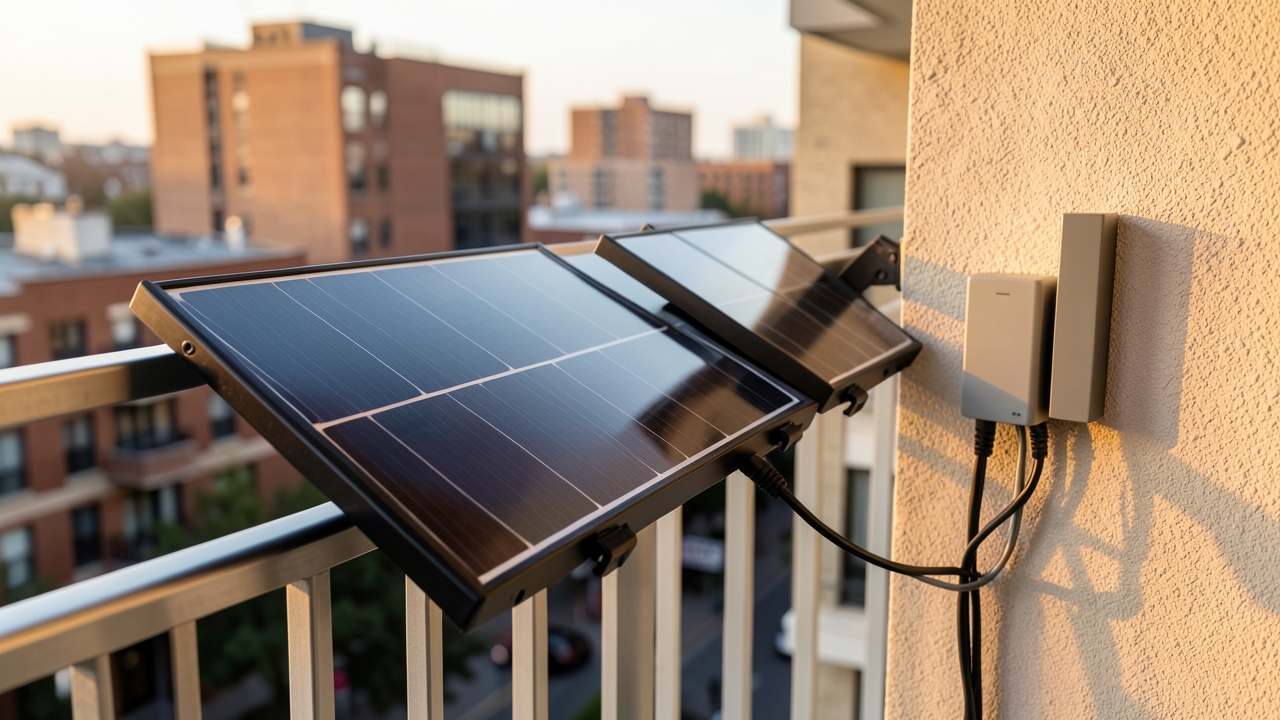
Is plug-in solar UK legal? Yes, with conditions. The government closed its consultation on domestic plug-in solar products, and thousands of households have since asked the same question. Nothing in law bans you from connecting a solar panel to a 13A socket. However, three things must line up: an inverter capped at 800W, wiring that satisfies BS 7671, and a G98 notification to your distribution network operator.
This guide cuts through the confusion left behind by the consultation. It sets out exactly what a UK household can plug in today, what the paperwork involves, and where Scotland diverges from England and Wales.
Plug-In Solar UK Legal: The 2026 Rules in Plain English
The Department for Energy Security and Net Zero ran its consultation on plug-in solar standards in early 2025. It asked how small consumer kits should be regulated. By November 2026, the direction of travel is clear. Regulators now treat these kits as appliances rather than full solar installations. Nevertheless, the electrical safety and network notification duties remain firmly in place.
Therefore, the legal position rests on three pillars. Break any one of them and your installation is non-compliant, even though no single law says so directly:
- Inverter output limited to 800W — roughly 3.5A at 230V.
- Wiring compliant with BS 7671 — the 18th Edition Wiring Regulations, including Amendment 3.
- Notification to your DNO under Engineering Recommendation G98 — within 28 days of commissioning.
If you are still choosing hardware, our complete guide to balcony solar panels in the UK covers panel types and mounting options in more depth.
The 800W Inverter Limit: What It Covers
The 800W figure is the maximum continuous AC output your inverter may deliver into the mains. It is not the panel rating. This distinction trips up buyers almost every week.
Why 800W and Not 3.68kW?
G98 already permits up to 16A per phase, which is about 3.68kW. So why the tighter ceiling? Two reasons carry weight. First, a 13A plug and a standard ring final circuit were never designed for sustained back-feed. Second, an 800W cap keeps current low enough that a domestic socket stays within its thermal limits.
Furthermore, the figure mirrors the 800VA limit used in Germany, where plug-in balcony systems are widespread. As a result, most inverters sold for this purpose already ship with an 800W ceiling built in.
Count the Inverter, Not the Panels
You can oversize the array slightly. A pair of 430W panels feeding a single 800W micro-inverter is compliant, because the inverter clips output at 800W. However, a 1,200W inverter fed by the same panels is not.
- Two 400–450W panels + 800W micro-inverter = compliant.
- One 800W inverter per plug-in kit = compliant.
- Two separate 800W kits on one property = a grey area; your DNO may aggregate them.
- Any inverter above 800W = not compliant for a plug-in installation.
BS 7671 and the Wiring Rules That Actually Matter
BS 7671 does not name plug-in solar directly. Instead, it applies its general principles to a circuit that can now export as well as import. The IET has issued guidance confirming that a compliant plug-in kit is possible, provided the circuit meets these conditions.
Sockets, RCDs and Dedicated Circuits
- RCD protection — 30mA, Type A, protecting the socket you use.
- Dedicated circuit preferred — a 13A radial socket is better than a spur off a ring final.
- No extension leads — never use a multi-way adaptor or trailing socket.
- Outdoor socket rating — IP65 or better, with a lockable isolator nearby.
- Anti-islanding — the inverter must shut down when grid power fails.
- Consumer unit labelling — a clear dual supply warning notice.
Here is the practical part. Plugging into an existing compliant socket does not usually count as notifiable electrical work. However, adding a new dedicated circuit does. In England and Wales that work falls under Part P, so a registered electrician must certify it.
G98 Notification and Your DNO
This is the step most buyers forget. Engineering Recommendation G98 covers generation up to 16A per phase. It requires you to tell your distribution network operator within 28 days of commissioning. The process is free and usually handled online.
- UK Power Networks — London, the South East and the East of England.
- National Grid Electricity Distribution — the Midlands, South West and South Wales.
- Northern Powergrid — the North East, Yorkshire and northern Lincolnshire.
- SP Energy Networks — central and southern Scotland, plus Merseyside and North Wales.
- SSE Networks — northern Scotland and the Highlands.
An 800W system draws only around 3.5A, so it sits comfortably inside the G98 envelope. Keep your commissioning certificate and the notification acknowledgement. If you skip notification, your DNO can insist you disconnect the system.
The rules are not designed to stop you. They exist so your neighbour’s supply and your own wiring stay safe when the sun is out.
Where Scotland Differs from England and Wales
The headline rules are the same north of the border. An 800W inverter cap, BS 7671 compliance and G98 notification all still apply. However, the enforcement framework differs in several important ways.
- Building standards, not Part P — Scotland uses the Building (Scotland) Regulations and Technical Handbooks. A new circuit may require a Building Warrant.
- Certification bodies — SELECT and NICEIC-registered sparks operate under a different scheme structure.
- Tenements — panels fitted to shared fabric need consent from every owner, often through a factor.
- Planning — conservation areas, listed buildings and World Heritage Sites require consent in both jurisdictions.
- Funding — Home Energy Scotland interest-free loans can sometimes cover renewables, so check current rates.
Meanwhile, Scotland’s two DNOs, SP Energy Networks and SSE Networks, both accept G98 notification online. The practical difference is minor, although tenement living makes written consent more important.
Planning Permission, Flats and Balconies
In England, rooftop solar on a house is permitted development under Part 14 of the General Permitted Development Order. Balcony panels on a flat are a different matter. You will usually need freeholder consent, plus planning permission in a conservation area.
- Panels must not protrude beyond the balcony edge in most cases.
- Ballast or clamp mounts should be rated for 100mph gusts.
- Listed buildings require listed building consent, without exception.
- Renters need written landlord permission before drilling or clamping.
For ideas on mounting without damage, see our round-up of the best plug-in solar kits for UK balconies.
What a Legal Plug-In Solar Kit Costs in 2026
Prices have fallen again this year. A fully compliant DIY setup now costs a fraction of a roof-mounted system.
- 400–450W panel: £90–£160 each.
- 800W micro-inverter with UK plug: £160–£280.
- Balcony brackets or ballast: £40–£120.
- IP65 outdoor socket and cabling: £60–£150.
- Electrician sign-off for a new circuit: £150–£350.
Total DIY cost lands at £400–£650. A professionally installed version with a dedicated circuit runs £650–£1,000. By comparison, a 4kWp roof system still costs £6,000–£8,000.
Realistic Output, Savings and Payback
An 800W balcony array in London generates roughly 750–850 kWh a year. In Manchester or central Scotland, expect 650–750 kWh. The Energy Saving Trust uses similar figures for small-scale generation.
- Electricity price assumption: about 24–26p per kWh under the 2026 price cap.
- Fully self-consumed output: £160–£210 saved annually.
- Realistic self-consumption of 60–80%: £110–£165 saved annually.
- Payback period: three to five years.
One caveat matters here. You cannot currently claim Smart Export Guarantee payments on a plug-in kit. The scheme requires MCS certification or an equivalent standard, which these products do not hold. Therefore, maximise self-consumption instead. Run the washing machine, dehumidifier or immersion heater during daylight hours using a timer or smart plug.
If you want to understand what your meter records, our explainer on smart meter export readings is worth a read.
Grey Areas Still Unresolved in 2026
Honesty helps here. Several details remain unsettled, and buyers should know them before spending money.
- Product standards — no single designated UK standard exists yet for plug-in kits, although BS EN 50549 is widely referenced.
- Export payments — still unavailable without certification.
- Insurance — tell your home insurer; some policies exclude unlisted generation.
- EPC ratings — plug-in systems are not counted in Energy Performance Certificates.
- Older smart meters — SMETS1 devices may not register reverse flow correctly.
The government’s consultation response confirms the intent to enable these products properly. Read the official GOV.UK consultation on plug-in solar standards if you want the source material.
Quick Answers to Common Questions
Can I plug a solar panel into a normal socket?
Yes, provided the inverter is capped at 800W and the socket circuit is RCD protected and compliant with BS 7671.
Do I need an electrician?
Not always. Reusing an existing compliant socket is usually fine. Adding a dedicated circuit requires a registered electrician and certification.
Do I still notify my DNO under 800W?
Yes. G98 notification applies to any generation up to 16A per phase, including an 800W kit. Submit it within 28 days of commissioning.
Will it trip my RCD?
A compliant inverter should not. Nuisance tripping usually points to a Type AC device, a shared circuit, or a faulty panel connector.
So, Is Plug-In Solar Worth It?
For most flat dwellers with a sunny balcony, yes. The kit is affordable, the paperwork is manageable, and payback arrives within a few years. Just follow the three pillars: 800W inverter, BS 7671 wiring, G98 notification. Do that and your installation sits on solid legal ground.
Have you already fitted a plug-in system this year? Tell us how your DNO handled the notification, and whether your balcony gets enough sun to make it pay.