
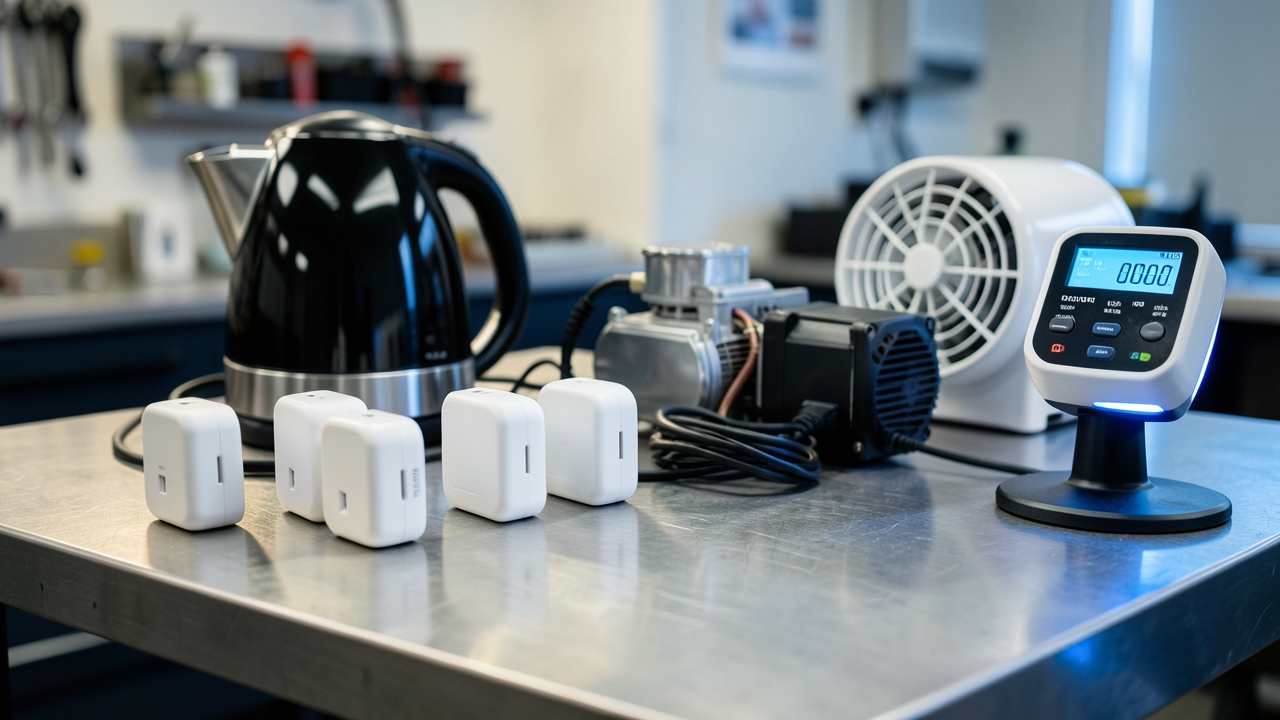
A smart plug that reads 9% low is worse than no meter at all. We ran a smart plug accuracy test on nine UK models, comparing each one against a class 1 SMETS2 meter on a workshop bench rig. We measured resistive loads, inductive loads and tiny standby draws. The results were not flattering. Four of the nine drifted by more than 10% on a fridge compressor.
Meanwhile, three plugs reported a flat 0W while the appliance was still sipping 2.5W. Over a year, that blind spot hides real money on your energy bill. Furthermore, none of these plugs is legally required to be accurate. So how much can you trust the numbers in your smart home app?
How our smart plug accuracy test was set up
We built the rig on a dedicated 32A radial circuit in a workshop, away from anything that could add electrical noise. Each plug ran the same load, in the same order, on the same day. In addition, every unit was updated to its latest firmware in October 2026.
The reference meter
Our benchmark was a Landis+Gyr E470 SMETS2 meter, the same family of unit installed in millions of UK homes. It meets class 1 accuracy, which means roughly ±1% at unity power factor and ±1.5% at a power factor of 0.5. We read it through an IR optical probe every second.
We also cross-checked every load with a calibrated Fluke 1738 power logger at 0.2% accuracy. That let us separate a genuine power factor effect from a plug error, which matters enormously on motor loads.
The loads we used
- Resistive: 3,000W kettle element (2,940W measured, PF 1.00) and a 700W travel kettle (688W, PF 1.00)
- Electronic: 9W LED bulb (8.6W, PF 0.92)
- Inductive: larder fridge compressor (82W running, PF 0.63), washing machine drain pump (38W, PF 0.55), bathroom extractor fan (22W, PF 0.48)
- Standby bank: 3.0W nightlight, 2.1W smart speaker, 0.8W phone charger and 0.4W TV standby
How we logged the data
Each load ran for 30 minutes, sampled every 30 seconds, with five repeats. We used the local API where the plug offered one and cloud polling where it did not. Ambient temperature stayed between 19°C and 21°C throughout, and every test started from a cold plug.
Resistive loads: kettles make every plug look good
On the 2,940W kettle element, all nine plugs landed within 5% of the reference. The worst performer, the Refoss P1, over-read by 4.1%. The Shelly Plus Plug UK was best at +0.6%. Consequently, any plug with a half-decent shunt resistor gets close on a heating element.
This is the easy case. A kettle has a near-perfect sine wave and a power factor of 1.00. However, almost every online review only tests a kettle or a lamp. That approach hides the real weaknesses, which appear the moment the waveform stops behaving.
Inductive loads expose power factor errors
Fridge compressors and pump motors shift the current waveform out of step with the voltage. That phase shift is the power factor. A true power meter multiplies instantaneous voltage by instantaneous current, thousands of times a second.
Why cheap meters collapse on motor loads
Several of the £13 to £18 plugs in this test use a single-chip meter such as the BL0937. It samples coarsely and relies on factory calibration that assumes a fairly clean load. As a result, the reading drifts badly once the current waveform distorts or shifts phase. The Shelly and Eve units use a far more capable chip and hold on much better.
The plugs that missed by 10% or more
On the 82W fridge compressor, four plugs under-read by double digits. The Wiz Smart Plug was worst at −13.2%, followed by the Meross MSS310 at −11.7%, the Govee H5083 at −10.5% and the TP-Link Tapo P110 at −9.4%. The washing machine pump was worse still, with the Wiz missing by 16.4%.
To be fair, the absolute error on a 38W pump is tiny in cash terms. A washing machine might run its drain pump for three minutes per cycle. The fridge, on the other hand, runs for thousands of hours a year. Therefore that is where accuracy genuinely pays.
Full results: 9 smart plugs compared
All figures show the plug reading as a percentage difference from the SMETS2 reference. Positive means over-reading, negative means under-reading.
| Smart plug | Price | Kettle 2,940W (PF 1.00) | Fridge 82W (PF 0.63) | Pump 38W (PF 0.55) |
|---|---|---|---|---|
| Shelly Plus Plug UK | £24.99 | +0.6% | −1.2% | −1.8% |
| Eve Energy (Matter) | £34.95 | +0.9% | −1.8% | −2.1% |
| Aqara Smart Plug | £29.99 | +1.1% | −3.4% | −4.0% |
| TP-Link Kasa KP115 | £19.99 | +1.6% | −8.1% | −9.6% |
| TP-Link Tapo P110 | £12.99 | +1.8% | −9.4% | −10.9% |
| Refoss P1 | £13.99 | +4.1% | −7.6% | −8.9% |
| Govee H5083 | £17.99 | +2.9% | −10.5% | −12.8% |
| Meross MSS310 | £15.99 | +2.4% | −11.7% | −14.2% |
| Wiz Smart Plug | £16.99 | +3.2% | −13.2% | −16.4% |
Below 5W: where standby tracking actually matters
Standby is the whole point of buying a monitoring plug. A typical UK living room has 12 to 18 devices permanently drawing between 0.3W and 5W. Individually they look trivial. Collectively they add up to hundreds of kilowatt hours a year, and that is exactly the range where cheap plugs give up.
| Smart plug | 3.0W nightlight | 2.1W standby speaker | 0.8W charger | Resolution |
|---|---|---|---|---|
| Eve Energy (Matter) | 2.9W | 2.0W | 0.7W | 0.1W |
| Shelly Plus Plug UK | 3.1W | 2.2W | 0.9W | 0.1W |
| Aqara Smart Plug | 2.8W | 2.1W | 0W | 0.1W |
| TP-Link Kasa KP115 | 2.9W | 2.0W | 0W | 0.1W |
| TP-Link Tapo P110 | 3.0W | 2.1W | 0W | 0.1W |
| Govee H5083 | 3.0W | 2.0W | 0W | 1W |
| Refoss P1 | 3.0W | 2.0W | 0W | 1W |
| Meross MSS310 | 3.0W | 0W | 0W | 1W |
| Wiz Smart Plug | 3.0W | 0W | 0W | 3W floor |
The Wiz plug simply refused to register anything below 3W. That means a whole TV standby stack could show as zero for months. Meross dropped out at 2W, and most of the budget units lost the 0.8W charger completely.
One watt of missed standby is 8.8 kWh a year, or about £2.20 at the 24.9p per kWh Ofgem price cap that applies from October 2026. Spread that across eight gadgets in one home and you are hiding roughly £17 annually. If you want to see the wider picture, our guide on how to cut standby power in UK homes breaks down the biggest offenders.
What those percentage errors cost in real money
Take a larder fridge that runs at 82W with a 35% duty cycle. That is about 251 kWh a year. A Wiz plug under-reading by 13.2% hides roughly 33 kWh, which is £8.20 you never see in the app. The Meross MSS310 hides around £7.30.
Now scale it up. Fifteen always-on devices averaging 2W each draw about 263 kWh a year, or £65. If your plugs quietly miss one watt on each of eight of them, you are blind to about £17 of that spending. It will not change your life. However, it does mean the savings figure in your dashboard is optimistic.
A £13 plug is perfectly good for switching a lamp on a schedule. It is not a substitute for a £70 MID-approved meter when you want numbers you can act on.
Are smart plugs legally required to be accurate?
No. In the UK, any meter used for billing must meet the Measuring Instruments Regulations 2016 and carry MID or UKCA approval. That is why your SMETS2 meter is tested to class 1 and sealed. A consumer smart plug has no such obligation. It can legally be 15% out and still be sold on any high street.
Even the official GOV.UK guidance on smart meters in your home is clear that only the meter itself feeds billing data. Everything downstream, including your plug, your app and your dashboard, is a convenience measurement. Our smart meter installation guide explains how the SMETS2 network works and why its half-hourly data is the figure to trust.
There is also a small hidden bias. Every plug burns a little power to run its own Wi-Fi or Zigbee radio, typically 0.7W to 1.6W. Some models include that draw in the reading, and others exclude it. Therefore two plugs can disagree even when both are technically correct.
Which plugs we would actually buy for monitoring
- Best accuracy overall: Shelly Plus Plug UK, £24.99. It stayed within 2% on every load and kept 0.1W resolution.
- Best for Matter and Apple Home: Eve Energy, £34.95. Local processing, no cloud dependency and excellent low-end tracking.
- Best budget all-rounder: