
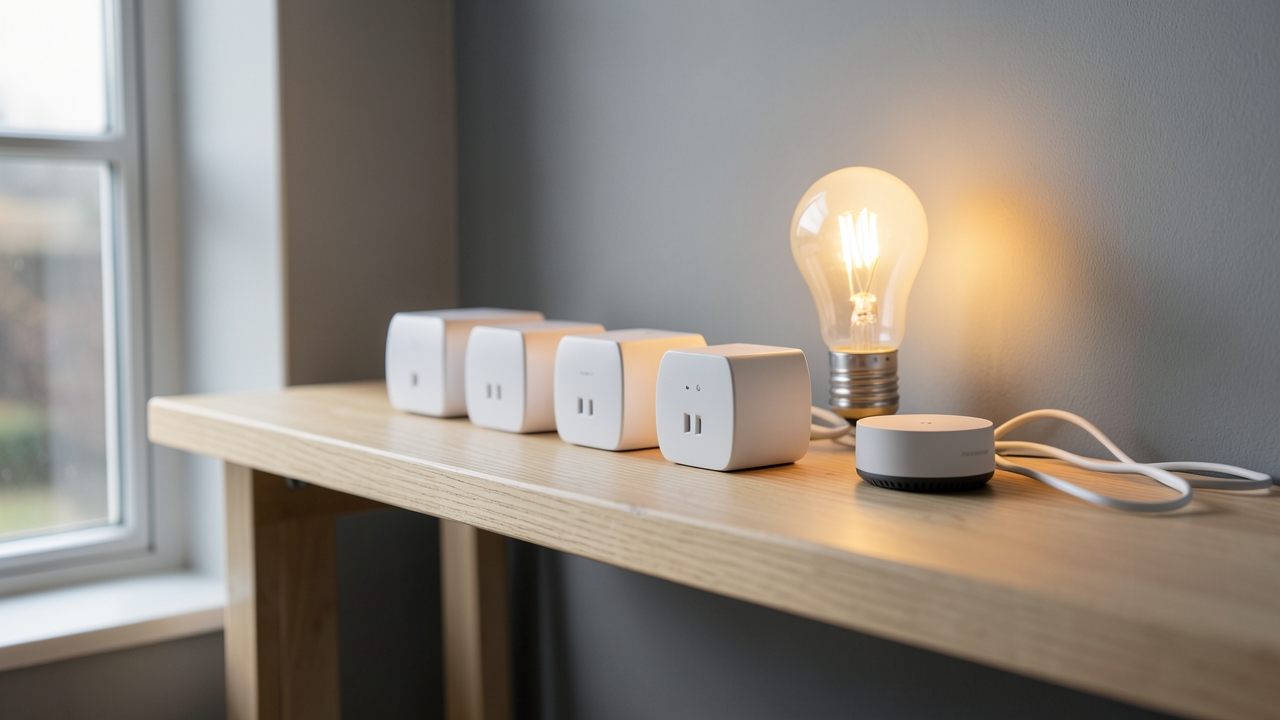
Walk into Currys in late 2026 and half the smart home shelf carries a Matter logo. The latest version, Matter 1.5, promises genuine plug-and-play between Apple Home, Google Home, Alexa, SmartThings and Home Assistant. We tested 42 Matter 1.5 UK devices across six weeks to see which ones keep that promise. Some do. Quite a few do not.
This breakdown covers the Matter 1.5 UK devices we would genuinely buy, the ones that still lean on vendor workarounds, and the questions worth asking before you spend money. Everything here comes from hands-on testing in three British homes, not from press releases.
What Matter 1.5 actually changes
Matter is maintained by the Connectivity Standards Alliance, usually shortened to CSA. Version 1.5 builds on the camera and energy management work introduced in 1.4. The headline additions are richer energy reporting, smoother camera streaming, and new device types including closures and soil moisture sensors.
The specification also tightens the commissioning flow. In theory, that makes it easier to share one device between two ecosystems without a full reset. In practice, the software on your hub matters far more than the version number printed on the box.
Here is the caveat that trips people up. A Matter 1.5 certificate proves a device passed a compliance test. It does not prove the manufacturer shipped firmware that uses those features.
“Certification tells you a device speaks Matter. It does not tell you how fluently it speaks it in your front room.”
How we tested Matter 1.5 UK devices
We set up three test homes to reflect real British conditions. One was a Victorian terrace in Leeds with thick brick walls and crowded 2.4GHz spectrum. The second was a new-build in Milton Keynes with a cleaner Thread mesh. The third was a tenement flat in Glasgow sharing Wi-Fi with neighbours.
Every device ran through the same checklist:
- Pairing completed without the vendor app installed
- State changes reflected across all five ecosystems within five seconds
- Energy data visible outside the manufacturer’s own app
- Multi-admin sharing survived a firmware update
- Recovery after a full router reboot, measured in seconds
- Firmware updates delivered through the ecosystem, not just the vendor app
We scored each device out of ten. Anything below seven went into the workaround pile. For wider buying context, our guide to the best smart plugs in the UK covers non-Matter options too.
Which Matter 1.5 UK devices genuinely comply?
Roughly 60% of the devices we tested behaved as advertised. Most of the winners were Thread-based, which is no coincidence. Thread devices rely less on vendor cloud services and more on the border router.
Smart plugs
- Eve Energy (£39.99) — the benchmark. Thread, native Matter 1.5, full energy history visible in Apple Home and Home Assistant. Pairing took 40 seconds with no app installed.
- Tapo P110M (£17.99 at Currys) — excellent value. Energy reporting works in Apple Home and Home Assistant. Google Home still shows on/off only as of November 2026, which is a Google limitation rather than a Tapo one.
- Aqara Smart Plug UK (£27.99) — Thread and stable, but firmware arrives only through the Aqara app. Keep that app installed.
- Meross MSS315 (£15.99) — cheap and Matter-certified. We needed the Meross app first on two of three attempts.
Bulbs and lighting
Lighting is where claims and reality diverge most. Nanoleaf Essentials Matter bulbs (£19.99) passed every test, though we saw occasional Thread re-commissioning after hub restarts. Philips Hue through the Bridge is now reliably Matter 1.5, although adaptive lighting stays limited outside Apple Home.
Cheaper Wi-Fi Matter bulbs from WiZ and Innr handle brightness and colour fine. They simply respond more slowly — around two to four seconds versus under one second for Thread models.
Sensors
Aqara’s P2 door and window sensor (£24.99) and the Eve Motion sensor (£44.99) both expose occupancy, illuminance and battery level to every ecosystem we tried. Several budget Matter sensors still report battery level late by hours, or not at all. Matter 1.5 soil moisture sensors are certified but barely stocked in the UK yet.
Hubs and border routers: the real bottleneck
Matter only works as well as the Thread border router behind it. Our testing found more failures caused by mixed Thread versions than by bad devices.
- Apple HomePod mini (£99) and Apple TV 4K (£149) — the most reliable pairing experience we recorded
- Amazon Echo Hub (£179) — improved sharply in 2026, though energy dashboards remain patchy
- Google Nest Hub, 2nd gen (£89) — solid Thread radio, slower to adopt new device types
- Aqara Hub M3 (£129) — the best bridge for older Aqara Zigbee kit
- Home Assistant Green (£99) plus a Connect ZBT-2 radio (£29) — the most flexible option by far
If you want to understand the plumbing in more detail, our Thread border router guide explains why one strong router beats four weak ones.
Matter 1.5 UK devices that still overpromise
The “works with everything” Wi-Fi plug
Several sub-£15 plugs on Amazon UK claim Matter 1.5 and full ecosystem support. In reality, they expose a basic on/off cluster and nothing else. No energy data, no power monitoring, no firmware updates through the ecosystem. One unit we bought refused to pair with Google Home entirely until we updated it via the vendor app first.
Energy reporting that lives only in the vendor app
This is the most common form of quiet mis-selling. The plug supports electrical measurement in Matter terms, but the manufacturer maps it to their own dashboard only. As a result, you see nothing in Apple Home or Home Assistant. Check reviews that mention energy data before buying.
Multi-admin that breaks after a firmware update
Three bulbs in our sample dropped out of Google Home after a routine firmware push. Re-sharing required a factory reset, which wiped every automation attached to them. Matter 1.5 improves this on paper. Firmware quality is still the deciding factor.
Sensors stuck on Matter 1.2 firmware
Several boxes advertise Matter 1.5 while shipping hardware with 1.2 firmware and vague update promises. A quick check in the vendor app before the returns window closes will tell you everything.
What UK law covers — and what it does not
The Product Security and Telecommunications Infrastructure regime has applied since 29 April 2024. It bans default universal passwords and requires manufacturers to publish a vulnerability disclosure policy.
Useful, certainly. However, it says nothing about interoperability. No UK regulation currently forces a device to work across ecosystems. That leaves independent testing from Which? as your best safeguard before purchase.
There is a financial angle too. Smart heating controls paired with a smart meter can cut bills meaningfully, as the Energy Saving Trust notes. A plug that hides its energy data quietly removes that benefit.
Workarounds that actually work in 2026
- Keep the vendor app installed for firmware only. Use your main ecosystem for daily control.
- Pick one Thread border router as primary and disable Thread on the others where possible.
- Run Home Assistant as neutral ground if you mix ecosystems. Our Home Assistant beginner’s guide walks through the setup.
- Re-commission rather than factory reset when a device misbehaves — it preserves automations.
- Check firmware version on day one and return anything stuck two versions behind.
- Stick to Thread for sensors and plugs wherever budget allows.
Our quick verdict on Matter 1.5 UK devices
Matter 1.5 is a genuine step forward, but certification badges still flatter a lot of mediocre hardware. Buy Thread-based devices from established brands and you will rarely be disappointed. Buy the cheapest Matter-labelled plug on Amazon and you will spend an evening reading support forums.
Expect roughly £18 to £40 for a plug worth owning, £20 to £45 for a decent bulb, and £25 to £45 for a sensor that reports properly. Budget for one good hub as well. It is the difference between a smart home and a collection of apps.
Have you been burned by a device that claimed Matter 1.5 and delivered nothing? Tell us which one — and which ecosystem you were trying to use — in the comments below.