
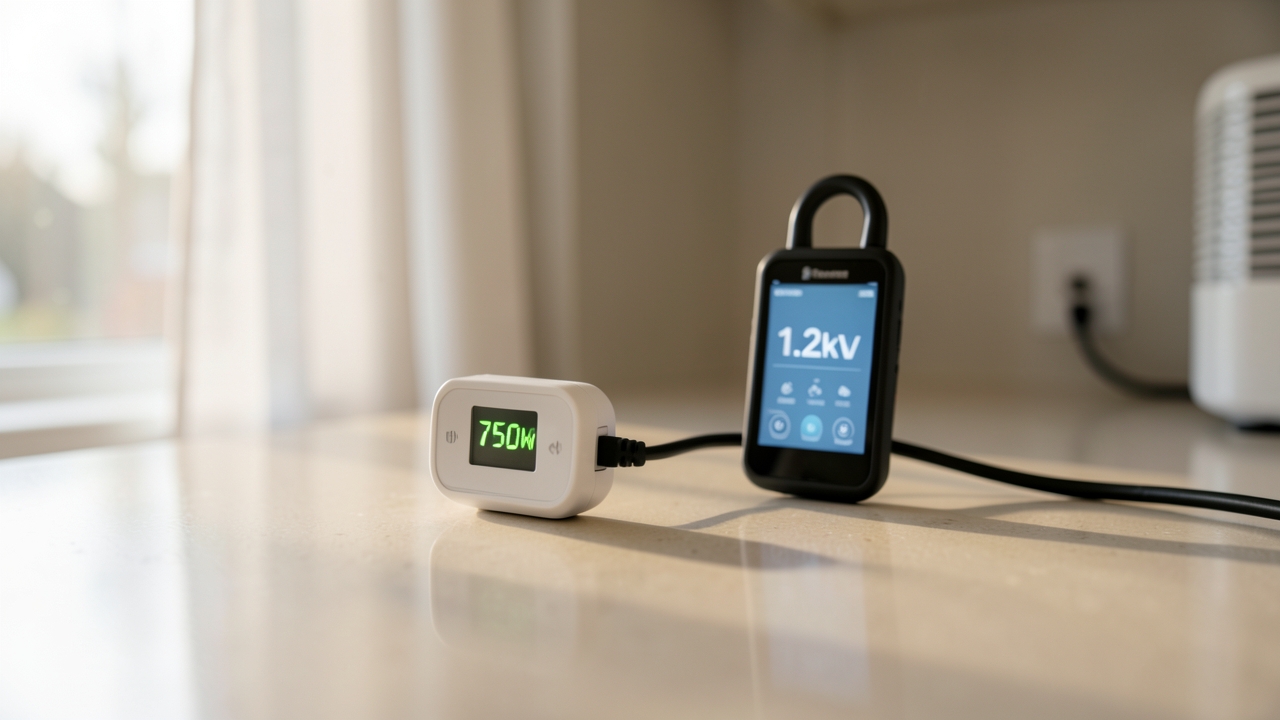
Choosing between a smart plug vs energy monitor is one of the most common questions we get from UK readers trying to shave money off their electricity bill. The two devices sit on the same shelf and both promise savings. However, they solve completely different problems. One measures a single appliance at the socket, while the other measures everything in the house through a clamp on your meter tails.
The short answer: they do completely different jobs
A metering smart plug tells you exactly what one appliance costs to run. A whole-home energy monitor tells you when the whole house is drawing power, and how much. Therefore, the plug answers “what is costing me money?” and the monitor answers “when am I spending?”
For most UK households in 2026, the smart plug delivers the faster payback. Meanwhile, whole-home monitoring is a diagnostic tool. It only earns its keep if you own solar panels, a battery, or an electric car on a time-of-use tariff.
How each device works in a UK home
Smart plugs with energy monitoring
A metering smart plug sits between the socket and the appliance. It records kWh, watts and run time, then pushes the data to an app. Prices in 2026 run from about £10 to £30. For example, a TP-Link Tapo P110 costs around £18, while a Shelly Plug S Gen3 is nearer £25.
Most are rated to 13A, which is roughly 2,990W. That suits TVs, dehumidifiers, fridges, freezers and desk setups. Check the rating before you use one with a tumble dryer or a fan heater, because some cheaper plugs are only rated to 10A.
Whole-home energy monitors
A whole-home monitor uses a current clamp around the live cable at your consumer unit or meter tails. It reports total consumption every few seconds. Prices start near £45 for a single-clamp Shelly EM kit and reach £200 for a multi-circuit Emporia Vue, plus £60–£120 for an electrician if you want it fitted inside the consumer unit.
Here is the catch. Almost every UK home with a smart meter already gets half-hourly data free through the supplier app or an in-home display. As a result, a paid monitor mostly buys speed and granularity, not genuinely new information.
A real 2026 UK household: the Hendersons in Reading
Let us use real numbers. A three-bedroom semi in Reading holds two adults, two children and a small electric car. Annual electricity use is 5,600 kWh, including 2,000 kWh for the car.
At the price cap running through the end of 2026, electricity sits at roughly 25p per kWh, with a standing charge near 62p a day. That gives an annual electricity bill of about £1,626, or £136 a month. Gas adds roughly £870 for 12,000 kWh of heating and hot water at about 6.3p per kWh.
Using free smart meter data plus a borrowed monitor, the family mapped their biggest loads. The figures below are annual, priced at 25p per kWh.
- Tumble dryer: 360 kWh, about £90
- Dehumidifier (winter only): 400 kWh, about £100
- Old chest freezer in the garage: 400 kWh, about £100
- Kitchen fridge-freezer: 320 kWh, about £80
- Standby and vampire loads: 250 kWh, about £63
- Cooking: 500 kWh, about £125
- Lighting: 180 kWh, about £45
- Electric car: 2,000 kWh, about £500 at the standard rate
Where a smart plug actually saves money
Killing standby without thinking about it
Standby is the easiest win. A games console in instant-on mode, plus a soundbar and a TV, can pull 20–25W continuously. That is 175–219 kWh a year, or £44–£55 at 25p. A £18 smart plug on a schedule cuts almost all of it, so payback lands in about five months.
Furthermore, the plug keeps working after you stop thinking about it. Automation beats willpower.
Proving which appliance is the problem
Numbers change behaviour faster than advice does. The Hendersons assumed their oven was the villain. The plug data showed the garage freezer drawing 400 kWh and frosting up badly. A new A-rated chest freezer uses about 150 kWh, saving £62 a year. The £18 plug effectively paid for itself in the first month of measurement.
Taming the dehumidifier and the dryer
Smart plugs with schedules or humidity triggers stop a dehumidifier running in an empty room. Cutting runtime by a quarter saves 100 kWh, or £25 a year. Similarly, seeing 360 kWh on the dryer app encouraged line drying for half the loads, saving another £45.
In total, three plugs costing under £60 unlocked roughly £130 of annual savings for this household. That is a payback period of around six months. The best smart plugs for UK homes all store historical kWh data, which matters here.
Where a whole-home monitor earns its keep
Hunting your baseload
Your baseload is the power drawn when nothing obvious is switched on. A typical UK home sits at 100–150W. A wasteful one sits at 300W, which is 2,628 kWh a year, or £657. Finding one 100W always-on device can save £219 a year, and a whole-home monitor finds it in an evening.
On the other hand, you can read your overnight baseload from an in-home display too. It is just clunkier. The monitor saves time, not money.
Time-shifting with an EV or a battery
Moving the car’s 2,000 kWh to an overnight EV tariff at 7.5p saves an impressive £350 a year. Again, that needs a smart meter and the right tariff, not a £60 clamp. The monitor only helps by confirming the charge actually happened inside the cheap window.
Solar owners get more from it. A monitor that separates import from export lets you time the dishwasher or immersion heater to the middle of the day. Our guide to balcony solar panels in the UK explains how small arrays change self-consumption patterns.
A monitor tells you the truth. A smart plug changes it.
Where neither device will cut your bill
This is the honest part. Roughly half of a typical UK dual-fuel bill is gas for heating and hot water, and neither device sees gas at all. Consequently, lowering your boiler flow temperature to 55°C or fitting a smart thermostat does far more for the total. The GOV.UK energy efficiency guidance covers the basics for free.
In addition, neither device touches the standing charge, which is about £226 a year for electricity alone and rising every cap period. Fridges, freezers and routers must run around the clock, so measuring them changes nothing unless you replace or relocate them.
Finally, data only works if someone acts on it. A monitor showing £136 a month with no plan attached is an expensive ornament. The Energy Saving Trust is a good starting point for the measures that pay back fastest.
Smart plug vs energy monitor: 2026 cost comparison
- Smart plug: £10–£30 each, typical first-year saving £60–£130 across two or three plugs
- Whole-home monitor: £45–£200 fitted, typical first-year saving £30–£80 from baseload finds
- Smart meter data: free, useful for baseload checks and tariff switching
- Payback: smart plug three to eight months, monitor twelve to thirty-six months
- Best for: plugs suit renters and curious tinkerers, monitors suit solar, battery and EV owners
Independent testing from Which? has consistently found that accuracy varies between cheap plugs, so buy one with a published tolerance of ±1% or better.
What we would actually buy in 2026
Start with the free smart meter data you already pay for. Then buy two metering plugs for the appliances you genuinely suspect, such as the dryer, the garage freezer or the dehumidifier. Leave them in place for a month before you decide anything.
Only add a whole-home monitor in three cases. You have solar or a battery and want export figures. Your baseload looks wrong and you cannot trace it with an in-home display. Or you are optimising an EV tariff. If charging costs are your focus, our EV charger installation cost guide sets out the 2026 figures.
Quick answers to common questions
Do smart plugs work with a smart meter?
Yes, and independently. The plug measures at the socket, the meter measures at the supply. They do not need to talk to each other, although some apps can combine both feeds.
Can I run a tumble dryer through a smart plug?
Usually yes, because a heat-pump dryer draws well under 1kW. A vented 2.5kW model is closer to the limit, so check the plug’s rating and never leave it unattended.
Is a whole-home monitor worth it if I already have an in-home display?
Rarely, unless you need second-by-second data for solar diversion or EV scheduling. For plain bill cutting, the display is enough.
Over to you
Both devices are cheap, honest tools, and neither is a silver bullet. For most UK homes in 2026, the smart plug wins on payback while the monitor wins on diagnosis. So which appliance in your house would you test first, and would you trust the app more than your own instincts? Tell us in the comments below.