
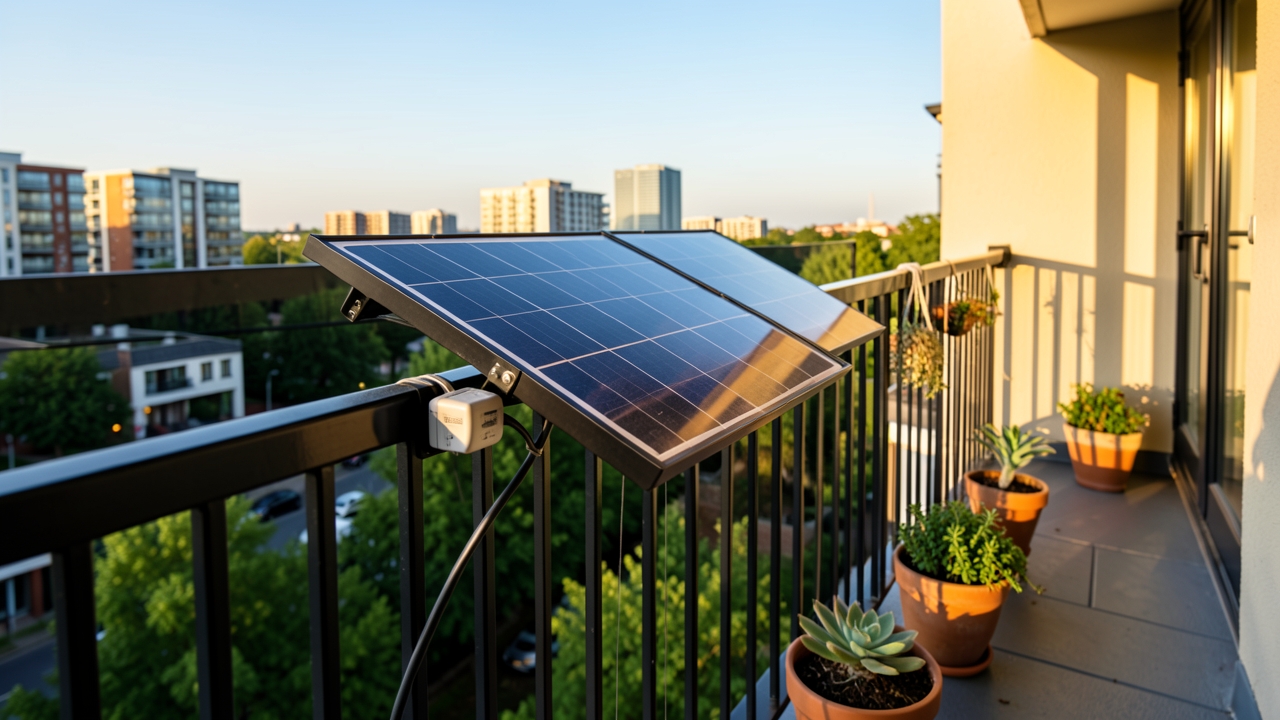
Renting a flat does not rule out generating your own electricity. A balcony solar panel UK renters can fit without drilling a single hole is now one of the fastest-growing micro-generation options in cities such as London, Manchester and Bristol. However, the real output depends almost entirely on which way your balcony faces. Meanwhile, the rules depend on your tenancy agreement, your freeholder and your local network operator.
This guide uses UK irradiance data to show what a 400W plug-in kit genuinely produces in 2026. In addition, it explains what landlords, leaseholders and insurers actually say about rail-mounted panels — and the payback you can realistically expect.
What is a plug-in balcony solar panel UK kit?
A plug-in solar kit is a compact system that connects to a normal 13A socket. Typically, it includes one or two 400W–450W panels, a micro-inverter and a mounting frame. You clamp it to a balcony rail, plug it in and start generating.
Consequently, installers are not required. There is no roof access, no scaffolding and no loft cable run. That is precisely why renters find them so attractive. If you want to compare hardware first, our guide to the best plug-in solar kits covers the main options on sale this year.
Real 2026 output: north, east, west and south balconies
Output is driven by irradiance — the amount of solar energy landing on the panel. A vertical panel on a balcony rail performs worse than a roof-mounted panel at 35°, because it faces the sky at a much shallower angle.
Annual generation from a single 400W panel
- South-facing balcony: roughly 240–280 kWh per year
- East-facing balcony: roughly 190–230 kWh per year, strongest before midday
- West-facing balcony: roughly 190–230 kWh per year, strongest in the afternoon
- North-facing balcony: roughly 90–130 kWh per year, from diffuse light only
Double those numbers for an 800W twin-panel kit. Therefore, an 800W south-facing setup should produce around 480–560 kWh a year in southern England. That falls to roughly 350–420 kWh in central Scotland.
Furthermore, balconies are shaded by overhangs, neighbouring blocks and the railings themselves. As a result, real-world figures are often 10–20% below the theoretical maximum.
Why orientation matters more than the brand of panel
The UK receives between roughly 900 and 1,150 kWh of solar energy per square metre each year, depending on latitude. However, a vertical panel only captures part of that, and the split varies hugely by direction.
South-facing panels benefit from the sun’s full arc across the day. East and west panels generate well for roughly half the day only. On the other hand, north-facing panels rely almost entirely on diffuse light bouncing off clouds and buildings.
A north-facing balcony can still generate electricity in the UK — just not enough to pay back a kit quickly.
For reference data on panel performance and siting, the Energy Saving Trust remains one of the most reliable UK sources.
Landlord rules and tenancy agreements
Most assured shorthold tenancies include a clause banning alterations without written consent. Hanging a panel on a balcony rail may count as an alteration, even though nothing is drilled into the building fabric.
What your tenancy agreement probably says
- Clauses banning fixtures, fittings or additions to the exterior
- Clauses requiring the property to be returned in its original condition
- Clauses about not obstructing communal areas, walkways or fire escapes
- Clauses limiting what can be stored on a balcony at all
Therefore, always ask your landlord in writing before you buy. Offer to add the kit to the inventory, and confirm in the same email that you will remove it at the end of the tenancy.
In addition, expect questions about wind loading. A 400W panel is roughly 1.7m by 1.1m, so it behaves like a sail on a gusty day. Consequently, approved rail clamps are far safer than a panel propped against a chair.
Freeholders, leasehold flats and cladding
If you own a leasehold flat rather than rent, your lease is the key document. Many leases prohibit anything that alters the external appearance of the building. Others ban items on balconies outright.
Furthermore, building safety rules introduced after Grenfell mean managing agents are cautious about anything fixed to a high-rise facade. On buildings with combustible cladding or a waking watch, expect a firm refusal.
You should also check whether your block has a balcony policy in its lease or house rules. If in doubt, email the managing agent and keep the reply on file.
Do you need planning permission?
Usually, no. Planning permission is rarely needed for solar panels on a dwelling, provided they do not protrude significantly and the building is not listed or in a conservation area. However, flats and maisonettes lose some permitted development rights.
As a result, leaseholders should confirm the position with the local planning authority before fitting anything permanent. A removable, rail-mounted kit is a much lower-risk option.
Costs, savings and payback in 2026
Prices have fallen again this year. A single-panel 400W plug-in kit with a micro-inverter now costs around £300–£450. A twin-panel 800W kit sits at roughly £500–£750, and balcony rail brackets add £45–£90.
Electricity under the Ofgem price cap has hovered around 25p–27p per kWh through 2026, according to Ofgem. Consequently, a 400W kit on a south-facing balcony saving 260 kWh a year is worth roughly £68 annually.
Realistic payback periods
- 400W, south-facing, £350 kit: about 5 years
- 400W, east or west-facing, £350 kit: about 6–7 years
- 400W, north-facing, £350 kit: 11 years or more
- 800W, south-facing, £650 kit: about 4–5 years
However, those figures assume you use every kilowatt hour yourself. Without storage, exported electricity earns you nothing, because plug-in kits are not MCS certified and cannot claim Smart Export Guarantee payments.
Therefore, run the dishwasher, washing machine or tumble dryer during daylight hours. In addition, a smart plug with energy monitoring will show you exactly when the panels are producing most.
Adding a small home battery would raise self-consumption. Nevertheless, it pushes payback out to eight years or more, which rarely makes sense for a renter.
How to mount a balcony solar panel UK renters can remove
Removability is the single most important design decision in a rented flat. The goal is zero permanent change to the building.
- Use rail-clamp brackets with rubber pads — no drilling
- Angle the panel at 70–90° to reduce wind loading
- Secure cables with UV-resistant clips and never trap them in a door
- Route the cable through a window seal gap rather than a wall
- Check the panel weight against your balcony’s stated load limit
On the other hand, never rest a loose panel on furniture. UK gales regularly lift unsecured objects off balconies, and a falling panel is a serious safety risk.
Do you need to tell your DNO or insurer?
Yes, in most cases you should notify your Distribution Network Operator. Under the G98 connection process, generators up to 16A per phase must inform the network operator. An 800W kit draws only about 3.5A, so the process is straightforward and free — but it is still a notification.
Furthermore, tell your contents insurer. Some policies cover portable solar equipment, while others exclude it. Consequently, a short phone call avoids a rejected claim later.
Is a balcony solar panel worth it for renters in 2026?
For a south, east or west-facing balcony, yes — provided you get consent and use the power during the day. Payback of four to seven years is reasonable for a device you can unplug and take to your next flat. Our wider guide to balcony solar panels covers kit sizing in more detail.
For a north-facing balcony, however, the numbers are weak. A £350 kit will take more than a decade to repay. In that case, an energy monitor and a switch to a cheaper tariff may save you more.
As of autumn 2026, government and BSI work on a dedicated plug-in solar standard is still ongoing. Once that lands, expect clearer rules for renters and simpler approval from landlords.
Have you asked your landlord about fitting a balcony solar panel yet — and what did they say? Share your experience in the comments below.