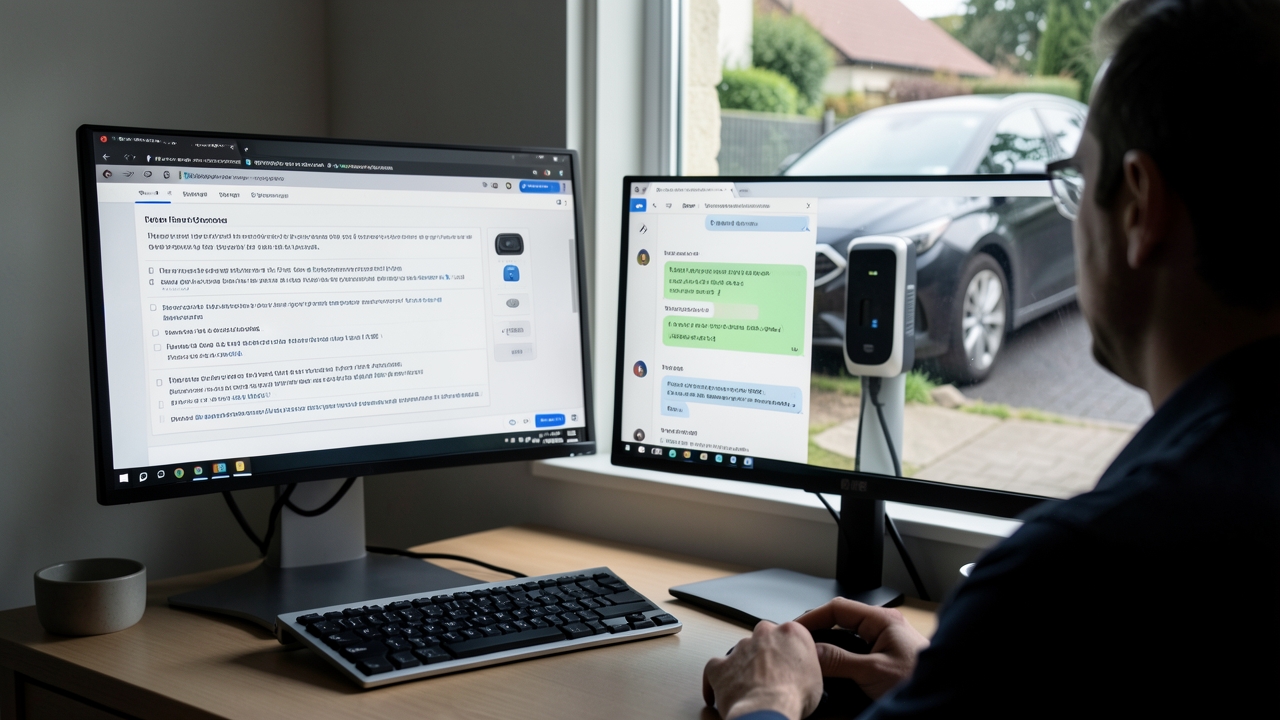
In the fast-evolving world of home electric vehicle (EV) charging, getting the details right is crucial. From power ratings in kilowatts (kW) to specific safety certifications, accuracy matters. As we move through 2026, many UK content creators and retailers are asking: can British English AI tools reliably generate the precise, locally-flavoured text needed for EV charger specifications and reviews? We put three leading platforms—ChatGPT, Jasper, and Copy.ai—through a rigorous series of tests to find out.
Why British English Accuracy Matters for EV Charger Content
It’s not just about spelling “colour” instead of “color”. For EV charger specifications, AI must grasp UK-specific terminology, regulatory frameworks, and consumer expectations. A charger description that references the wrong wiring regulations or uses American voltage terms would be immediately unhelpful and potentially dangerous for a UK audience.
Furthermore, compliance is non-negotiable. Content must align with the latest government guidelines for residential charging points and reference correct standards like BS 7671. An AI tool that consistently uses US-centric terms like “electrical outlet” instead of “socket” or “power outlet” simply won’t suffice.
Our Testing Methodology for British English AI Tools
We designed three specific prompts to evaluate each AI’s performance:
- Prompt 1 (Specification Sheet): “Generate a detailed technical specification sheet for a 7.4kW home EV charger, suitable for a UK property. Include details on connection type, cable length, and safety certifications.”
- Prompt 2 (Review Snippet): “Write a 100-word product review for a solar-compatible EV charger, focusing on its benefits for UK homeowners with solar panels.”
- Prompt 3 (Compliance Query): “Explain the UK Smart Charging regulations (from April 2022) and how a new smart EV charger complies with them.”
We then graded the outputs on a simple scale: spelling/grammar accuracy, correct UK terminology, factual compliance, and overall naturalness for a British reader. Let’s see how they performed.
ChatGPT: The Knowledgeable Generalist
ChatGPT performed consistently well across all three prompts. Its knowledge base is extensive, and it correctly used terms like “Type 2 connector,” “Commando socket,” and referenced the OLEV (Office for Zero Emission Vehicles) grant. The generated specification sheet included accurate points about tethered cables and the importance of a dedicated circuit.
Strengths & Weaknesses
Strengths: Strong factual accuracy and excellent grasp of UK electrical terminology. It naturally incorporated phrases like “meter box” and “consumer unit” rather than American equivalents.
Weaknesses: The language, while correct, could sometimes sound slightly clinical or textbook-like. For example, it might describe a feature as “beneficial for energy bill reduction” rather than the more conversational “great for keeping your energy bills down.” It occasionally needed a nudge to add more engaging, consumer-facing flair.
Jasper: The Creative Powerhouse with a Learning Curve
Jasper excelled at the product review prompt. It generated vibrant, persuasive copy that highlighted benefits like “future-proofing your home” and “optimising your solar self-consumption.” Its tone was perfectly pitched for a UK marketing audience. However, for the pure technical specification and compliance prompts, it required more specific guidance.
Strengths & Weaknesses
Strengths: Unmatched for engaging, benefit-driven content. It readily adopts brand voices and creates compelling narratives around UK-specific scenarios, like pairing with balcony solar panels for energy independence.
Weaknesses: Without careful prompting, it could sometimes generate plausible-sounding but inaccurate regulatory details. For instance, it initially described the Smart Charging regulations as “mandating off-peak charging,” which is an oversimplification. It needed correction to reflect the nuance of enabling smart capabilities rather than forcing a schedule. This highlights the need for human oversight on compliance topics.
Copy.ai: The Efficient Template-Filler
Copy.ai approached the task efficiently, particularly with structured data. It quickly produced clean, well-organised specification lists. Its understanding of British spelling was perfect. However, it demonstrated less depth when asked to explain complex, evolving regulations.
Strengths & Weaknesses
Strengths: Excellent for generating consistent, templated content like feature lists or comparison tables. It reliably outputs content with correct British English spelling and common UK terms.
Weaknesses: Its response to the compliance query was more generic, mentioning “following local standards” without detailing the specifics of the UK Smart Charging mandate. Consequently, it felt less authoritative on niche, regulation-heavy topics than ChatGPT.
UK Compliance and Local Terminology: The Deciding Factor
The biggest differentiator was how each tool handled UK-specific compliance and jargon. A successful output should correctly mention:
- The necessity of a Mode 3 charging cable for home installations.
- The requirement for an IP65-rated enclosure for outdoor chargers.
- The availability of the EV Chargepoint Grant (successor to the original OLEV grant).
- The use of a 3-pin plug only for emergency, occasional charging, not as a permanent solution.
ChatGPT led in this area, consistently referencing these points. Jasper could be guided to include them with the right prompts. For deep technical accuracy, cross-referencing with the Energy Saving Trust or manufacturer datasheets remained essential.
Practical Advice: Using AI for UK EV Content in 2026
These tools are powerful assistants, not replacements for expert knowledge. Here’s how to use them effectively for EV charger content:
1. Seed the Prompt with UK Context: Always start by stating, “You are writing for a UK audience.” Specify the desired tone (technical, conversational, etc.).
2. Verify All Claims: Treat AI output as a first draft. Fact-check every price, regulation, and technical detail against official sources or product manuals.
3. Use the Right Tool for the Job: For specifications, use ChatGPT or Copy.ai. For engaging reviews, try Jasper. For explaining regulations, rely on ChatGPT but verify meticulously.
Remember, the best EV charger buying guides blend accurate AI-generated drafts with genuine expert insight and real-world testing.
Final Verdict: Capable, With Human Oversight
In 2026, British English AI tools are remarkably capable of generating the core content for EV charger specifications. They handle spelling and common terminology well. However, for the nuanced, regulation-specific details that UK consumers depend on, human expertise remains vital. The AI can handle the heavy lifting of drafting, but a knowledgeable editor must ensure compliance, accuracy, and that natural, trustworthy British voice.
What’s been your experience using AI for technical UK content? Have you found similar strengths or pitfalls? Share your thoughts in the comments below.