
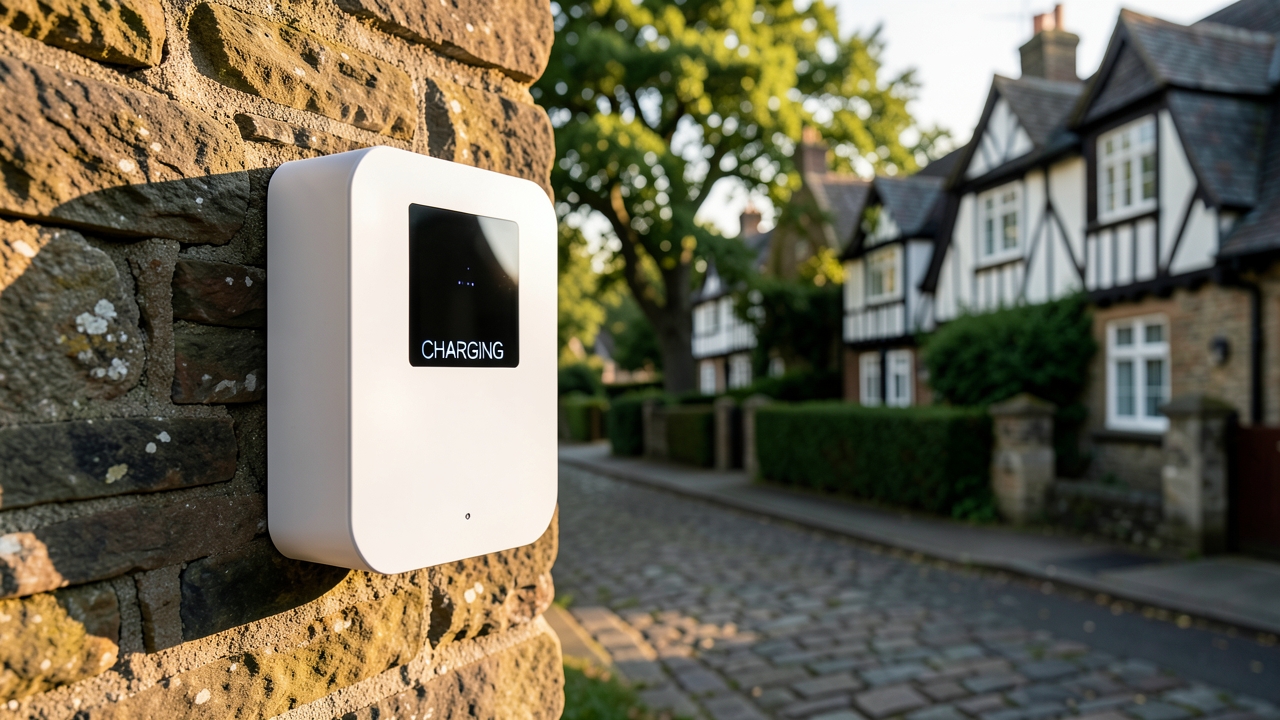
Living in a conservation area or owning a listed building in the UK does not mean you have to give up on electric vehicle charging. However, the process of installing a conservation area EV charger comes with unique planning rules and restrictions that you must navigate carefully. In this guide, we explore the specific permissions you need, the challenges involved, and the alternative charging solutions available for heritage properties in 2026.
As of 2026, there are over 6.8 million vehicles registered in the UK, and electric vehicle registrations continue to climb rapidly. The government’s commitment to ending the sale of new pure petrol and diesel cars by 2035 means more homeowners than ever need home charging solutions. But for the estimated 500,000+ properties within English conservation areas and the roughly 500,000 listed buildings across the UK, the journey to EV ownership is not quite as straightforward.
Understanding Conservation Areas and Listed Buildings
Before diving into the specifics of conservation area EV charger installation, it helps to understand what these designations actually mean.
What Is a Conservation Area?
A conservation area is a zone designated by the local planning authority because it has special architectural or historic interest. There are approximately 10,000 conservation areas across England alone. Living within one does not mean you cannot make changes to your property. However, it does mean that any alterations — including the installation of a wallbox charger — may require planning permission.
What Is a Listed Building?
A listed building is one that has been placed on the National Heritage List for England (NHLE) because of its special architectural or historic interest. Listed buildings fall into three grades:
- Grade I — buildings of exceptional interest (roughly 2% of all listed buildings)
- Grade II* — particularly important buildings of more than special interest (roughly 5.8%)
- Grade II — buildings of special interest, warranting every effort to preserve them (roughly 91.6%)
Furthermore, if your property is both listed and located within a conservation area, you face a double layer of regulatory oversight.
Why Installing a Conservation Area EV Charger Is Different
For most homeowners in the UK, installing a home EV charger is relatively straightforward. The Permitted Development rights introduced in 2015 allowed certain electrical installations to proceed without planning permission. However, these rights are significantly restricted — or removed entirely — in conservation areas and for listed buildings.
Here is what makes the process more complex:
- Permitted Development restrictions: In conservation areas, Permitted Development rights are narrower. You typically cannot install external equipment on a side or rear elevation that faces a highway. Front elevations are almost always restricted.
- Listed Building Consent: If your property is listed, any work that affects its character — including drilling into walls, running cables externally, or mounting a charger — requires Listed Building Consent. This is separate from and in addition to planning permission.
- Material considerations: Local planning authorities assess how visible the charger will be, what materials and colours are used, and whether the installation affects the streetscape.
Consequently, ignoring these rules can result in enforcement action, fines, and even a legal requirement to reverse the installation at your own expense.
Planning Permission for a Conservation Area EV Charger
In most cases, you will need to apply for planning permission before installing an EV charger in a conservation area. Here is what to expect in 2026:
The Application Process
You will submit a planning application to your local planning authority. The standard fee for a householder planning application in England is currently £258 (as of 2025-26). However, fees may be updated annually, so check the Planning Portal for the latest charges.
Your application should include:
- A site plan showing your property and the proposed charger location
- Elevational drawings showing the charger mounted on the wall
- Photographs of the existing property and surrounding area
- A brief written description of the proposed installation
- Details of the charger model, colour, and dimensions
What Planning Authorities Consider
Local authorities will evaluate several factors. For example, they will assess whether the charger is visible from the public highway, whether the installation preserves the character of the conservation area, and whether there are less harmful alternatives. On the other hand, planning officers may take a sympathetic approach if you propose a discreet, well-designed charger that blends with the building.
Furthermore, the National Planning Policy Framework (NPPF) recognises the importance of supporting EV infrastructure. Planning authorities must balance heritage protection against the need to encourage sustainable transport. This means that, in many cases, a well-considered application can still succeed.
Listed Building Consent
If your property is listed, you also need Listed Building Consent. There is no fee for this application. However, the process is often more rigorous than standard planning permission. You will likely need to demonstrate that the installation does not harm the special interest of the building. In some cases, a heritage consultant or conservation architect may need to prepare a heritage impact assessment.
As a result, the total time from application to decision can be several weeks or even months. Therefore, plan well in advance, especially if you have already ordered an electric vehicle.
Alternative EV Charging Solutions for Heritage Properties
What happens if your planning application is refused, or you simply want to avoid the hassle? Fortunately, several alternative approaches exist for charging an EV at a conservation area property.
1. Tethered or Untethered Driveway Chargers (Discreet Models)
Some EV chargers are designed with heritage sensitivity in mind. Compact, low-profile units in neutral colours can be far less visually intrusive than standard wallboxes. Brands like Zappi, Ohme, and GivEnergy offer units that can be positioned discreetly. Prices for these units typically range from £800 to £1,400, excluding installation.
Additionally, placing the charger on a side or rear wall — where it is less visible from the street — may make planning approval more likely. For more information on choosing a suitable charger, see our guide on the best EV chargers for UK homes in 2026.
2. Garage-Based Charging
If your property has a garage, installing the charger inside can eliminate external visual impact entirely. In this scenario, the charger is hidden from public view. However, you may still need building regulations approval for the electrical installation, and Listed Building Consent could still apply if internal changes are involved.
3. Ground-Mounted or Bollard Chargers
A ground-mounted charging post or bollard can avoid the need to drill into the building at all. These sit on the driveway surface and connect to your home’s electrical supply underground. However, they may still require planning permission in a conservation area, as they alter the appearance of the curtilage.
4. Portable EV Chargers (Granny Chargers)
A portable or “granny” charger plugs into a standard 3-pin household socket. This is the least visually permanent option. You simply run a cable through a window or door when needed. Charging speeds are slower — typically around 2.3 kW — but for overnight charging, this can still add 40-50 miles of range over eight hours.
However, note that you should use a dedicated, protected circuit for regular EV charging, and a standard domestic socket is not ideal for prolonged high-current use. In addition, this approach is not practical if you need faster charging speeds.
5. Public Charging Networks
The UK’s public charging network is expanding rapidly. As of early 2026, there are over 73,000 public charge points across the UK. Many conservation areas, particularly in towns and cities, have on-street charging points nearby. For more on this option, read our article on EV charging costs across the UK in 2026.
How Much Does a Conservation Area EV Charger Installation Cost?
The total cost depends on several factors, including the charger model, installation complexity, and any planning application fees.
Here is a rough breakdown for 2026:
- Standard wallbox charger (7kW): £800 – £1,400
- Installation labour: £300 – £800
- Planning permission application: £258 (householder)
- Listed Building Consent: Free
- Heritage impact assessment (if required): £300 – £1,000+
- Upgraded electrical supply (if needed): £500 – £2,000+
Therefore, a homeowner in a conservation area could pay between £1,500 and £5,000+ for the complete process, depending on complexity. Meanwhile, homeowners outside conservation areas typically spend between £1,000 and £2,000 in total.
It is also worth noting that the Electric Vehicle Homecharge Scheme (EVHS) still provides up to £350 towards the cost of a home charger installation for eligible applicants in 2026. However, this grant requires you to install an OZEV-approved charger, and the scheme rules do not override planning requirements.
Tips for a Successful Planning Application
If you decide to go ahead with a formal application for a conservation area EV charger, these tips can improve your chances of approval:
- Choose a discreet charger: Opt for a compact unit in a colour that matches or complements your property’s exterior.
- Position it carefully: Side or rear elevations are less contentious than the front of the house.
- Minimise cable runs: External cables are visually intrusive. Discuss options with your electrician to route cables internally where possible.
- Consult the conservation officer early: Many local authorities have a dedicated conservation officer. Contact them before submitting a formal application for informal advice.
- Use a qualified installer: Ensure your installer is certified (e.g., OZEV-approved, NAPIT, or Part P registered). This demonstrates professionalism in your application.
- Include a cover letter: Explain why the charger is necessary, how you have considered visual impact, and how the installation supports the UK’s net-zero goals.
The Bigger Picture: EV Charging and Heritage Preservation
The UK faces a genuine tension between preserving its architectural heritage and embracing the clean energy transition. However, these two goals do not have to be mutually exclusive. In fact, many heritage organisations, including Historic England, acknowledge that sustainable technologies can be integrated into historic properties sensitively.
As a result, planning authorities are becoming more experienced in assessing EV charger applications. Many councils now have published guidance on installing EV chargers in conservation areas. For example, some have pre-approved charger models or suggest specific mounting methods that minimise visual harm.
Furthermore, the technology itself is improving. Newer chargers are smaller, quieter, and available in a wider range of finishes. Some manufacturers now offer heritage-friendly designs specifically developed for sensitive locations.
Consequently, the outlook for homeowners in conservation areas is more positive than it was even a few years ago. The key is to engage with the planning process rather than avoid it.
Frequently Asked Questions
Do I always need planning permission for an EV charger in a conservation area?
In most cases, yes. Permitted Development rights are significantly restricted in conservation areas. While some minor works may still qualify, mounting an EV charger on an external wall almost always requires planning permission. Contact your local planning authority to confirm.
Can I install a charger inside my listed building without consent?
Minor internal works that do not affect the character of the building may not require Listed Building Consent. However, if the installation involves altering fabric, running new wiring through historic walls, or modifying original features, you should apply for consent. When in doubt, consult the conservation officer.
What happens if I install a charger without permission?
Installing an EV charger without the required permissions in a conservation area or on a listed building is a breach of planning law. The local authority can serve an enforcement notice, which may require you to remove the charger and restore the property. In serious cases, prosecution can result in unlimited fines.
How long does the planning process take?
Standard householder applications should be decided within eight weeks. However, applications involving listed buildings or conservation areas may take longer, particularly if consultation with external bodies (such as Historic England) is needed.
Final Thoughts
Owning a property in a conservation area or a listed building should not prevent you from embracing electric vehicle ownership. However, it does mean you need to take extra steps to ensure your installation complies with UK planning law. By understanding the rules, choosing a discreet charger, and engaging proactively with your local planning authority, you can find a solution that works for both your vehicle and your heritage property.
Are you living in a conservation area and considering an EV charger installation? Have you already gone through the planning process? Share your experience in the comments below — we would love to hear how you got on.
EV Charger Cost Calculator
Estimate your installation cost and annual charging bill — free, no sign-up.