Imagine your electric vehicle charging itself during the cheapest electricity hours, seamlessly communicating with your solar panels, battery storage, and smart home ecosystem. That is the promise of Matter protocol EV charging in the UK. As the smart home standard matures in 2026, Matter is making it easier than ever to connect your EV charger to virtually any smart home hub, regardless of brand.
In this comprehensive guide, we explore how the Matter standard enables interoperability between EV chargers and smart home systems across UK homes. We cover compatible chargers, UK grid requirements, smart charging tariffs, and practical setup steps you can follow today.
What Is the Matter Protocol?
Matter is a universal smart home connectivity standard developed by the Connectivity Standards Alliance (CSA). It launched in October 2022 and has since grown rapidly. The protocol creates a shared language that lets devices from different manufacturers communicate with one another.
For example, a Matter-certified EV charger can work with Apple HomeKit, Google Home, Amazon Alexa, and Samsung SmartThings simultaneously. You no longer need to worry about whether your charger brand supports your preferred smart home platform.
Matter operates over three core networking technologies: Wi-Fi, Ethernet, and Thread. Thread is particularly significant for smart homes because it creates a low-power mesh network. Devices relay signals to one another, which strengthens coverage throughout your property. In larger UK homes with thick stone or brick walls, Thread can prove far more reliable than a single Wi-Fi connection.
Why Matter Protocol EV Charging Matters for UK Homeowners
The UK government introduced the Electric Vehicles (Smart Charge Points) Regulations 2021, which require all newly installed private EV charge points to include smart functionality. This means your charger must be capable of scheduling, communicating with your energy provider, and responding to grid signals.
Matter protocol EV charging aligns perfectly with these requirements. It provides a standardised, secure framework for all those smart functions. Furthermore, it ensures that your charger remains compatible even if you switch smart home ecosystems or energy providers in the future.
Additionally, interoperability matters enormously for long-term value. Proprietary ecosystems can lock you into a single manufacturer. Matter eliminates that risk by keeping your options open.
How Matter Protocol EV Charging Works in Practice
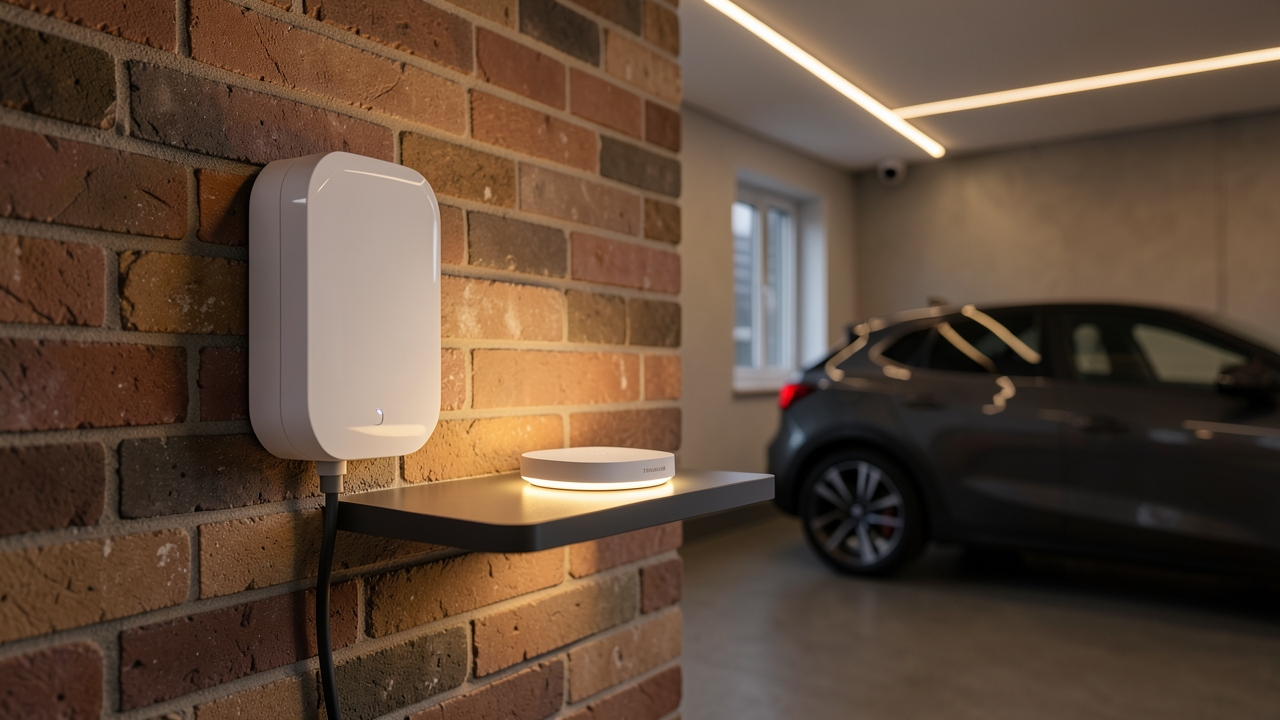
At its core, Matter protocol EV charging involves three key components working together. Your EV charger communicates with a Matter-compatible smart home hub or controller. That hub then connects to your broader smart home network. Meanwhile, cloud services handle remote access and advanced automations.
The Thread Network and Your EV Charger
Many Matter-certified devices, including newer EV chargers, support Thread as their primary communication method. Thread creates a resilient mesh network across your home. Each Thread device acts as a node, relaying data to other nodes.
Consequently, even if your EV charger sits in a detached garage at the far end of your property, Thread devices can relay the signal back to your central hub. You typically need a Thread border router, which is built into many modern smart home hubs and speakers such as the Apple TV 4K, Google Nest Hub (2nd gen), and Amazon Echo 4th generation.
Energy Management Features
Matter 1.3, released in May 2024, introduced formal support for Electric Vehicle Supply Equipment (EVSE). This specification includes several critical energy management features:
- Scheduled charging based on time-of-use tariffs
- Real-time energy consumption monitoring
- Vehicle state-of-charge reporting
- Demand response capabilities for grid balancing
- Load management to prevent household circuit overload
These features mean your charger can automatically charge your EV during off-peak hours when electricity costs as little as 7p per kWh on certain tariffs. Meanwhile, it avoids drawing power during peak demand periods, which helps stabilise the national grid.
UK EV Chargers Compatible with Matter
The Matter ecosystem for EV chargers is expanding steadily in 2026. While not every UK charger supports Matter yet, several leading manufacturers have committed to the standard or already released Matter-certified models. Here is an overview of notable options:
Zappi V2 by myenergi remains one of the most popular solar-integrated EV chargers in the UK, priced from approximately £599 for the unit alone or around £1,100\u2013£1,400 fully installed. myenergi has been an active participant in the CSA, and Matter compatibility is a key part of their roadmap for seamless smart home integration.
Wallbox Pulsar Plus offers compact design and robust app integration, with units priced from around £500\u2013£650. Wallbox has been a leading advocate for open standards and has announced Matter support for its latest hardware iterations.
Ohme ePod is a smart-only charger with no manual controls, relying entirely on app and smart home connectivity. Priced from approximately £500\u2013£600 for the unit, Ohme has focused heavily on dynamic tariff integration and is aligning its platform with Matter-compatible ecosystems.
Hypervolt Home 3 Pro combines fast charging at up to 22kW with a sleek design, with units from around £550. Hypervolt has indicated that its newer firmware builds support Matter-based automations through certified hub partnerships.
For a deeper look at the best options available, explore our guide to the best EV chargers in the UK for 2026.
UK Grid Requirements and Smart Charging Regulations
The UK electricity grid operates at 230V on a single-phase supply for most homes. This limits standard home EV charging to 7.4kW, which adds roughly 30 miles of range per hour of charging. Three-phase properties can support up to 22kW, though these are less common in residential settings.
The UK\u2019s smart charge point regulations impose several technical requirements. Your charger must include:
- Pre-set charging schedules as a default behaviour
- The ability to respond to signals from your energy provider
- Minimum 9\u2500hour delay start capability
- A mechanism to prevent charging during peak grid hours unless overridden by the user
- Data security and privacy protections
Matter protocol EV charging fulfils all of these requirements natively. Its encrypted communication layer provides the security the regulations demand. Furthermore, its energy management cluster allows schedulers and grid operators to communicate with your charger through standardised APIs.
You can find more details on government requirements via the GOV.UK EV charging guidance.
Setting Up Matter Protocol EV Charging at Home
Setting up Matter protocol EV charging in your UK home is surprisingly straightforward. Follow these four steps for a smooth installation.
Step 1: Check Your Charger Compatibility
First, verify that your EV charger supports Matter. Check the manufacturer\u2019s website or product documentation for the Matter logo and certification details. If your current charger does not support Matter, you may be able to update its firmware. Alternatively, consider upgrading to a Matter-certified model.
Step 2: Choose a Matter-Compatible Smart Hub
You need a central hub or controller that supports the Matter standard. Popular options in the UK include:
- Apple HomePod Mini or Apple TV 4K \u2014 ideal for Apple HomeKit users, priced from £99
- Google Nest Hub (2nd gen)
- Amazon Echo 4th gen \u2014 suits Alexa-based setups, from £89
- Samsung SmartThings Hub \u2014 versatile multi-protocol support, from £129
- Home Assistant with a Thread border router \u2014 the most customisable option for advanced users
If you already run a smart home system, chances are your existing hub supports Matter or can be updated to support it. Meanwhile, Home Assistant users can add Thread support through a relatively inexpensive USB dongle.
Step 3: Connect and Automate
Pairing your charger with a Matter hub involves scanning a QR code on the device or entering a setup code. Once paired, the charger appears in your smart home app alongside your other devices.
From there, you can create automations. For example, you might set your charger to begin charging at 11:30pm when Octopus Energy\u2019s Intelligent Go tariff drops to its lowest rate. Alternatively, you could link it to your solar panel output so it only charges when surplus energy is available.
For inspiration on broader automations, check our complete smart home automation guide.
Step 4: Select a Smart Tariff
A Matter-connected charger truly shines when paired with a time-of-use electricity tariff. Several UK energy providers offer excellent EV-specific tariffs in 2026:
- Octopus Intelligent Go \u2014 7p/kWh off-peak rate for up to eight hours nightly
- EDF EV Tariff \u2014 competitive off-peak rates with smart charging integration
- British Gas EV Tariff \u2014 fixed-rate EV charging windows
- Octopus Agile \u2014 half-hourly dynamic pricing that Matter-enabled chargers can respond to in real time
As a result, your Matter-connected charger can automatically select the cheapest charging windows without any manual intervention. On Agile tariffs, electricity prices can even go negative on windy nights, meaning you effectively get paid to charge your car.
Benefits of Matter Protocol EV Charging
Adopting Matter protocol EV charging offers several compelling advantages for UK homeowners:
- Future-proofing \u2014 Matter is backed by over 600 companies, ensuring long-term support and development
- Interoperability \u2014 your charger works across all major smart home platforms
- Security \u2014 Matter uses AES-128 encryption and distributed authentication for robust device security
- Simplified setup \u2014 a single standard means no more wrestling with incompatible apps and protocols
- Cost savings \u2014 automated scheduling on smart tariffs can save UK EV owners £300\u2013£500 per year compared to flat-rate charging
- Grid support \u2014 demand response features help balance the UK grid during periods of high demand
Furthermore, Matter\u2019s local control capability means your automations work even if your internet connection drops. Unlike purely cloud-dependent solutions, Matter processes critical commands locally through your hub.
Challenges and Considerations
Although the outlook is promising, Matter protocol EV charging does come with some challenges worth noting.
Limited charger availability. Not every UK charger currently carries Matter certification. However, the number of certified devices grows with each specification update. By late 2026, most major manufacturers are expected to offer Matter-compatible models.
Thread border router requirements. If your home lacks Thread coverage, you may need to purchase additional border routers. These typically cost between £30 and £100, so the investment is modest.
Professional installation. In the UK, you should always use a qualified, OZEV-registered installer for your EV charger. The Matter pairing process is simple, but the electrical installation itself must comply with BS 7671 wiring regulations and Part P of the Building Regulations.
Household electrical capacity. A 7kW EV charger draws approximately 30 amps. If your household supply or consumer unit is already heavily loaded, you may need an upgraded supply. This can cost between £500 and £1,500 depending on your Distribution Network Operator\u2019s requirements.