
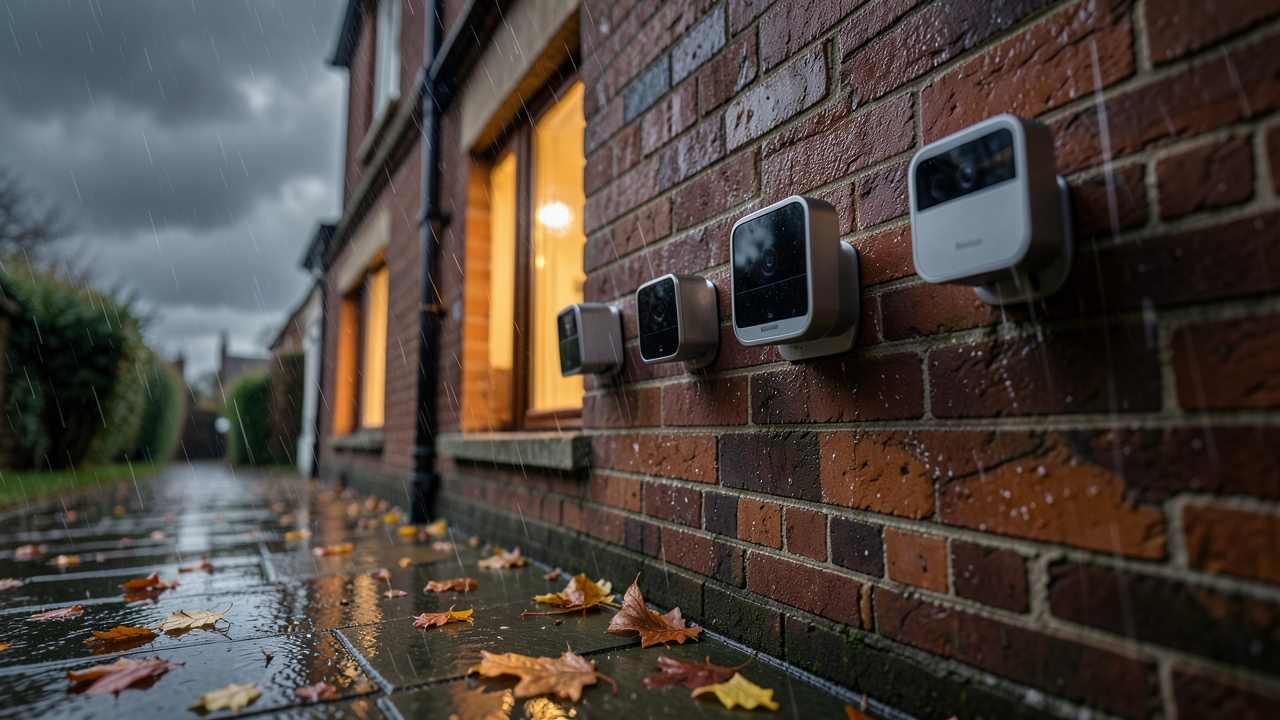
Choosing a smart doorbell UK weather can genuinely survive is harder than the marketing suggests. Between November 2025 and March 2026, we mounted four of Britain’s most popular video doorbells on the same west-facing brick wall in Greater Manchester.
That wall takes the full force of Atlantic rain, overnight fog and hard frost. Over 18 weeks we logged 112 days of testing, 63 frosty mornings and four named storms.
Here is exactly how Ring, Eufy, Arlo and Hive coped, and which one we would fit to our own front door.
How We Tested Smart Doorbells in Real British Weather
Every doorbell ran on the same 2.4 GHz Wi-Fi network at roughly -52 dBm signal strength. We used identical motion zones, recording schedules and notification settings.
As a result, differences in performance came down to hardware, software and weather sealing. Nothing else.
These are the four models we tested, with prices checked in September 2026:
- Ring Battery Doorbell Pro — £199.99
- Eufy Video Doorbell E340 — £179.99
- Arlo Essential Video Doorbell Wire-Free — £169.99
- Hive Video Doorbell — £149.99
IP Ratings Explained: What IP65 and IP66 Really Mean
An IP rating uses two digits. The first covers dust and solid objects, while the second covers water. For a UK front door, the second digit matters most.
- IP44 — splash resistant, fine under a deep porch but not on an exposed wall
- IP65 — dust tight and protected against low-pressure water jets
- IP66 — protected against powerful water jets and heavy driving rain
- IP67 and IP68 — protected against temporary or continuous immersion
All four doorbells carry IP65 or better. Therefore, none failed completely. However, real-world sealing quality varied far more than those ratings suggest.
The Weak Points Manufacturers Rarely Mention
Rubber gaskets shrink in sub-zero temperatures. In addition, charging ports and battery compartments are the first places water creeps in.
By January, the Hive unit showed visible condensation behind its lens. Meanwhile, the Ring and Eufy units stayed clear for the whole test.
Rain, Fog and Frost: Head-to-Head Results
Ring Battery Doorbell Pro — Best All-Rounder in Rain
Ring delivered 1080p footage in driving rain without a single dropout. Its 150-degree horizontal view captured the whole driveway, although edges softened noticeably in heavy downpours.
The battery fell from 100% to 34% over 18 weeks with average UK footfall. That works out at roughly one recharge per winter, which is acceptable but not outstanding.
Eufy Video Doorbell E340 — Best for Local Storage
The Eufy E340 was the only model that never lost a clip. It stores footage on 8 GB of built-in memory or a microSD card. Consequently, you avoid subscription fees entirely.
Its dual-lens design pairs a 2K front camera with a 1080p downward camera for parcels. In fog, that lower lens stayed surprisingly usable.
Arlo Essential — Sharpest Night Vision
Arlo produced the crispest image after dark. Its colour night vision held up until roughly 8 metres, which is excellent for a doorbell at this price.
On the other hand, the Arlo demanded the most mains charging. Its battery lost 41% across the same period.
Hive Video Doorbell — Cheapest, With Compromises
The Hive doorbell is the cheapest of the four and works neatly with an existing Hive Hub. However, its 1080p sensor struggled badly in fog.
Lens fogging appeared on 11 separate mornings. Furthermore, motion detection triggered late in low-contrast scenes, so visitors were often halfway up the path before recording began.
Night Vision Clarity in Fog and Darkness
We scored every clip recorded between 21:00 and 06:00 on a simple one-to-five scale. Two testers rated each clip independently, which reduced personal bias.
- Arlo Essential — 4.4 out of 5 (best overall)
- Eufy E340 — 4.1 out of 5
- Ring Battery Doorbell Pro — 3.8 out of 5
- Hive Video Doorbell — 2.9 out of 5
Infrared range is usually quoted at 7 to 10 metres. In practice, thick fog cuts that by around a third. Therefore, mounting position matters as much as specification.
If your doorbell sits more than 2.2 metres high, you will mainly film the tops of heads and umbrellas.
Mount the camera at chest height where possible, then angle it slightly downwards. This single change improved face recognition in fog on every model we tested.
False Alerts During Wind and Heavy Rain
False alerts were the biggest complaint across all four brands. Wind-blown foliage, rain on the lens and passing headlights all triggered unwanted notifications.
- Arlo Essential: 14 false alerts over 112 days — best in test
- Eufy E340: 22 false alerts
- Ring Battery Doorbell Pro: 31 false alerts
- Hive Video Doorbell: 58 false alerts — worst in test
Adjusted motion zones cut those figures dramatically. For example, excluding the pavement reduced Ring alerts by roughly 60%.
If your front garden needs wider coverage, it may be worth comparing dedicated outdoor cameras. Our guide to the best smart security cameras in the UK covers that in detail.
Cold Weather, Battery Drain and Wi-Fi Reliability
Lithium-ion batteries lose capacity below freezing. In other words, a doorbell that lasts three months in summer may last only eight weeks in January.
Wired doorbells sidestep this problem entirely, but they need a transformer rated between 8 and 24 V AC. If you are unsure, our video doorbell installation guide walks through the wiring safely.
Wi-Fi was the other winter surprise. Cold, damp air slightly attenuates 2.4 GHz signals, and the Arlo dropped its connection three times during the January storms.
British weather tests smart doorbells in ways a laboratory simply cannot. Nevertheless, the gap between the best and worst performer was striking.
Privacy, Security and UK Rules in 2026
If your doorbell films beyond your property boundary, UK data protection law applies to you. Under the UK GDPR, you become the data controller for that footage.
The Information Commissioner’s Office recommends narrow motion zones, short retention periods and clear signage. For most households, a simple doorbell sticker is enough.
Since April 2024, the Product Security and Telecommunications Infrastructure Act has banned weak default passwords on smart devices sold in the UK. The GOV.UK secure by design guidance explains exactly what to look for.
Which? also tests doorbell security and privacy settings independently, and its video doorbell reviews are worth reading before you spend anything.
Running Costs and Subscriptions in 2026
Hardware is only part of the bill. Cloud storage subscriptions add up quickly, particularly if you own several smart devices.
- Ring Protect Basic — £4.99 per month or £49.99 per year
- Arlo Secure — £4.99 per month for one camera
- Hive Video Playback — £4.99 per month
- Eufy — no subscription, local storage included
Over three years, that makes the Eufy roughly £150 cheaper than the Ring once you factor in the £199.99 purchase price and rolling subscriptions.
If you are building out a wider system, our guide to the best smart home hubs in the UK shows how to link a doorbell to lights, locks and alarms without paying twice for storage.
Our Verdict: Which Smart Doorbell Wins?
The Eufy Video Doorbell E340 is our overall pick. It shrugged off rain and frost, never missed a clip, and costs nothing to run after purchase.
The Arlo Essential wins on night vision and false alerts. Choose it if your door faces a dark driveway and you already pay for Arlo Secure.
The Ring Battery Doorbell Pro remains the safest all-rounder. It has the best app and the widest ecosystem, although the subscription is unavoidable.
The Hive Video Doorbell is only worth buying at a heavy discount, or if you already own Hive heating and lighting.
Have you fitted a video doorbell that survived a full British winter without fogging up or draining flat? Tell us which model you use, and how it coped with the storms, in the comments below.