
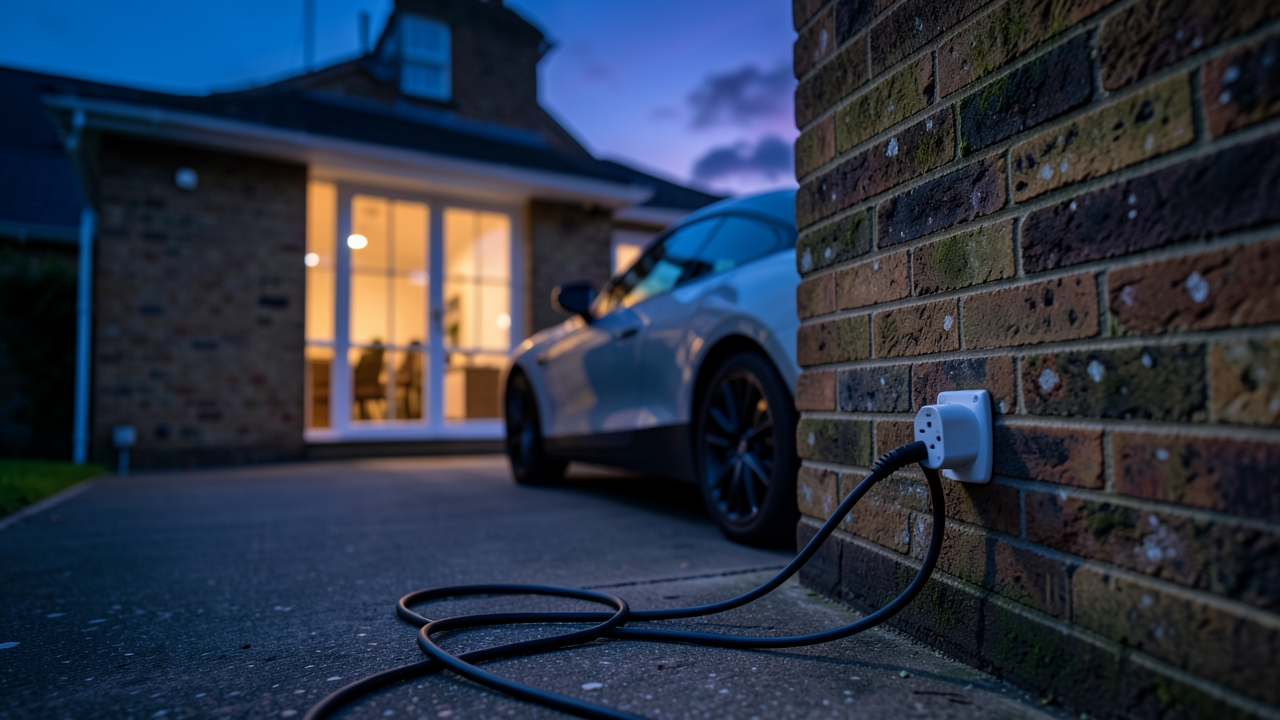
You have an electric car, a three-pin socket in the garage and a spare smart plug in a drawer. It is tempting to connect the two and track every kilowatt from your phone. However, smart plug EV charging UK drivers attempt every winter carries real legal, safety and insurance risks. Here is what the rules say in 2026.
The short answer is uncomfortable. No single law bans the practice outright. Nevertheless, it usually breaches the manufacturer’s instructions, ignores UK wiring guidance and can leave you uninsured after a fire.
Is smart plug EV charging legal in the UK?
Legally, you can plug almost anything into a 13A socket in your own home. However, legality and safety are different tests. The plug, the socket and the wiring must all suit the load.
A typical granny charger pulls about 10A for six to ten hours. That is a continuous load of roughly 2.3 kW. Most smart plugs are tested for short bursts, not marathon sessions, and their relays were never built for that duty cycle.
What the IET Code of Practice says
The IET Code of Practice for Electric Vehicle Charging Equipment Installation guides every qualified installer in the UK. It rules out Mode 1 charging, where a plain cable links the car to a socket with no protection at all.
Mode 2 charging, using the in-cable control box supplied with the car, is allowed only as an occasional fallback. Furthermore, the guidance expects a dedicated, RCD-protected socket, not a shared ring main with a smart plug in the middle.
The Smart Charge Point Regulations 2021
Since 30 June 2022, new private charge points sold in Great Britain must meet the Electric Vehicles (Smart Charge Points) Regulations 2021. They must offer smart scheduling, off-peak defaults and randomised delays.
A smart plug is not a charge point under those rules. Consequently, it skips every safety feature the regulations assume, including PEN fault detection and 6mA DC leakage protection.
The safety risks of charging an EV through a smart plug
- Overheating sockets. Ten amps for eight hours warms the pins. Repeated heat cycles weaken the contacts and raise resistance.
- Welded relays. A small relay inside a £20 plug can stick closed under sustained load, so the car keeps drawing power.
- Blind RCDs. Smooth DC fault current can desensitise a Type A RCD. Proper charge points include 6mA DC detection.
- PEN faults. A lost neutral on the supply can put 230V on the car’s bodywork. Dedicated chargers cut off in milliseconds.
- Extension leads. A coiled lead traps heat. Fire services treat this as one of the most common causes of charging fires.
- Weather and cables. A plug hanging in the rain, or a cable trapped in a garage door, adds moisture and mechanical risk.
Fire and rescue services already warn about charging batteries on domestic circuits. An EV battery pack is far larger than an e-bike battery. Therefore, the consequences of a failure are correspondingly bigger.
Will a smart plug affect your home insurance?
Most home policies require you to maintain the property and follow manufacturer instructions. If a fire starts because you charged a car from an unsuitable socket, an insurer may reduce or reject the payout.
In addition, many policies exclude damage caused by faulty electrical work or by appliances used outside their intended purpose. That wording is exactly where a smart plug sits.
Charging an EV is a material fact for many insurers. Tell them how you charge, and keep the installation certificate for any dedicated charge point.
On the other hand, a professionally installed 7.4 kW charger, notified under Part P of the Building Regulations, is exactly what insurers like to see. It also protects you if a fault damages a neighbour’s property.
When can you use a three-pin plug to charge an electric car?
A three-pin socket is a fallback, not a habit. If you must use one, follow these rules.
- Use only the Mode 2 cable supplied with the car, complete with its control box.
- Plug into a dedicated, RCD-protected socket, ideally on its own circuit.
- Never use an extension lead, a multi-socket adaptor or a smart plug.
- Set the car to its lowest current limit, usually 10A or 6A.
- Feel the plug and socket after 30 minutes. If either is hot, stop charging.
- Charge when you are awake and at home, so you can react to a problem.
For most drivers, this is an emergency measure for a top-up at a relative’s house. It is not a long-term substitute for a proper home charger.
Smart plug vs dedicated EV charger: cost and performance
- Smart plug on a 13A socket: £15–£45, delivers 2.3 kW, adds roughly 6–8 miles of range per hour.
- Mode 2 granny cable: often included with the car, same 2.3 kW, same limitations.
- 7.4 kW home charger: £800–£1,300 installed, adds 25–30 miles of range per hour on a single-phase supply.
- 22 kW three-phase charger: £1,500 or more, where the supply and the car both support it.
- Government EV chargepoint grant: up to £350, or 75% of the cost, for flat owners and renters.
Running costs matter too. A standard variable tariff sits near 24p per kWh in late 2026, while off-peak EV tariffs drop to around 7p. A 7.4 kW charger fills a 60 kWh battery inside a short cheap window; a 2.3 kW plug simply cannot.
You can read more in our guide to the cost of charging an EV at home. For a faster setup, compare the best home EV chargers in the UK.
Are smart plugs ever useful for EV owners?
Yes, just not in the charging cable. Smart plugs excel at monitoring the tumble dryer, the fridge or a home office setup. Our round-up of smart plugs for energy monitoring explains the strongest options.
To track what your car actually costs, fit a CT clamp monitor inside the consumer unit instead. It reads the whole circuit without routing 10A through a £20 relay for hours.
Safer alternatives and practical recommendations
Book a qualified installer who works to the IET Code of Practice and BS 7671:2018+A2:2022. The work is notifiable under Part P in England and Wales, and your installer should issue an electrical installation certificate.
Choose a charger with built-in PEN fault protection, 6mA DC detection and open PEN. In addition, check the Energy Saving Trust guidance on home charging before you buy.
If you rent or live in a flat, the chargepoint grant can cut the bill. Meanwhile, drivers without a driveway can lean on lamppost chargers, workplace charging and rapid hubs.
Frequently asked questions
Can I plug a granny charger into a smart plug?
Technically the plug fits. Practically, no. The smart plug adds a weak link to a circuit already running at its limit for hours.
Is it illegal to charge an EV from a three-pin socket?
Not in itself. However, using a socket, lead or device outside its rating can breach consumer safety law and your insurance terms.
Will my insurance cover a fire caused by EV charging?
It depends on the policy and the cause. Ask your insurer directly and keep receipts for approved equipment. Do not assume cover.
How much does a proper home EV charger cost in 2026?
Expect £800–£1,300 installed for a 7.4 kW unit, less any grant. Add £200–£400 if your consumer unit needs a spare way or an earth rod.
So the honest answer is that a smart plug can legally sit between your car and a socket, but it should not. A dedicated charger costs less than most people expect and protects your home, your warranty and your cover. Have you ever charged from a three-pin socket, and would you do it again? Tell us in the comments below.