
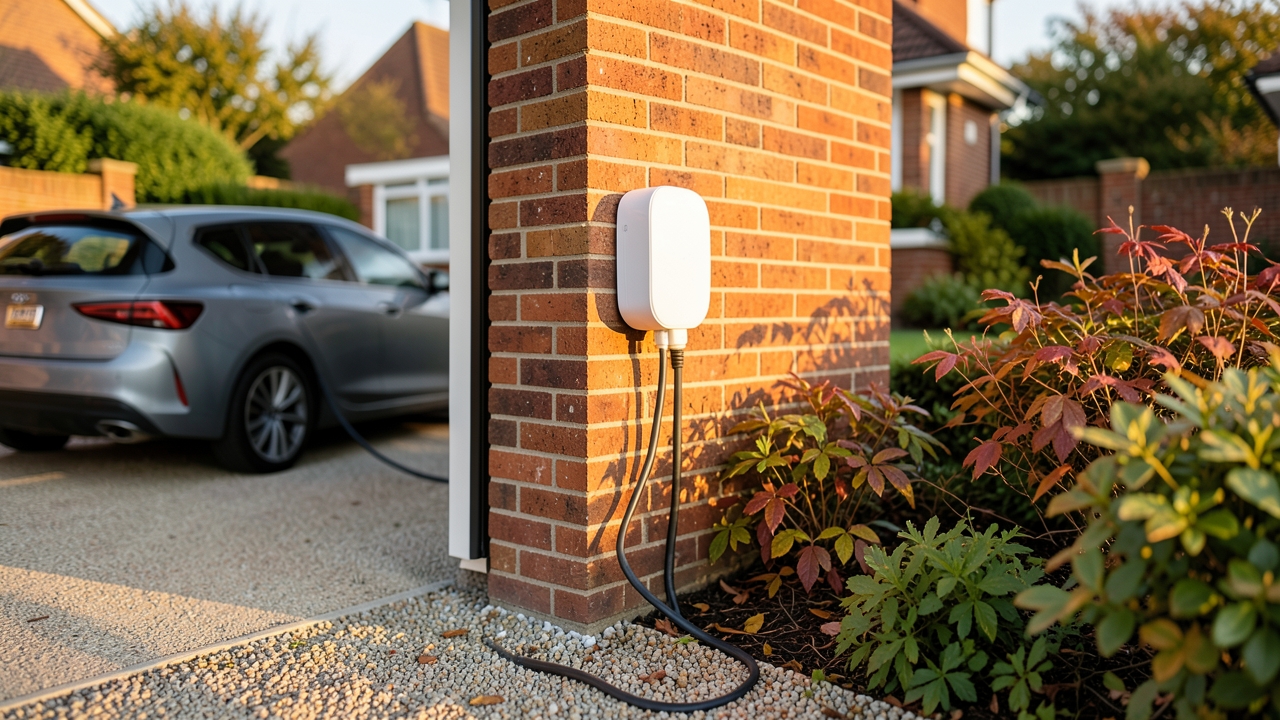
Working out the true home EV charger costs UK households actually pay in 2026 takes more than a glance at a product page. The three most-searched units — the Ohme ePod, Pod Point Solo 3 and Wallbox Pulsar Plus — sit within about £150 of each other on hardware alone. However, the installed price can swing by several hundred pounds depending on the property. Cable runs, surge protection and fuse upgrades move the goalposts far more than the brand badge does.
Home EV Charger Costs UK 2026: The Real Headline Numbers
All three chargers deliver 7kW on a standard single-phase supply. That adds roughly 25 to 30 miles of range for every hour of charging. Furthermore, every unit must meet the same wiring rules under BS 7671. As a result, the box on the wall is rarely the deciding factor in your final bill.
- Ohme ePod: £899 to £1,050 fully installed (untethered, so you use your own Type 2 cable)
- Pod Point Solo 3: £979 to £1,149 installed (tethered, with standard installation included in the quoted price)
- Wallbox Pulsar Plus: £949 to £1,150 installed (tethered, with power sharing and a five-year warranty)
Those ranges assume a straightforward job. Add a long cable run or a fuse upgrade and any of them can climb past £1,500.
What Each Charger Costs Before Installation
Ohme ePod
The ePod sells for around £449 to £499 as a standalone unit in 2026. It is untethered, which means you plug your own Type 2 cable into a socket on the front. In addition, it has built-in PME fault detection, so most homes avoid the cost of an earth electrode. Ohme’s real selling point is tariff integration. The ePod works natively with smart off-peak tariffs, which we cover in our guide to the best EV tariffs for overnight charging.
Pod Point Solo 3
Pod Point seldom sells the Solo 3 as a bare box. Instead, the company quotes an all-in installed price from about £979. That figure includes a standard installation and a 4.5m tethered cable. A 7.5m cable option adds roughly £50. The fixed-price approach suits buyers who dislike nasty surprises, although it also means less flexibility on where the unit goes.
Wallbox Pulsar Plus
The Pulsar Plus costs £549 to £649 as a unit. It brings Bluetooth, Wi-Fi, dynamic power sharing and a five-year warranty. Therefore it appeals to households planning a second chargepoint later. Fitted prices through approved installers typically land between £949 and £1,150. You can read our full breakdown in the Ohme ePod review if you are weighing the two against each other.
What Counts as a Standard Installation?
Nearly every quote you see online assumes a standard installation. That phrase hides a specific set of conditions. Usually it means the following:
- A cable run of no more than 10 metres
- Surface-mounted cable, with no digging or lifting of floors
- A spare way in an existing consumer unit
- A single-phase supply with satisfactory earthing
- Ground-floor mounting on a solid wall
The box on the wall is the cheap part. The route from your consumer unit to your driveway is where the money actually goes.
If your property fails any of those tests, the price climbs. Therefore, always ask your installer to confirm their assumptions in writing before you pay a deposit.
The Extras That Quietly Add Hundreds
These are the line items that turn a £900 quote into a £1,600 invoice. The figures below reflect typical UK rates in 2026.
- Extra cable beyond 10 metres: £55 to £75 per metre
- Surge protection device (SPD): £90 to £160
- DNO fuse upgrade, for example 60A to 100A: £200 to £500
- Consumer unit upgrade or an extra RCBO: £250 to £500
- Earth electrode for TT earthed supplies: £150 to £300
- Trenching, ducting or lifting block paving: £250 to £700
- Access equipment or scaffolding: £250 to £450
- Load management CT clamp or energy meter: £100 to £200
- Mounting post, bollard or wall pillar: £150 to £300
Why surge protection is often non-negotiable
Under the 18th Edition wiring regulations, most chargepoint circuits need surge protection unless a documented risk assessment says otherwise. Some units include it internally. Others do not, so the installer adds a separate device. Furthermore, an SPD is genuinely useful on a rural or exposed supply.
Why a DNO fuse upgrade adds time, not just money
Your distribution network operator owns the main fuse, and only they may upgrade it. Companies such as UK Power Networks and SP Energy Networks handle these requests. Lead times in 2026 often run to six to eight weeks. Consequently, a fuse upgrade can delay your entire installation.
Is There Still Grant Support in 2026?
The old Electric Vehicle Homecharge Scheme closed to new applicants on 31 March 2025. However, the EV Chargepoint Grant still exists. It is worth up to £350 or 75% of the installation cost, whichever is lower. Eligibility covers flat owner-occupiers and people in rental accommodation who have off-street parking.
In addition, Home Energy Scotland has offered chargepoint funding for used electric vehicle buyers, with a rural top-up. Some councils add their own incentives on top. As a result, it pays to check before you sign anything. The GOV.UK chargepoint grant guidance lists the current rules and approved installers.
Who qualifies for the £350 grant
- Owner-occupiers of flats, including maisonettes with their own parking
- Tenants of flats or houses who have off-street parking
- Landlords installing at a rental property they own
You must use an approved installer, and the work has to meet the grant’s technical standards. The Energy Saving Trust publishes plain-English guidance on home charging if you want a second opinion.
Worked Example: A Midlands Semi
Take a 1930s semi in Solihull with a driveway beside the garage. The consumer unit sits in the garage, roughly ten metres from the meter box. The owner chose the Wallbox Pulsar Plus because they plan a second electric car in 2028.
- Wallbox Pulsar Plus 7.4kW tethered: £599
- Standard installation, including a 10m cable run: £325
- Surge protection device: £95
- DNO fuse upgrade: not needed, as a 100A fuse was already fitted: £0
- Consumer unit: spare way available: £0
- Total: £1,019
Worked Example: A London Terrace
Now take a Victorian terrace in Islington. The consumer unit lives in the cellar, and the charger must go on the front wall 15 metres away. The main fuse is rated at 60A and feeds an electric shower. Consequently, the installer recommended a network upgrade alongside the chargepoint.
- Wallbox Pulsar Plus 7.4kW tethered: £599
- Standard installation, including a 10m cable run: £325
- Extra 5m of armoured cable at £65 per metre: £325
- Surge protection device: £95
- DNO fuse upgrade from 60A to 100A: £270
- Total: £1,614
Same charger, same installer, different postcode. The gap is £595, or almost 60% more than the Midlands job. Interestingly, the hardware price was identical in both cases.
Why Location Changes the Price So Much
Older housing stock
Victorian and Georgian terraces frequently have