
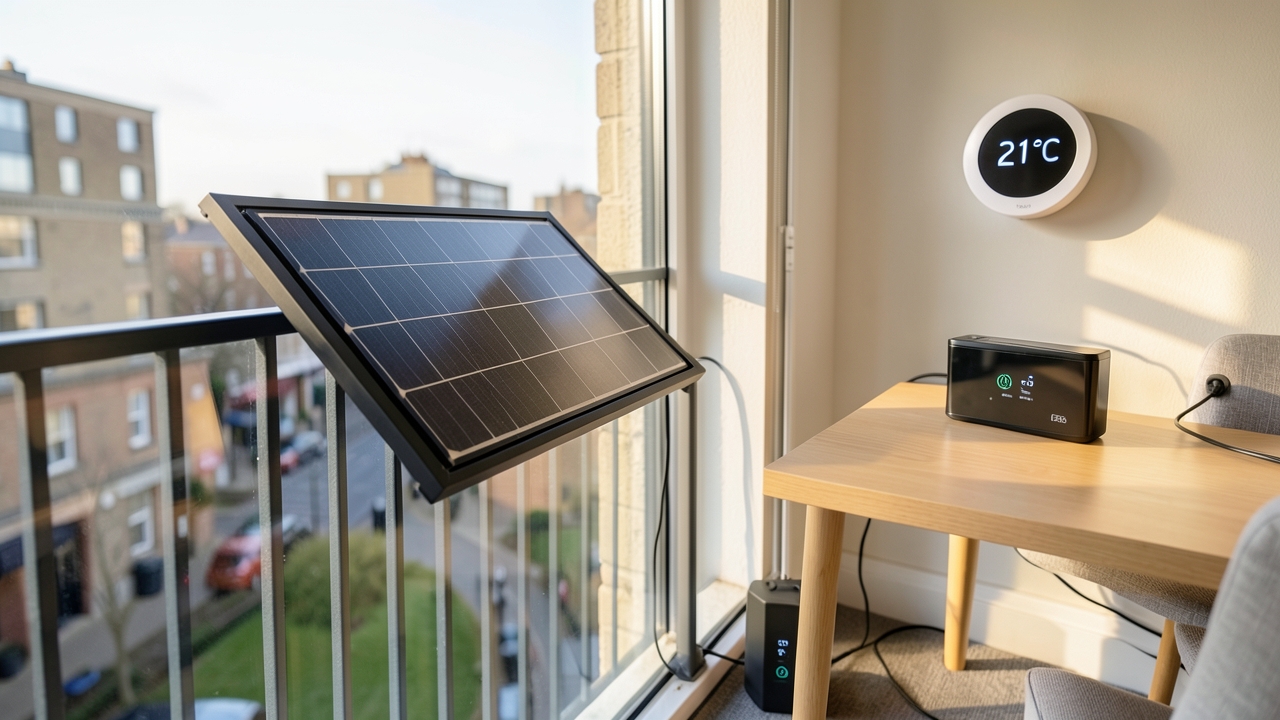
As energy prices remain a key concern for urban residents in 2026, combining smart home technology with renewable energy is no longer just for homeowners. For those living in UK flats and apartments, Tado solar integration UK offers a practical, cost-effective way to harness solar power for heating control. This step-by-step guide will walk you through connecting your Tado smart thermostat with a compact balcony solar panel system to reduce your gas or electricity bills.
Why Combine Tado Thermostats with Balcony Solar Panels?
The primary benefit is maximising the use of free, self-generated solar energy to power your heating system’s smart controls. A Tado thermostat itself uses minimal power, but when connected to a smart radiator valve (TRV) or your boiler, it actively manages when and how your heating runs. Furthermore, if you have a balcony solar setup, you can align your heating schedule with peak solar generation, reducing reliance on the grid.
For flat dwellers, this integration addresses a major limitation: the inability to install large, roof-mounted solar arrays. A typical 100W-400W balcony solar panel kit, costing between £150 and £500, provides sufficient power for running smart home devices and can even contribute to your heating system’s operational needs. Consequently, this combination directly targets reducing your heating costs by making smarter, data-driven decisions.
Checking Compatibility: Your Tado and Solar Setup
Before starting, ensure your equipment is compatible. You will need:
- A Tado Smart Thermostat (either the wired or wireless model, Starter Kit V3+ is common).
- Tado Smart Radiator Thermostats (TRVs) for individual room control.
- A balcony solar panel kit with a small battery and an inverter that provides a stable 240V AC output or a suitable DC-to-USB power adapter.
- A Wi-Fi connection strong enough on your balcony for the Tado bridge.
The Power Requirement
The Tado system is low-power. The bridge uses approximately 1-2W, and each TRV uses around 0.5W. Therefore, a small 100W panel, even on a cloudy UK day, can easily generate enough power to keep these devices running. The key is managing the power conversion from the solar panel’s output (often 12V/24V DC) to the AC or USB power your Tado devices require.
Step-by-Step Guide to Tado Solar Integration UK
Step 1: Install and Position Your Balcony Solar Panel
Securely mount your solar panel on your balcony railing using the provided brackets. Angle it south-facing for maximum UK sun exposure. Ensure the panel’s cable is safely routed indoors. Connect it to the included battery and inverter unit. Most modern kits for UK flats are designed for simple plug-and-play installation without needing planning permission, as long as they are fixed and not hanging over the street.
Step 2: Power the Tado Bridge via Solar
The Tado Bridge is the central hub that connects your thermostat to the internet. You can power it directly from your solar system’s battery output. Use a voltage converter if needed to step down to 5V USB. For example, you could connect a 12V battery output via a DC-DC converter to a USB cable that plugs into the Tado Bridge. This ensures the brain of your heating system runs on your solar power.
Step 3: Configure Tado for Optimal Solar Use
This is the crucial software step. Open the Tado app and navigate to the “Geolocation” and “Smart Schedule” features. You want to create a schedule that prioritises heating during the day when your solar battery is likely to be charged. For instance, you could schedule a slight temperature boost in the late morning and early afternoon, aligning with peak solar production.
In addition, use the “Open Window Detection” feature. Tado automatically pauses heating if it detects a rapid temperature drop, which is perfect for ventilating a flat in summer without wasting energy.
Step 4: Monitor and Adjust
Use the Tado app to monitor your heating energy consumption alongside your solar generation data (if your inverter has a companion app). Over the first few weeks, observe which schedules yield the lowest grid consumption while maintaining comfort. You might find, for example, that pre-heating the flat just before you arrive home from work, using stored solar power, is more efficient than heating a cold space from scratch.
Cost Savings and Practical UK Data for 2026
According to the Energy Saving Trust, smart thermostat use can reduce heating bills by up to £145 per year on a typical gas tariff. Integrating solar power can amplify this saving. While your balcony panel won’t power your entire boiler, it can offset the cost of running the smart controls and potentially contribute to the power draw of electric TRVs.
Assuming an average UK electricity price of 27p per kWh (2026 estimate) and a solar kit generating 0.5 kWh per day on average, you save roughly 13-14p per day or around £50 per year on electricity. When combined with the heating efficiency gains from precise Tado control, total savings could reasonably exceed £150 annually.
“The combination of smart zoning with TRVs and renewable self-generation is a powerful tool for energy reduction in the UK’s urban housing stock.” – UK Green Building Council, 2025 report.
Common Challenges and Solutions
One frequent challenge in UK flats is poor Wi-Fi signal on the balcony. A Wi-Fi mesh system or a dedicated outdoor access point can solve this, ensuring your solar inverter and Tado bridge stay connected. Another issue is condensation on solar panels. Ensure your panel has adequate drainage and consider a slight tilt angle. Finally, always check your lease agreement regarding balcony modifications. Most fixed, non-intrusive solar kits are acceptable, but it’s wise to inform your landlord or management company.
FAQs on Tado Solar Integration UK
Does this setup work with my combi boiler?
Yes. The Tado thermostat communicates directly with your combi boiler via a wired connection or the internet, controlling it on/off. The solar power simply runs the Tado devices themselves.
Do I need an electrician for installation?
For the Tado thermostat wiring into your boiler, a Gas Safe registered engineer is required. However, setting up the low-voltage solar panel and powering the Tado bridge is a DIY task that most residents can handle safely. For more complex wiring, consulting an electrician is advised.
What about the Smart Export Guarantee (SEG)?
The SEG scheme allows you to sell excess electricity back to the grid. However, the small output of a balcony panel (typically under 3.68kW) may not make the administrative process worthwhile for most households. The primary financial gain is from self-consumption and bill reduction.
Final Thoughts on Smart Heating and Solar
Tado solar integration UK represents a smart, incremental step towards energy independence for flat residents. It combines the immediate bill-saving benefits of intelligent heating control with the growing accessibility of small-scale solar technology. While it requires some initial setup and configuration, the long-term savings and enhanced comfort are well worth the effort.
Have you tried integrating smart home tech with renewable energy in your flat? What has been your biggest challenge or saving? Share your experiences in the comments below!
For more on sustainable home tech, explore our guides to the best balcony solar panels in the UK and top EV chargers for 2026.