
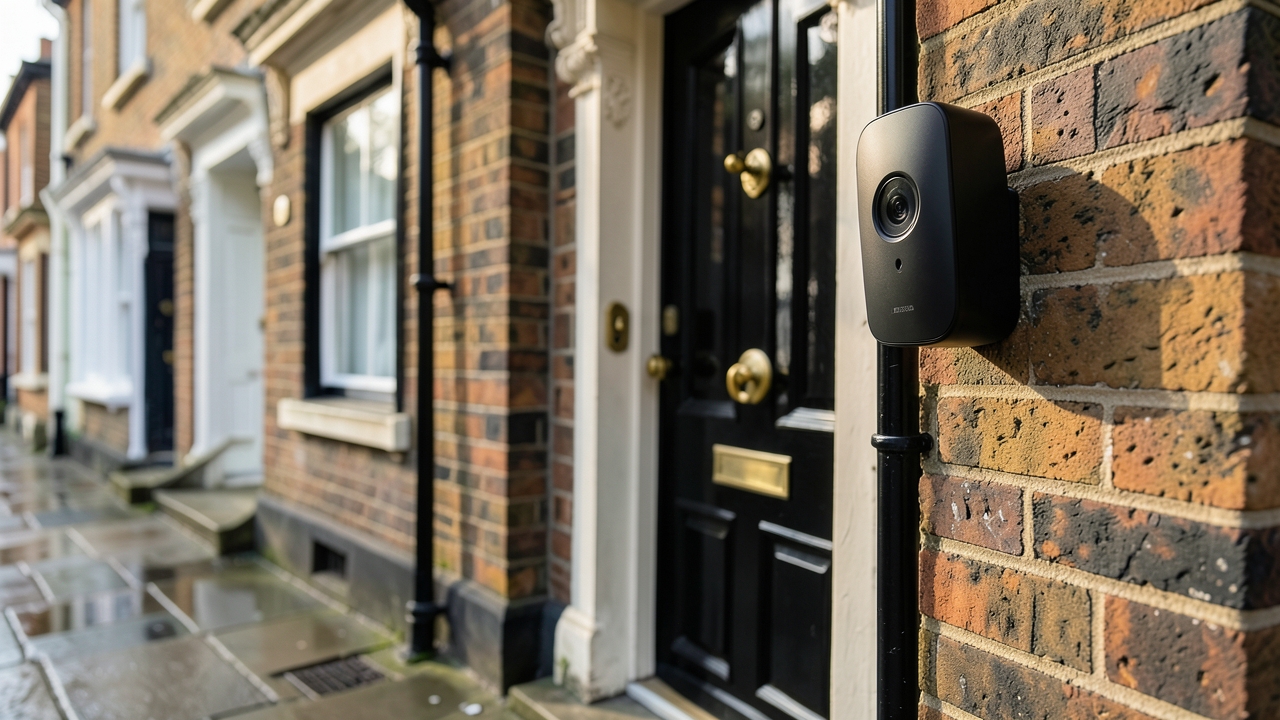
Do you need a GDPR sign for a video doorbell in the UK? The short answer is: it depends where your camera points. If it films only your own doorstep, you are probably exempt. However, the moment it catches the pavement, a shared path or a neighbour’s front door, the video doorbell GDPR rules apply to you — and a sign is only the first of several duties.
Video doorbells are now one of the most popular smart home devices in Britain. They are also, quietly, one of the most common causes of neighbour disputes. Consequently, the Information Commissioner’s Office (ICO) has been clear that domestic cameras are not a legal free-for-all.
This guide explains what the ICO expects from homeowners in 2026. It covers the hidden risk of audio recording and why terraced houses attract the most complaints.
Do the Video Doorbell GDPR Rules Apply to Your Home?
UK GDPR Article 2(2)(c) contains what lawyers call the household exemption. It covers processing carried out by an individual in the course of a purely personal or household activity. Section 36 of the Data Protection Act 2018 sits alongside it.
Therefore, a camera that only records your own porch, hallway or back garden normally falls outside data protection law. You are not a data controller. You do not need a privacy notice, and you do not need a sign.
On the other hand, the exemption is narrow. It protects private life, not surveillance of other people. In addition, the ICO has stated that footage capturing images beyond your property boundary is not covered by the exemption at all.
If your camera captures images beyond your boundary — a pavement, a shared driveway or a neighbour’s windows — the household exemption no longer protects you.
When Your Doorbell Turns You Into a Data Controller
Once the exemption falls away, you become a data controller with legal duties. In practice, that means the following:
- Tell people they are being recorded — normally with a visible sign.
- Collect only the footage you actually need, known as data minimisation.
- Keep recordings no longer than necessary.
- Provide footage of an individual to that person if they ask, within one month and free of charge.
- Keep the camera system and its cloud account secure.
You can read the regulator’s own guidance on domestic CCTV systems for the full position.
Is Audio Recording on a Video Doorbell Legal?
This is the part most homeowners miss. Almost every doorbell camera records audio by default, and that microphone does not respect your boundary.
A doorbell mounted at chest height can clearly capture a conversation held on the pavement five or ten metres away. The ICO treats audio as more intrusive than video, because it captures content rather than movement. Furthermore, it is very hard to justify for home security.
As a result, the single most effective step you can take is to switch audio recording off. Most apps hide this setting under device, privacy or audio options. Do it today.
Why Terraced Homeowners Are Most Exposed
In a detached house with a long drive, a doorbell can usually be angled to avoid everything except your own property. In a Victorian terrace, that is often impossible.
Many terraced front doors open directly onto the pavement, with neighbours’ doors one to three metres away. Consequently, any camera wide enough to cover your own doorstep will also cover public highway and somebody else’s front door.
Modern doorbells make this worse. A typical model offers a 150 to 160 degree field of view, which is excellent for security but unforgiving on a narrow street. Meanwhile, the footage reveals your neighbour’s visitors, their deliveries and their daily comings and goings. All of that is personal data about them.
Shared porches, communal alleyways and flats above shops create the same problem. If you are unsure how wide your camera reaches, walk the street after dark and check what the night vision picks up. Our guide to setting up home CCTV properly explains motion zones and privacy masks, while our doorbell installation guide covers mounting angles for narrow streets.
What a Compliant Doorbell Sign Must Say
There is no single prescribed wording in law. Nevertheless, the ICO expects you to inform people clearly and in advance of recording. A compliant sign therefore needs to cover a few essentials.
- The purpose of recording, for example crime prevention and home security.
- A clear statement that recording is in operation.
- The identity of the controller — your name or the property address.
- Contact details for questions or footage requests.
- A note that complaints can be raised with the ICO.
Place the sign where people can see it before they enter the monitored area. For a doorbell, that normally means beside the front door or on the gate at eye level. Keep the text legible from one to two metres away.
Cost is not an obstacle. Ready-made CCTV signs cost roughly £5 to £15 from Screwfix, Amazon or a local hardware shop. A personalised sign carrying your own contact details usually costs £10 to £25. In addition, keep a copy of your notice indoors so you can produce it if anyone asks.
Storage, Sharing and Subject Access Requests
Retention matters as much as the sign. Ring’s free plan keeps recordings for 180 days in the UK, while paid Ring Protect plans start at around £4.99 per month per device. A domestic controller rarely needs 180 days of history.
Therefore, set the shortest retention your app allows, often 30 to 60 days, and delete anything else. Also switch on two-factor authentication. A hacked camera account is a data breach, and you are responsible for it.
If a neighbour asks for footage of themselves, you must respond within one month and you cannot charge a fee. Do not post clips on Facebook, Nextdoor or WhatsApp groups, even if you believe a crime has occurred. Share them with the police instead. The ICO has repeatedly warned that publishing footage online is a breach in itself.
What Happens If You Ignore the Video Doorbell GDPR Rules?
Realistically, the ICO will not fine a homeowner £17.5 million. It will, however, investigate complaints, and its decisions can be uncomfortable.
The bigger risk is civil. In Fairhurst v Woodard, an Oxfordshire homeowner was ordered to pay £100,000 in damages in 2021. His CCTV and doorbell cameras overlooked a neighbour’s home and garden, and the claim combined data protection breaches with harassment.
Furthermore, the Protection from Harassment Act 1997 can apply where surveillance forms a course of conduct. Claims for distress under section 168 of the Data Protection Act 2018 often settle for a few hundred to a few thousand pounds. As a result, a £10 sign is cheap insurance.
Since the Data (Use and Access) Act 2025, complainants are generally expected to raise the issue with the controller first. In practice, that means your neighbour may knock on your door before contacting the regulator. Handle that conversation well. GOV.UK publishes the basics of data protection law if you want to check your position.
Your 2026 Doorbell Compliance Checklist
- Walk your boundary and note exactly what the camera sees.
- Turn off audio recording in the app.
- Draw motion zones that exclude the pavement and neighbours’ doors.
- Apply privacy masks over next-door windows and shared paths.
- Angle the camera downwards and towards your own threshold.
- Fit a clear sign with your purpose and contact details.
- Reduce cloud storage retention.
- Turn on two-factor authentication.
- Never share footage publicly.
- Talk to your neighbour before they complain.
If you are choosing hardware, look for models with strong privacy controls and flexible motion zones. Our roundup of the best video doorbells in the UK compares the options that make compliance easiest.
Frequently Asked Questions
Is a GDPR sign legally required for a video doorbell?
Not always, but it usually is if your camera sees beyond your boundary. In that situation you must inform people that they are being recorded, and a sign is the practical way to do it.
Can I record the pavement outside my house?
Technically you can, but the footage is then covered by UK GDPR. Therefore, you need a lawful reason, a sign, limited retention and a route for people to request footage of themselves.
Do I need to register with the ICO?
No. Domestic controllers do not pay the ICO data protection fee, which applies to organisations. You do, however, still have to follow the data protection principles.
The rules are not designed to stop you protecting your home. They ask for a little thought, a cheap sign and a five-minute app change. Consequently, most doorbell disputes are entirely avoidable.
Have you had a neighbour raise concerns about your doorbell? Or have you fitted a sign and found it solved the problem? Share your experience in the comments below — it helps other readers get this right.