
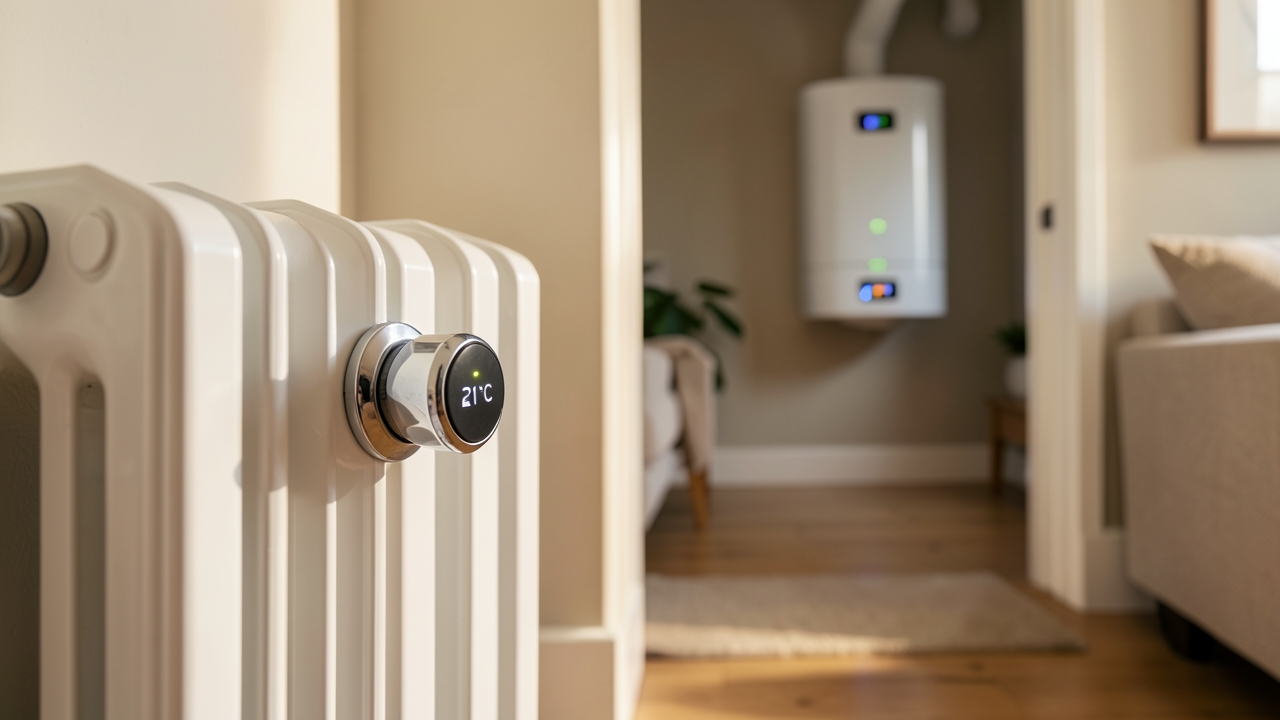
A smart TRV UK combi boiler project looks simple on paper. You buy half a dozen Zigbee radiator valves, screw them onto the tails, add a hub, and wait for the savings to arrive. Unfortunately, the boiler has other ideas.
Around 15 million UK homes now run a combi boiler, and most of them still rely on basic wax TRVs. Those valves throttle individual radiators, but they never tell the boiler to slow down or stop. Consequently, you end up with hot bedrooms, cold hallways and a gas bill that refuses to move. This guide shows how to fix that with Home Assistant, Zigbee TRVs and either OpenTherm or relay control.
Why Smart TRVs Alone Cannot Modulate a Combi Boiler
A combi boiler understands two states: heat demanded, or heat not demanded. It has no idea which room asked for warmth. Traditional wax TRVs simply restrict water flow once a room hits temperature, which reduces the load without ever telling the boiler to reduce its output.
As a result, a combi fitted with smart TRVs but no boiler link will still fire in short bursts. Engineers call this short cycling. It wastes gas, adds wear to the heat exchanger and makes condensing mode much harder to reach.
To solve it, Home Assistant needs two things. First, each TRV must report its demand. Second, the boiler must receive a signal whenever any zone wants heat. That second part is where most DIY retrofits fall down.
- Zigbee smart TRVs on every radiator except the bypass radiator
- A Zigbee coordinator such as a Sonoff ZBDongle-E or Home Assistant Connect ZBT-1
- Home Assistant running on a Raspberry Pi, mini PC or Home Assistant Green
- An OpenTherm gateway or a smart relay wired to the boiler call-for-heat contact
- A Gas Safe registered engineer for any work inside the boiler casing
Smart TRV UK Combi Boiler Zoning: How It Actually Works
Zoning splits a home into areas and heats only the areas that need warmth. For example, bedrooms can sit at 16°C overnight while the living room holds 20°C until 22:30. Meanwhile, the bathroom stays warm enough to dry towels without heating the whole house.
The magic is not the valve. It is the conversation between the TRV and the boiler. When the last zone stops calling for heat, the boiler should shut down completely. When one zone calls, the boiler should fire at the lowest useful flow temperature.
That last point matters more than most people realise. A condensing boiler only reaches peak efficiency when its return water sits below roughly 55°C. Running at a 75°C flow temperature defeats the purpose entirely.
OpenTherm or Relay Control? Check Your Boiler First
OpenTherm is a low-voltage digital protocol that lets a controller set the boiler flow temperature directly. Many Intergas, Ideal and Baxi models support it natively. However, Worcester Bosch uses its own EMS bus and Vaillant uses eBUS, so both need a converter module.
Relay control is simpler and works with every combi. Home Assistant switches a relay that energises the boiler switched live. The boiler then runs at its own flow temperature until demand disappears. You lose modulation, yet you still stop paying to heat empty rooms.
- OpenTherm: best efficiency, needs boiler support or an adapter, around £40–£70
- EMS or eBUS converter: required for Worcester Bosch and Vaillant, around £60–£100
- Relay and zone valve: universal, cheapest, no modulation, around £20–£70
Anything that involves opening the boiler case or touching gas pipework is a job for a Gas Safe registered engineer. OpenTherm terminals are low voltage, but manufacturers vary on whether DIY connection affects your warranty.
The Best Zigbee Smart TRVs for a UK Combi Boiler in 2026
Not every smart valve plays nicely with Home Assistant. The following options all expose proper climate entities through Zigbee2MQTT or ZHA, and all fit the standard M30 x 1.5 valve thread found on most UK radiators.
- Sonoff TRVZB – around £25 each. Zigbee 3.0, reports valve position and battery, outstanding value.
- Aqara Radiator Thermostat E1 – around £50 each. Zigbee and Thread variants, very reliable, neat build.
- Drayton Wiser Smart TRV – around £55 each, or £160 for a starter kit. Works locally in Home Assistant.
- Honeywell Home evohome HR92 – around £70 each. Premium build and superb zoning at a higher entry price.
- Moes or Tuya Zigbee TRV – around £30. Cheap, but firmware quirks are common.
Check your existing valve bodies before ordering. Danfoss RA and RAVL fittings need an adapter, although most kits include one. If you are unsure which protocol suits your wider setup, our guide to Matter vs Zigbee in the UK explains the trade-offs.
Building the Setup in Home Assistant
Step 1 – Pair Your TRVs with Zigbee2MQTT or ZHA
Zigbee2MQTT offers the most control and the best device support. ZHA is simpler and works well for mainstream hardware. Either way, hold the pairing button on each valve until the LED flashes, then let the coordinator discover it.
Rename every entity straight away. Names like climate.living_room_trv and climate.bedroom_two_trv will save you hours later. In addition, enable the valve position and battery sensors so you can monitor performance over time.