
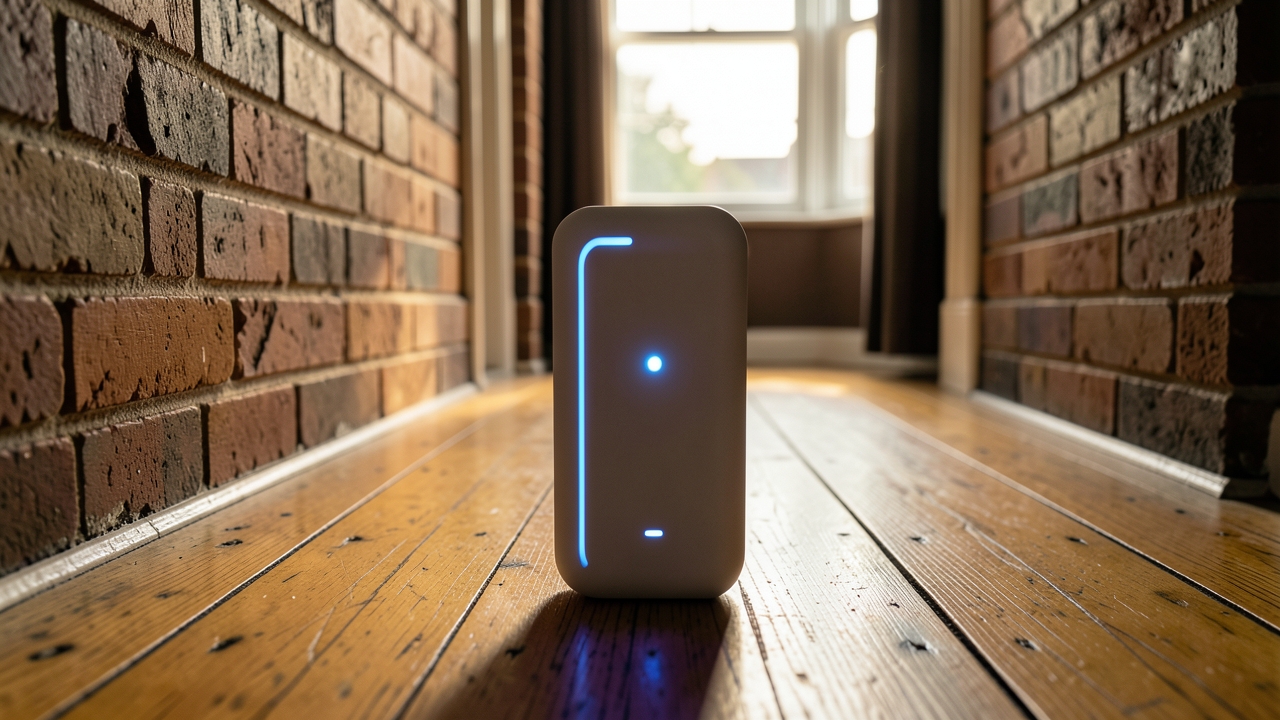
If a bedroom sensor in your solid-wall home goes offline every night, the firmware is probably not the problem. The walls are. Most Matter Thread UK homes sit inside brick and masonry that 2.4 GHz radio simply cannot cross, and that single fact explains the majority of dropped devices, slow automations and flat batteries reported in 2026.
In this guide we test a real Thread mesh inside a 1930s semi-detached house, explain what Matter 1.4 and Thread 1.4 genuinely improved, and give you repeater placement and channel strategies that work when your walls are 230 mm of solid brick.
Why Matter Thread UK homes struggle behind solid brick
Thread uses the same 2.4 GHz band as Wi-Fi and Zigbee. That band is fast and globally licence-exempt, but it is also absorbed, reflected and scattered by dense materials. Consequently, the advertised indoor range of 30 metres or more rarely survives contact with a British semi.
How much signal each wall really eats
- Plasterboard stud wall: 2 to 4 dB
- 9-inch solid brick at 230 mm: 10 to 16 dB
- Solid brick with lime plaster and lath: 15 to 20 dB
- Chimney breast or party wall: 20 to 30 dB
- Foil-backed plasterboard or radiator reflector: an extra 10 to 15 dB
- Low-emissivity double or triple glazing: 20 to 30 dB
Thread nodes needs roughly -85 dBm or better to hold a stable link, and battery sensors work best above -75 dBm. Therefore two solid walls between two nodes can easily consume 30 dB, which is the difference between a snappy sensor and a dead one.
Compare that with Z-Wave, which transmits at 868 MHz in the UK. Lower frequencies penetrate masonry about 6 to 10 dB better, which is why some installers in period properties still recommend it. On the other hand, Z-Wave has a smaller ecosystem, so most people stick with Thread and fix the layout instead.
The insulation retrofit trap
Here is an awkward side effect of the net zero push. Internal wall insulation, foil-faced boards, radiator reflectors and modern low-E glazing all block 2.4 GHz far more effectively than they block heat. As a result, a home upgraded for energy efficiency in 2025 can break its own Thread mesh in 2026.
The Energy Saving Trust notes that roughly a third of UK homes have solid walls, which is around 8 million properties. If you are planning solid wall insulation, plan your smart home network at the same time, not afterwards.
The security rules you should know about
In addition, every connectable smart device sold in the UK must now meet the PSTI Act security requirements set out by government. That covers passwords and update policy, but it does nothing at all for radio coverage.
Real-world test: a 1930s semi in autumn 2026
We tested a three-bedroom 1934 semi in the Midlands. The main house is solid 9-inch brick with lime plaster. A 1980s rear extension has cavity walls. The loft conversion has foil-backed insulation boards. The Thread border router was an Apple TV 4K on Ethernet in the living room, with two further border routers added later.
What the numbers showed
- Living room to hallway, one solid brick wall: -66 dBm, LQI 150, no issues.
- Hallway to front bedroom, one solid wall plus a chimney breast: -79 dBm, mostly stable, occasional 3-second delay.
- Kitchen to rear bedroom, two solid walls diagonally: -87 dBm, intermittent, sensor dropped twice a day.
- Living room to loft office, foil-backed boards plus one solid wall: -93 dBm, never joined the mesh.
- Same loft sensor after forcing a link: it drained a CR2450 battery in nine weeks instead of the expected 18 months.
That last point matters most. Thread devices do not always announce a bad link. Instead, they cling on, retry, and burn through batteries. Meanwhile, your app shows everything as online until the moment it does not.
A solid brick wall does not switch your smart home off. It filters it, slowly and silently, until the battery is gone.
Matter 1.4 and Thread 1.4: what actually changed
Matter 1.4 brought genuinely useful improvements. Thread over Infrastructure lets several border routers join the same Thread network over Ethernet or Wi-Fi, so you can place a border router at each end of the house rather than stretching one mesh. In addition, Thread 1.4 uses Service Registration Protocol, which cuts the multicast chatter that used to flood home networks during commissioning.
However, none of that changes radio physics. A battery sensor is still a Sleepy End Device, so it cannot relay traffic for anything else. Consequently, better routing only helps if you give the mesh enough mains-powered routers to route through. That is where most UK installs still fail.
For a wider look at hubs, fabrics and multi-admin, see our Matter smart home hub guide, and for hardware shortlists see our round-up of the best Thread border routers in the UK.
Repeater placement in a solid-wall home
Think in walls, not metres
Stop measuring distance and start counting walls. Our rule of thumb is simple: no two Thread nodes should ever have more than one solid wall between them. Furthermore, treat a chimney breast as two walls, because that is how 2.4 GHz behaves in practice.
Only mains-powered devices route
Thread Routers must have permanent mains power. Therefore, use smart plugs, hard-wired relays, always-on bulbs and mains-powered hubs as your repeaters. Battery sensors, radiator valves and buttons will never strengthen your mesh, no matter how many you buy.
- Fit one mains-powered Thread router in every room that contains battery devices.
- Add a router in the hallway or on the landing to create a vertical spine through the house.
- Prefer Ethernet backhaul: Apple TV 4K at around £169, Aqara Hub M3 at around £129.99 and Nest Wifi Pro all support it.
- Never hide a repeater behind a radiator, inside a metal cabinet, or beside a fridge or microwave.
Watch the party wall
In a semi or terrace, your neighbour is often on the same 2.4 GHz channels as you, just 230 mm away. If their router sits