
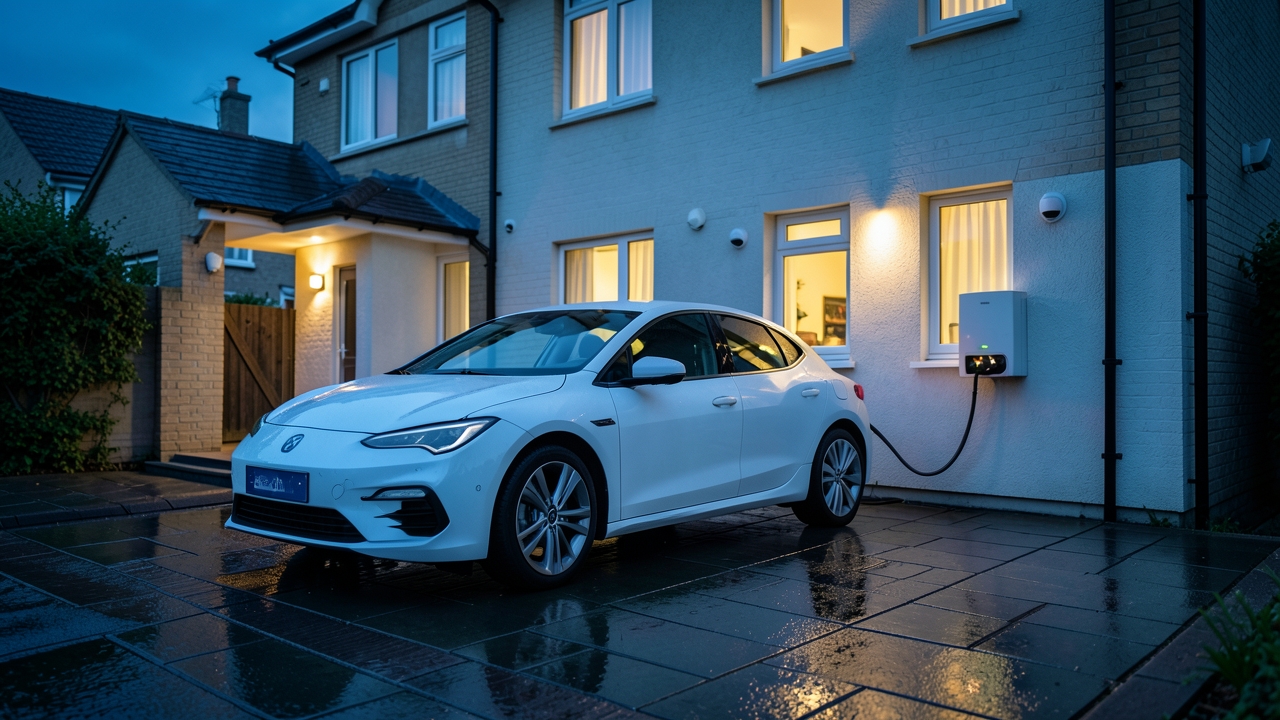
If you are planning to add an EV charger and heat pump supply to a typical UK home, check your electricity supply before anything else. Most UK houses still sit behind a single-phase 100A cut-out. That caps the whole property at roughly 23 kW. Add a 7.4 kW charger and a heat pump, and you can sail straight past that limit.
In this guide, we break down the real load calculations. We also cover DNO fuse upgrade lead times and the true cost of going three-phase in 2026.
How Much Power Does an EV Charger and Heat Pump Supply Really Need?
Start with the basics. A 7.4 kW home charger draws 32 amps continuously on a single phase. Meanwhile, an 8 kW air source heat pump pulls around 2.5 to 3 kW of electricity in mild weather.
However, that figure climbs quickly. On a cold January morning with a defrost cycle running, the same heat pump can demand 4 to 5 kW. In addition, the 3 kW immersion heater may kick in for hot water. Suddenly you are close to 8 kW from heating alone.
kW versus kWh: the mistake most people make
kW measures the rate of power. kWh measures energy used over time. Your DNO cares about kW, because that is what the fuse sees at any given second.
Therefore, a heat pump that uses 6,000 kWh across a year is not the problem. The problem is the 4 kW it demands at 7am on a freezing Tuesday.
A worked load calculation for a typical three-bed semi
Here is how the numbers stack up for a fairly ordinary UK home:
- Base load (lighting, sockets, fridge, TV, broadband): about 2.5 kW
- Electric cooker and oven: 7 kW, cut to roughly 4 kW once diversity is applied
- Electric shower: 9.5 kW, counted at full value if it is the largest load
- Air source heat pump: 3 kW, rising to 5 kW in cold snaps
- EV charger: 7.4 kW at 32A, with no diversity applied at all
Apply the IET diversity rules and this house may sit at 45 to 55A before the car is even plugged in. Add 32A for the charger, and the total reaches 77 to 87A. Add a cold-weather heat pump peak of 20A, and you are over 100A.
What a 100A Single-Phase Supply Can Actually Deliver
On the UK nominal 230V supply, a 100A fuse allows about 23 kW. In practice, DNOs and electricians treat the safe continuous limit as closer to 80A, which is around 18.4 kW. Furthermore, the fuse is designed around diversity, not three big loads running flat out together.
Many older UK homes have a 60A or 80A cut-out, not 100A. Consequently, the headroom is even tighter than most owners expect. If your property still runs on a looped supply shared with a neighbour, upgrades get more complex again.
Two 32A loads on a 100A supply is not a disaster. Two 32A loads plus a shower and a cooker, all at the same time, is where the fuse goes.
DNO Fuse Upgrades: Lead Times in 2026
Your distribution network operator owns the fuse and the cable to your door. You cannot swap the fuse yourself, and no qualified electrician would pull it either. Instead, your installer submits an application and the DNO assesses the load.
Lead times in 2026 vary widely by region and property type. As a rough guide:
- Single-phase fuse upgrade (60A or 80A to 100A): usually free, occasionally up to £300, typically 2 to 8 weeks
- Supply capacity increase with a new cable: £500 to £2,500, and 8 to 16 weeks
- Three-phase conversion: quote within 10 working days, delivery in 8 to 24 weeks
- Looped supply separation (unlooping): £1,500 to £4,000, often 12 to 20 weeks
For example, UK Power Networks and SP Energy Networks publish indicative timescales online. However, rural properties on long overhead lines can wait far longer. As a result, start the process before you order any hardware.
Going Three-Phase in 2026: What It Really Costs
A three-phase 100A supply gives you roughly 69 kW of capacity split across three phases. That is more than enough for a heat pump on one phase, a charger on another and the house on the third.
Realistic 2026 prices look like this:
- DNO three-phase connection or conversion: £2,000 to £6,000, averaging around £3,500
- Easy sites close to a substation: £1,000 to £1,800
- Rural or long-cable sites: £8,000 to £15,000 or more
- Three-phase distribution board and consumer unit, fitted: £800 to £1,500
- Three-phase EV charger: £800 to £1,800, plus £300 to £600 fitting
- Three-phase heat pump premium: £300 to £900
- Electrical installation condition report and certification: £150 to £300
Therefore, a realistic all-in budget for a clean three-phase conversion with new hardware sits between £5,000 and £9,000 in 2026.
However, check the car before you commit. Many EVs only have a 7.4 kW single-phase onboard charger. On a three-phase supply they will still charge at 7.4 kW. The real gain is load distribution, not raw charging speed.
Smarter Alternatives Before You Dig Up the Drive
Dynamic load management
Most modern chargers support dynamic load balancing. A CT clamp on the main tail monitors the whole house. The charger then reduces its output automatically to protect the fuse. Many of the models in our guide to the best home EV chargers in the UK include this as standard.
Timer interlocking and smart tariffs
Run the heat pump for hot water during the day, then charge the car overnight. On an Intelligent Octopus Go or EDF style time-of-use tariff, off-peak electricity costs roughly 7p to 12p per kWh. Consequently, the two biggest loads rarely peak at the same moment.
Derate the charger or fit a smaller unit
A 7.4 kW charger can be set to 16A (3.6 kW) or 20A during commissioning. On a 100A supply with a heat pump, a 3.6 kW charge rate is often the cheapest safe answer. It adds about four hours to a full charge, but it avoids a £5,000 upgrade.
Battery storage and solar
A home battery can shave your peak demand, so the fuse never sees both loads at once. Pairing one with balcony solar panels or a roof array shrinks grid draw even further. In addition, you charge the battery overnight on cheap power and release it during the evening peak.
Grants and Funding That Help in 2026
The Boiler Upgrade Scheme still offers £7,500 towards an air source heat pump in England and Wales. Furthermore, VAT on heat pump installations remains at 0% until March 2027. You can also check the Energy Saving Trust for the latest eligibility rules.
On the charging side, the old Electric Vehicle Homecharge Scheme closed in 2022. However, the EV Chargepoint Grant still gives £350 to flat owners and renters. Homeowners with a driveway get no grant, so budget the full EV charger installation costs yourself.
Your Step-by-Step Checklist
- Ask a qualified electrician to measure your existing base load over 24 hours
- Check the cut-out rating: 60A, 80A or 100A
- Decide a realistic charger output: 3.6 kW, 7.4 kW or higher
- Submit the DNO application early, because the assessment is usually free
- Get three quotes for any three-phase work before signing anything
- Choose a charger with dynamic load management built in
- Move to a smart time-of-use tariff and schedule both loads
- Consider a battery if your DNO refuses an upgrade
Always use an installer registered with NICEIC, NAPIT or an equivalent competent person scheme. They will also notify the DNO and issue the building regulations certificate you need at resale.
The Bottom Line
Most UK homes can run an EV charger and heat pump supply together, but rarely at full power simultaneously. For many owners, a fuse upgrade plus dynamic load management solves the problem for under £500. For a minority, a three-phase conversion costing £5,000 to £9,000 is the only clean fix.
Would you rather spend a few hundred pounds on smart load management, or several thousand on a three-phase supply? Let us know your own DNO experience in the comments below.