
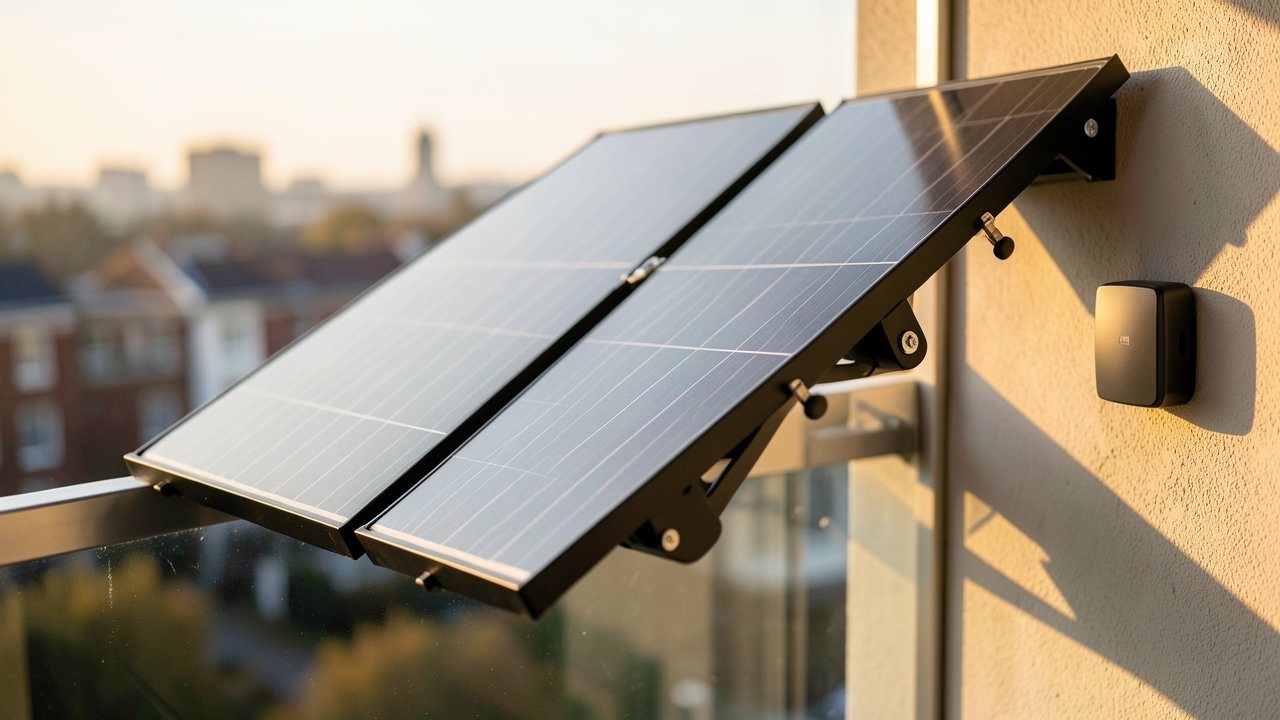
Questions about whether plug-in solar is UK legal have exploded in 2026, and the confusion is easy to understand. A balcony panel that hooks over a railing and feeds a 13 A socket looks like the cheapest route to home-generated electricity. In practice, the hardware is legal to buy, the grid connection can be legal, and yet plenty of real installations still break the rules. This guide unpacks BS 7671, G98 and G99, and explains exactly what a compliant balcony system must include this year.
Is plug-in solar UK legal in 2026? The short answer
Yes, plug-in solar is legal in the UK, provided the kit is certified and connected correctly. Nothing in UK law prevents you from generating your own electricity. Furthermore, the network rules actively allow small generators to connect without asking permission first.
However, legal does not mean anything goes. A compliant system uses a grid-tied micro-inverter with loss-of-mains protection, sits on a properly protected circuit, and is notified to your distribution network operator (DNO). A non-compliant system leans on uncertified hardware, daisy-chained extension leads, or a home-made cable with live pins at both ends.
The equipment is rarely the problem. In most cases, the connection method decides whether a balcony array is compliant or not.
In addition, the rules shift depending on where you live. England, Scotland, Wales and Northern Ireland each handle building regulations differently. Therefore, always check local guidance before you drill a single bracket into a wall.
The 2026 rules that actually apply to balcony solar
Three separate frameworks govern a plug-in solar installation in the UK. They overlap, which is exactly why the topic feels so muddy.
BS 7671 and the IET Wiring Regulations
BS 7671, better known as the IET Wiring Regulations, sets the safety standard for electrical installations across the UK. It covers low-voltage generating sets, protection against electric shock, isolation and labelling. Consequently, any inverter you connect must be installed so that existing protective devices still operate as designed.
Here is the awkward part. BS 7671 does not describe a plug-and-socket method for feeding generation into a final circuit. Therefore, a 13 A plug connection sits in a grey area rather than a clearly approved one. Many electricians will only sign off such a setup when it uses a dedicated circuit, a Type A RCD or RCBO, and a visible warning notice at the consumer unit.
G98 and G99: notifying your network operator
G98 is the Engineering Recommendation covering generation up to 16 A per phase, which works out at roughly 3.68 kW. A typical balcony kit peaks far below that figure. As a result, you connect first and notify your DNO within 28 days of commissioning.
G99 applies to larger systems and needs approval before you switch on. On the other hand, no sensible plug-in kit comes close to G99 territory. Most 2026 balcony kits sit between 400 W and 800 W, so G98 is the relevant route for almost every buyer.
Your supplier or installer should hand over the G98 notification paperwork as standard. If they cannot explain how the notification works, walk away and buy elsewhere.
Building regulations, Part P and planning permission
In England and Wales, Part P of the Building Regulations covers electrical work in dwellings. Adding a plug-in kit to an existing socket is usually not notifiable. Conversely, hard-wiring a new circuit is notifiable work, and a registered competent person must carry it out.
Planning permission is a separate matter entirely. Solar panels on a house roof often fall under permitted development rights. Flats and maisonettes, meanwhile, generally do not enjoy the same freedoms for wall-mounted panels. The GOV.UK planning guidance sets out the national position, and leaseholders should also expect to need written freeholder consent.
What a compliant plug-in solar UK kit must include
A legal, safe balcony setup normally includes all of the following:
- A G98-compliant micro-inverter with certified loss-of-mains (anti-islanding) protection
- Type A RCD protection rated at 30 mA on the circuit you use
- Correctly rated DC cabling with IP65 or better connectors
- A warning notice at the consumer unit stating that a second source of supply exists
- Secure, corrosion-resistant mounting rated for wind loading, because a 2 m2 panel behaves like a sail in a gale
- A weatherproof cable route rather than a window-trapped extension lead
- UKCA marking, manufacturer manuals and a declaration of conformity
- G98 notification submitted to your DNO within 28 days
What makes a balcony solar setup non-compliant
Some shortcuts are merely untidy. Others are genuinely dangerous, and a few are unlawful.
- A double-ended lead with two male plugs, sometimes sold online as a cheap connector
- An inverter without anti-islanding protection, which can electrify the network during a power cut
- A string exceeding 16 A per phase connected without G99 approval
- Indoor extension leads used outdoors, where water ingress can defeat RCD protection
- No DNO notification, or generation hidden from your energy supplier
- Panels fixed with cable ties rather than rated brackets
If you recognise your own setup in that list, switch it off and get it reviewed. Safety always comes before savings.
What plug-in solar costs and saves in 2026
Prices have fallen again this year. As a rough guide for UK buyers:
- 400 W single-panel kit: £300 to £500
- 800 W dual-panel kit: £550 to £950
- Replacement micro-inverter: £120 to £250
- Electrician inspection and certification: £120 to £250
A well-sited 800 W balcony array in southern England might generate 650 to 750 kWh a year. At an electricity price of around 25p per kWh in 2026, that is roughly £160 to £190 of avoided import. Consequently, most buyers see payback within three to five years.
Export payments are the catch. The Smart Export Guarantee normally requires an MCS-certified installation, and most plug-in kits are not MCS certified. The Energy Saving Trust explains how certified systems earn export income. Therefore, surplus electricity from a balcony kit is usually given away free. Adding home battery storage can soak up that surplus instead, although a small balcony array rarely justifies the cost on its own.
Do I need an MCS-certified installer for plug-in solar?
Not for your own consumption. MCS certification matters when you want Smart Export Guarantee payments. For example, most large suppliers require MCS or equivalent accreditation before they will pay for exported units. Without it, you still generate legally, but you cannot sell the surplus.
Renters, leaseholders and flats: extra checks
Renting or owning a flat adds another layer of rules. In addition, landlords and freeholders can impose conditions that have nothing to do with wiring regulations.
Ask for written permission before installing anything on a balcony. Check your lease for restrictions on external fixtures. If you are a tenant, your tenancy agreement may ban modifications outright. On the other hand, plenty of landlords welcome tidy, removable kits that leave the building fabric untouched.
How to stay legal: a five-step checklist
- Buy a kit with a G98-certified micro-inverter and full documentation.
- Ask a qualified electrician to assess the socket, circuit and RCD protection before you plug anything in.
- Fit panels with rated brackets suited to your balcony type and local wind loading.
- Submit the G98 notification to your DNO within 28 days of commissioning.
- Label the consumer unit and keep certificates, receipts and manuals together for future surveys or sales.
Ultimately, plug-in solar is a practical, low-cost way to cut bills, and the 2026 rules are clearer than they were two years ago. Check certification, protect the circuit, notify your DNO, and most of the legal risk simply disappears. Before you buy, our balcony solar panels guide covers sizing and mounting in more detail, while our round-up of the best plug-in solar kits in the UK compares current pricing. Planning to add a balcony panel this winter? Tell us which kit you are considering and we will flag any compliance gaps.