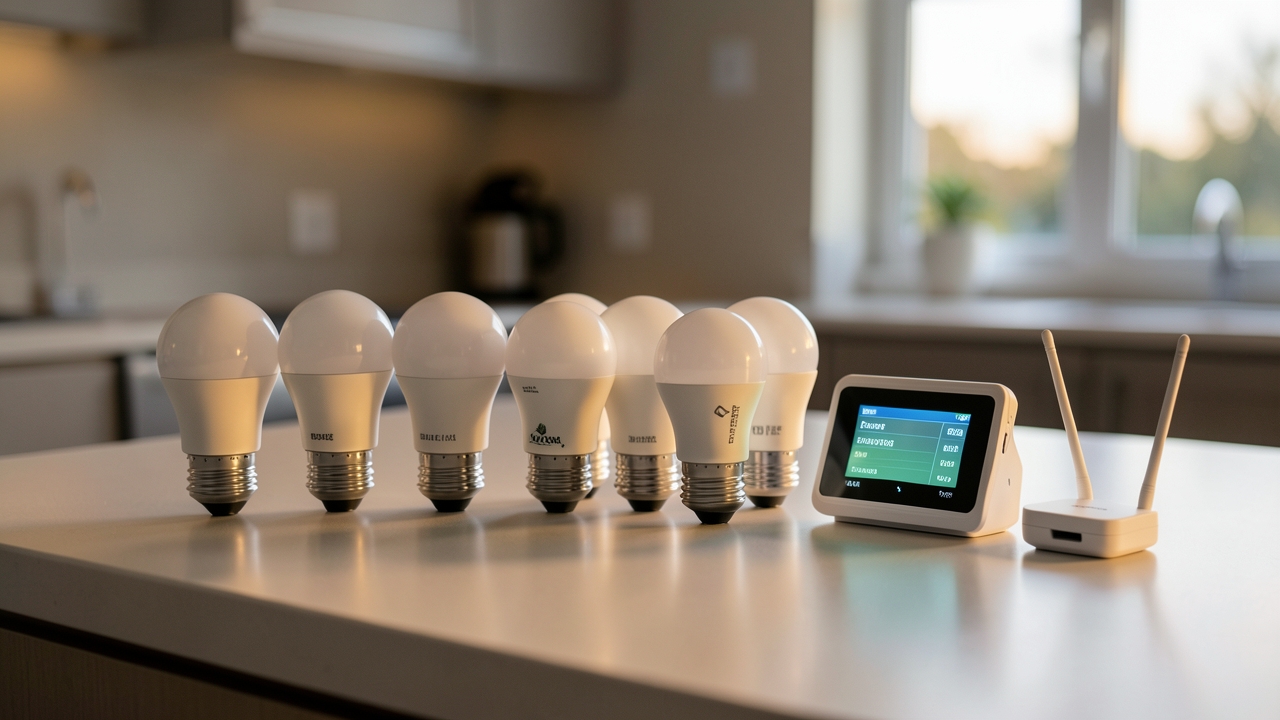
After 12 months of testing, our smart bulb running costs figures are finally in. We metered 12 bulbs from Philips Hue, TP-Link Tapo, IKEA Trådfri, Nanoleaf, WiZ and Aqara for a full year. Every reading was then converted into pence at the October 2026 Ofgem price cap.
The headline result: a smart bulb costs between £1.95 and £4.77 a year to run at three hours a night. That range includes standby draw and a share of the bridge or hub it needs. Manufacturers rarely publish either number on the box.
How we measured smart bulb running costs over 12 months
We ran the test from 1 October 2025 to 30 September 2026. Each bulb sat in a desk lamp and plugged into a TP-Link Tapo P110 energy monitoring plug, accurate to roughly 1%. Bridges, gateways and Thread border routers were metered separately.
Every bulb followed an identical pattern. Three hours a day at 100% brightness, then 21 hours powered but switched off in the app. That reflects how most UK homes actually use smart lighting. In total, each bulb delivered 1,095 hours of light and 7,665 hours of standby.
Costs use the October 2026 Ofgem price cap unit rate of 25.6p per kWh. We excluded the daily standing charge, because you pay it whether you own a smart bulb or not.
What one watt really costs for a year in 2026
Ofgem’s cap for October to December 2026 sits at £1,812 a year for a typical household. The electricity unit rate behind that figure is 25.6p per kWh. Therefore, one watt running non-stop for a year costs £2.24.
That single number explains the whole test. A bulb sipping 0.94W on standby quietly adds £2.11 to your annual bill. Meanwhile, a 60W halogen burning three hours a night costs £16.82. Standby draw suddenly matters as much as brightness.
The results: smart bulb running costs ranked from cheapest
All figures assume three hours of daily use, standby for the remaining hours, and a 10-bulb share of any hub. Purchase prices are typical UK street prices in October 2026.
- IKEA Trådfri GU10 400lm — £1.95 a year (bulb £7)
- Philips Hue White GU10 — £2.49 a year (bulb £17.99)
- IKEA Trådfri E27 806lm — £3.14 a year (bulb £8.99)
- Philips Hue White A60 E27 — £3.52 a year (bulb £14.99)
- TP-Link Tapo L510E — £3.56 a year (bulb £8.99)
- Amazon Basics A60 — £3.67 a year (bulb £9.99)
- TP-Link Tapo L530E colour — £3.81 a year (bulb £12.99)
- Philips Hue White and Colour A60 — £3.84 a year (bulb £44.99)
- Nanoleaf Essentials Matter A19 — £4.08 a year (bulb £17.99)
- WiZ A60 Matter — £4.10 a year (bulb £9.99)
- Aqara LED Bulb T2 — £4.38 a year (bulb £15.99)
- Lepro Matter A60 (budget) — £4.77 a year (bulb £6.99)
The pattern is uncomfortable. The two GU10s win because they emit less light, not because their electronics are cleverer. Furthermore, the cheapest bulb in the entire test has the highest running cost. The Lepro’s 0.94W standby is nearly three times the Hue White’s 0.32W.
For a wider view of what to look for on the box, our smart bulb buying guide covers lumens, colour rendering and protocol in more depth.
The hidden hub cost that never reaches the box
Zigbee bulbs need a bridge. That box draws power 24 hours a day, every day of the year. We measured the Philips Hue Bridge at 1.34W, which works out at £3.00 annually. The IKEA Trådfri gateway pulled 0.98W, adding £2.20 a year.
Thread setups hide the same cost in plain sight. A HomePod mini or Apple TV acting as a border router draws 1.1W to 1.5W on standby. Consequently, that is another £2.47 to £3.37 a year before a single bulb gets involved.
Zigbee vs Wi-Fi vs Thread standby compared
- Zigbee bulbs (Hue, Trådfri) — 0.26W to 0.38W standby
- Wi-Fi bulbs (Tapo, WiZ, cheap Matter) — 0.54W to 0.94W standby
- Thread bulbs (Nanoleaf) — around 0.72W standby
In a three-bulb flat, Wi-Fi wins. Three Tapo bulbs burn £4.10 of standby a year. Three Hue bulbs plus a bridge cost £5.36. On the other hand, the maths flips in a 20-bulb house. Zigbee standby totals £18.70 there, against £27.36 for the same number of Wi-Fi bulbs.
If you are still deciding between protocols, our guide to Matter and Thread explains which hubs you actually need.
Smart bulbs vs ordinary LEDs and halogens
A plain 8.5W LED, used three hours a night, costs £2.38 a year and nothing at all on standby. A 60W halogen in the same fitting costs £16.82. Therefore, the saving from ditching halogen is dramatic and the smart part is almost irrelevant to it.
Replacing a halogen with a Philips Hue White A60 saves around £13.30 a year. Against a £14.99 purchase price, that pays back in roughly 13 months. The £8.99 Trådfri E27 saves £13.68 a year and pays back in under eight months.
If you already own LEDs, smart bulbs cost you money
This is the awkward truth of the test. Swapping a working £2 LED for a £14.99 Hue adds about £1.14 a year in energy. You also spend the purchase price. Buy smart bulbs for scheduling, dimming and scenes, not for savings.
The smart premium in 2026 is roughly £1 a year per bulb in electricity. The rest of the saving comes from the LED inside, which you can get for £2.
Six ways to cut your smart bulb running costs
- Share one hub across more bulbs. A bridge split 20 ways costs 15p per bulb annually, not £3.
- Dim rather than switch. Our Hue Colour drew 9.6W at full output but only 2.3W at 10% brightness. Dimming helps, although driver overhead never disappears.
- Pick Zigbee for big installs, Wi-Fi for small ones. The crossover sits at roughly eight bulbs.
- Use motion sensors and schedules. A bulb that is on for 90 minutes instead of three hours halves its running cost.
- Avoid full-saturation colour. Deep blues and reds drew 6% to 9% more than warm white at the same perceived brightness.
- Switch off at the wall in rarely automated rooms. That removes standby entirely, at the cost of app control.
What UK rules say about smart bulb standby
The Ecodesign for Energy-Related Products and Energy Information Regulations 2021 cap networked standby at 2W. All 12 bulbs passed comfortably. However, that ceiling is generous. A bulb sitting at 1.9W would be perfectly legal and would still cost £4.26 a year doing nothing.
In addition, the energy label’s standby figure hides in the small print, and hub consumption is not covered at all. Check independent testing through Which? light bulb reviews and the Energy Saving Trust lighting advice before you buy a bundle.
Verdict: which smart bulbs are cheapest to run in 2026?
IKEA Trådfri remains the value champion once hub costs are shared. Philips Hue sits