
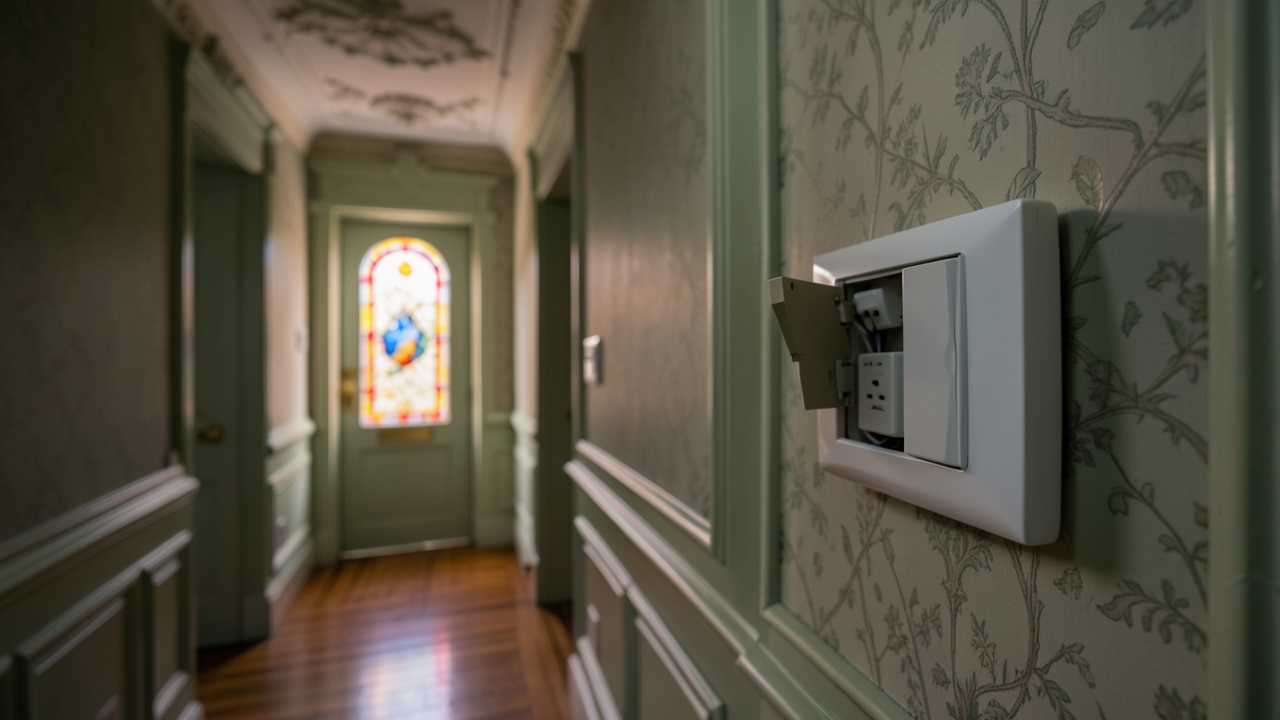
If you own a Victorian terrace, the phrase no-neutral smart switch UK will probably define your entire lighting upgrade. Most British homes wired before the 1970s simply do not have a neutral conductor inside the switch back box. As a result, a large share of the popular smart switches sold online will never work in your hallway.
This guide tests the no-neutral options that genuinely work with UK wiring. We cover Shelly, Aqara and Lutron in detail. Furthermore, we show how to wire each one into Home Assistant and how to eliminate flicker and ghosting for good.
Why Victorian terraces have no neutral at the switch
British lighting circuits use a loop-in layout. The permanent live, neutral and earth all meet at the ceiling rose. Only two wires drop down the wall to the switch: permanent live and switched live.
That single missing wire creates the problem. A smart switch needs power for its radio and electronics. With no neutral, it must steal a trickle of current through the lamp itself.
Victorian terraces add three extra headaches. First, back boxes are often only 16mm deep. Second, many pre-1966 lighting circuits have no earth conductor at the switch. Third, staircase lighting is usually wired as a two-way circuit.
The three layouts you will find behind the plate
- Loop-in at the ceiling rose (most common): live and switched live at the switch, neutral above your head. You cannot fix this without lifting floorboards.
- Joint box or old fuse-box era wiring: single red and black conductors, often with no earth at the switch position. Expect cloth or rubber insulation in the oldest properties.
- Two-way staircase switching: three-core strapper between two switches. No-neutral modules cannot replicate this without rewiring.
Modern good practice, and the norm in new-build homes since the early 2000s, is to run a neutral to every switch position. However, roughly 60% of the UK’s 29 million homes were built before 1970. Consequently, the retrofit market is enormous.
How a no-neutral circuit actually powers a smart switch
A no-neutral module sits in series with the lamp and draws a tiny leakage current through it. The lamp stays off because the current is too small to strike the LED driver. Meanwhile, the module harvests enough energy to run its Wi-Fi or Zigbee radio.
This design has two consequences. It needs a minimum load, typically 10W to 25W, or the module browns out and reboots. In addition, cheap LED lamps often glow faintly when switched off. That is the ghosting everyone complains about.
Rule of thumb: if your downstairs circuit has four 5W LED lamps, you have 20W of load. That is borderline for most no-neutral dimmers, and it will flicker.
The no-neutral smart switch UK options that actually work
We have fitted all three systems below in period properties. Each one solves the missing neutral differently, and each suits a different budget.
Shelly Dimmer Gen3 and Shelly 1L
Shelly is the default choice for UK retrofits. The Dimmer Gen3 (around £33) needs no neutral and dims LED loads up to 200W. The Shelly 1L (around £20) is a simple on/off relay that fits behind an existing plate.
Both sit in the back box and keep your original Victorian switch plate. You toggle the wall switch to send commands instead of cutting power, and Home Assistant takes over the logic. The modules are small enough for a 25mm box, although a 16mm box will be tight.
Shelly runs locally over Wi-Fi with no cloud dependency. Therefore it integrates with Home Assistant instantly through the official Shelly integration.
Aqara Smart Wall Switch H1 (no neutral)
Aqara’s H1 no-neutral rocker (around £35 to £45) replaces the whole plate. It looks like a modern screwless switch and is available in single and double rocker versions. It uses Zigbee 3.0, so it needs an Aqara hub or a Zigbee coordinator.
Two cautions apply. The H1 requires at least 25mm of box depth, so old 16mm boxes need chasing out. Also, a metal Victorian plate is not an option here because the module is built into a plastic faceplate.
On the other hand, Zigbee is far more reliable than Wi-Fi in a terrace with 9-inch solid brick walls. If your router struggles at the back of the house, this is the better platform. Our guide to Zigbee versus Wi-Fi for UK terraces explains why in more depth.
Lutron RA2 Select
Lutron solves the problem architecturally. Its RA2 Select system places the dimmer module at the ceiling rose, where a neutral already exists. The wall control is battery-free and wireless, so no mains wiring reaches the switch at all.
Performance is flawless. Dimming is smooth down to 1%, and ghosting is impossible because the module is not in series with the lamp. In addition, the system is fully local and works without internet.
The catch is cost. Expect £350 to £500 for a starter kit, £90 to £120 per dimmer module, and professional installation on top. Lutron is the right answer for a whole-house refurbishment, not a single hallway.
The smart bulb and kinetic switch workaround
Sometimes the smartest answer is to leave the wiring alone. Fit dimmable smart bulbs and cover the old switch with a blanking plate. Then mount a battery-free kinetic switch, such as an Aqara or EnOcean model, on the wall or beside the bed.
This approach costs £15 to £25 per bulb and £25 to £40 per kinetic switch. It also avoids any electrical work, which matters if you rent or lack an earth at the switch. Our round-up of the best dimmable smart bulbs for UK homes covers the models that dim smoothly.
What no-neutral smart lighting costs in the UK in 2026
- Shelly 1L module: £20, plus £60 to £120 for an electrician to fit it.
- Shelly Dimmer Gen3: £33, plus the same labour cost.
- Aqara H1 no-neutral switch: £35 to £45, plus a hub at £50 to £80 if you have none.
- Anti-flicker bypass capacitor: £8 to £12 per circuit.
- Deeper 35mm back box and plaster repair: £15 to £40 per position.
- Lutron RA2 Select: £350 to £500 for a starter kit, fitted.
A typical Victorian hallway therefore costs £80 to £150 to automate properly. That is roughly half the price of rewiring a neutral to the switch, which involves lifting floors and redecorating.
Fixing flicker and ghosting for good
Flicker and ghosting are not faults. They are symptoms of too little load or an incompatible LED driver. Fortunately, both are fixable in an afternoon.
Fit a bypass capacitor
A bypass capacitor, such as the Fibaro Bypass 2 or the Shelly Bypass, wires across the lamp at the ceiling rose. It provides a path for the leakage current and stops the LED glowing when off. Fit one per circuit, not per lamp.
Set a minimum brightness
No-neutral dimmers struggle at the bottom of their range. In Home Assistant, cap the minimum brightness at 8% to 12% and reduce the dimming range. This single change fixes most low-level flicker on Shelly dimmers.
Match your lamps
Never mix lamp brands on one circuit. Different drivers behave differently, and the module tunes itself to the total load. Choose dimmable lamps from a single range, and keep a spare box of the same batch.
Wiring a no-neutral smart switch into Home Assistant
Both platforms integrate natively and run entirely on your local network. Therefore no cloud account is required once set up. Our Home Assistant setup guide for UK homes covers the server side if you are starting from scratch.
Shelly over Wi-Fi
- Wire permanent live to L and the switched live to O. Connect the lamp return to the switch terminal.
- Power up and connect to the Shelly’s own hotspot, then join your 2.4GHz network.
- In Home Assistant, add the Shelly integration. All devices on the subnet are discovered automatically.
- Switch the module to detached or dual mode so the wall plate becomes a scene trigger.
Aqara over Zigbee
- Pair the H1 with Zigbee2MQTT or ZHA using a coordinator such as a Sonoff or SkyConnect stick.
- Create a binding to the coordinator so the switch still works if Home Assistant restarts.
- Expose the switch as a trigger, then automate the relay or bulb from there.
Whichever route you take, keep a physical fallback. Guests and family members should never need an app to turn on a hallway light.
Regulations, safety and insurance
In England and Wales, Part P of the Building Regulations covers electrical safety in dwellings. A like-for-like switch replacement is minor work and not notifiable. Adding a new circuit, or work in a kitchen or bathroom, is notifiable and needs a registered electrician.
Three safety points matter in period homes. First, metal faceplates must be earthed, and many pre-1966 switch drops have no earth at all. Second, all work must comply with BS 7671, the 18th Edition Wiring Regulations. Third, landlords in England must hold a valid EICR every five years.
You can check typical running costs for efficient LED setups at the Energy Saving Trust, and independent testing data at Which?. Both are worth reading before you buy lamps for a dimmer circuit.
The verdict for Victorian terraces
For most period homes, a Shelly Dimmer Gen3 behind the original plate is the sweet spot. It is cheap, local, and it works with the wiring you already have. If your Wi-Fi is patchy, choose Aqara Zigbee instead. If budget is no object, Lutron at the ceiling rose is simply better engineering.
Do budget for a bypass capacitor and a deeper back box. Those two small extras turn a flickering experiment into a system your family actually uses.
Have you retrofitted smart lighting in a pre-1970s property? Tell us which module survived your staircase circuit, and whether ghosting ever went away completely.