
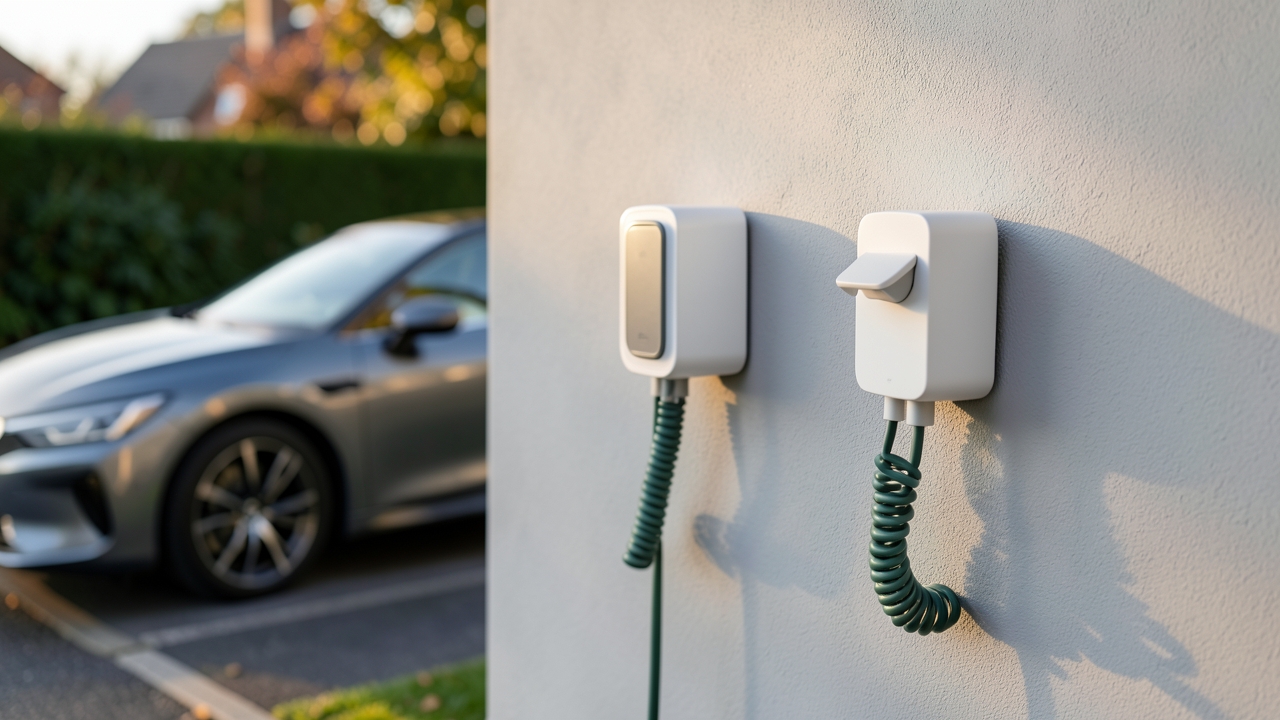
Working out the real Ohme ePod vs Wallbox Pulsar Plus and Pod Point Solo 3 cost means looking past the headline price. In 2026, the charger unit accounts for roughly two-thirds of the bill. The rest comes from cable runs, surge protection, earthing and load management. This guide breaks down every line item for a typical 7kW single-phase UK install.
Why the sticker price is only half the story
Retailers advertise 7kW chargers from about £549 to £749. However, very few UK homes can simply hang one on the wall and plug it in. Most need a new dedicated 32A circuit from the consumer unit, an isolator and a compliant earthing arrangement.
As a result, the realistic out-the-door figure in 2026 sits between £878 and £1,350. Where your property lands on that scale depends on cable routing and earthing, not on the badge on the box. For a wider view of labour rates, read our guide to EV charger installation costs in the UK.
Ohme ePod vs Wallbox vs Pod Point: the 2026 like-for-like table
The table below models a typical semi-detached UK home with a 10-metre cable run from the consumer unit to the driveway. It assumes a single-phase 230V supply and a TN-C-S (PME) earth. All figures include VAT at 20%.
| Cost item | Ohme ePod | Wallbox Pulsar Plus | Pod Point Solo 3 |
|---|---|---|---|
| Unit price (inc. VAT) | £699 | £579 | £649 |
| Standard installation (up to 10m) | £250 | £299 | £325 |
| Surge protection device (fitted) | £120 | £95 | £110 |
| Earth rod for TT supply | £150 | £150 | £150 |
| Extra cable (per metre) | £12 | £10 | £14 |
| CT clamp for load management | Included | Included | £75 |
| Typical out-the-door (easy install) | £949 | £878 | £974 |
| Out-the-door (SPD, earth rod, 8m extra cable) | £1,315 | £1,203 | £1,346 |
Those prices reflect what OZEV-approved installers are quoting in late 2026 rather than headline list prices. Your own quote will vary, yet the gaps between the three chargers rarely shift by more than £50.
The cheapest quote is rarely the cheapest install. Ask what has been left out before you compare totals.
What standard installation actually covers
Every installer defines standard a little differently. Nevertheless, most quotes include the following items as standard.
- Up to 10 metres of 6mm² cable
- A dedicated RCBO in the consumer unit
- An isolating switch next to the charger
- Type A RCD protection with 6mA DC detection
- Commissioning, testing and building control notification
Anything outside that list becomes an extra. Always ask for exclusions in writing before you pay a deposit.
Extra cable runs: £10 to £14 per metre
Cable is cheap, but labour is not. Most installers charge £10 to £14 for each metre beyond the 10m allowance. A detached house with a long driveway can easily add £150 to £250 to the bill.
Armoured SWA cable also costs more than standard cable, and it is often mandatory outdoors. Check which cable type the quote specifies before you compare totals.
Surge protection: the line item quotes often skip
Surge protection devices (SPDs) are recommended for circuits feeding outdoor equipment. Fitted prices run from £95 to £120.
A nearby lightning strike or a grid switching event can destroy the charger’s internal electronics. Consequently, skipping a £100 SPD to save money is usually a false economy.
Earth rods and TT supplies
Homes on a TT earthing system, which is common in rural areas, cannot rely on the supplier’s earth. They need a physical earth rod and sometimes a 100mA time-delayed RCD. Budget £150 to £250.
If the installer finds a looped supply, work stops until your distribution network operator upgrades it. That can take several weeks, so book a survey early.
Load management and DNO notification
A 7kW charger pulls around 30A. On a 60A or 80A main fuse, the network operator may insist on G100-compliant load management before it approves the job.
All three chargers support a CT clamp for dynamic load balancing. Fitting one typically adds £60 to £90 when it is not bundled into the package.
Ohme ePod vs Wallbox: smart tariff compatibility compared
Since June 2022, the Electric Vehicles (Smart Chargepoint) Regulations 2021 have required every new home chargepoint sold in the UK to be smart. In practice, that means pre-set off-peak charging, a randomised delay and demand response.
The real differentiator is which energy tariffs each unit can talk to. Our Octopus Intelligent Go review explains how those schedules work behind the scenes.
Ohme ePod
Ohme integrates natively with Octopus Intelligent Go, OVO Charge Anytime, British Gas Electric Driver and E.ON Next Drive. The ePod itself is untethered and screenless, so everything runs through the app.
Because Ohme hands scheduling control to the supplier, the charger can soak up cheap slots well outside the standard 23:30 to 05:30 window. That flexibility is often worth more than the £70 you might save on a cheaper unit.
Wallbox Pulsar Plus
The Pulsar Plus works with Intelligent Go and OVO Charge Anytime, and adds a built-in energy meter for solar diversion through Power Boost. It also comes with a tethered 5m or 7m cable if you prefer that setup.
Its myWallbox app is more feature-heavy than Ohme’s, although the interface takes longer to learn.
Pod Point Solo 3
Pod Point’s Solo 3 appears on the approved list for Intelligent Go and most major supplier tariffs. Its app is simpler, and the company runs the largest UK support network of the three.
On the other hand, Pod Point has historically been slower to add brand-new tariff integrations.
Running costs: what the charger does to your bill
A driver covering 8,000 miles a year in an efficient EV uses roughly 2,300 kWh. At a standard rate of about 26p/kWh, that costs around £598.
On an off-peak rate near 7p/kWh, the same mileage costs about £161. Therefore, a charger that reliably hits the cheap window saves over £400 a year, and payback on any premium is measured in months.
Grants, warranties and the paperwork nobody mentions
The EV chargepoint grant for renters and flat owners still offers up to £350 off. However, it only applies through OZEV-approved installers, and only where there is dedicated off-street parking.
All three chargers ship with a three-year warranty as standard. Wallbox sells paid extensions, while Pod Point bundles a longer support commitment on some packages.
Before you buy, check the GOV.UK chargepoint grant guidance and the Energy Saving Trust advice on home charging.
Five questions to ask before you sign
- Is this a fixed price, or an estimate subject to survey?
- How many metres of cable are included, and what is the per-metre rate beyond that?
- Is surge protection included, or is it an optional extra?
- Does the price cover building control notification under Part P?
- Which smart tariffs is this exact model certified for today?
A written answer to each of those five questions will separate a fair quote from a cheap headline.
So which charger wins on value in 2026?
On pure out-the-door cost, the Wallbox Pulsar Plus is usually cheapest. Expect around £878 for an easy install and £1,203 once you add surge protection, an earth rod and eight metres of extra cable.
The Ohme ePod lands in the middle at £949 and £1,315. Meanwhile, the Pod Point Solo 3 is the priciest at £974 and £1,346, although its aftercare is arguably the strongest of the three.
If tariff flexibility matters most, choose Ohme. If you want solar diversion and a tethered cable, choose Wallbox. If you value a familiar UK support line above all, choose Pod Point. To widen the shortlist, compare the best EV home chargers in the UK before you commit.
Which of the three would you put on your own wall this winter, and has a recent quote surprised you on the extras? Share your figure in the comments below.