Smart home technology has exploded in popularity across Britain. From Manchester flats to Scottish farmhouses, homeowners embrace connected living. Among the many platforms available, Samsung SmartThings UK has carved out a formidable reputation. It serves as a central nervous system for hundreds of smart devices. But does it still deserve your attention in 2026?
In this comprehensive review, we examine everything UK homeowners need to know. We cover current hub pricing, device compatibility, the refreshed app, and robust Matter support. We also compare SmartThings against Home Assistant and Apple HomeKit. By the end, you will know whether SmartThings fits your British home perfectly.
What Is Samsung SmartThings?
Samsung SmartThings is a smart home platform that connects and controls compatible devices from one central hub. Originally a standalone startup, Samsung acquired it in 2014. Since then, it has grown into one of the largest smart home ecosystems globally.
The platform works through a combination of hardware and software. The physical hub communicates with devices using protocols like Zigbee, Z-Wave, Wi-Fi, and Thread. Meanwhile, the SmartThings app on your phone or tablet lets you control everything remotely. You can create automation routines, set schedules, and monitor energy usage.
Crucially, Samsung has positioned SmartThings as an open platform. Unlike some rivals, it supports thousands of third-party devices. This openness is a significant advantage for British households. After all, most UK homes feature a mix of different smart brands.
Samsung SmartThings Hub Pricing in the UK 2026
Understanding the hardware costs is essential before committing to any platform. Samsung has restructured its hardware lineup over the past few years. The original SmartThings Hub v3 is no longer in production. However, several options exist for UK buyers in 2026.
SmartThings Station
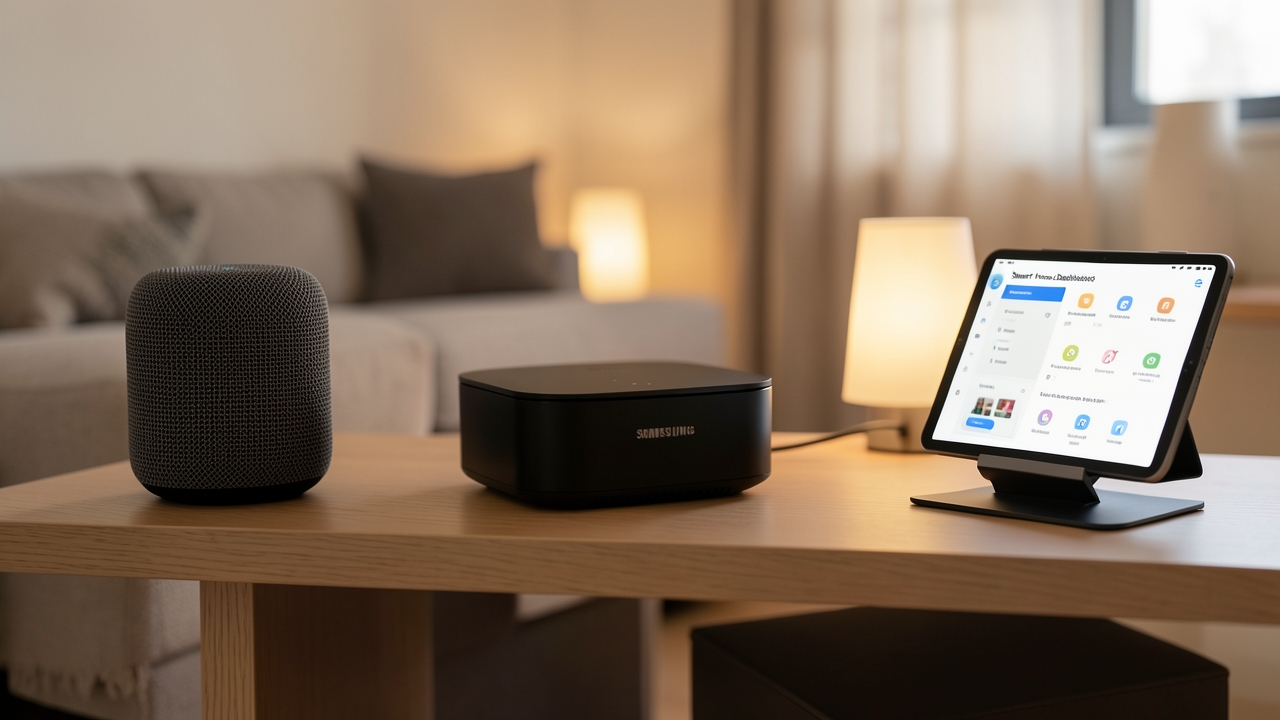
The SmartThings Station launched as Samsung’s compact, modern hub. In the UK, it retails for approximately £89.99. It doubles as a wireless charger for compatible Samsung phones. The Station supports Zigbee, Matter, and Wi-Fi. It connects directly to your home router via Ethernet.
This device suits flat-dwellers and those wanting a discreet entry point. However, it lacks Z-Wave support. That matters if you own older Z-Wave-only devices popular in some UK smart homes.
Aeotec Smart Home Hub (SmartThings Compatible)
The Aeotec Smart Home Hub remains available and fully certified for SmartThings. Priced at around £109.99, it supports Zigbee, Z-Wave, and Wi-Fi. Furthermore, it received Matter support through a firmware update. This hub is the best choice for UK homes with mixed protocol devices.
Using a Samsung TV or Refrigerator as a Hub
Interestingly, many newer Samsung TVs and Family Hub refrigerators function as SmartThings hubs. If you already own a 2024 or newer Samsung Smart TV, you may not need separate hardware. The built-in hub supports Zigbee and Matter natively.
UK Tip: Check whether your existing Samsung devices double as SmartThings hubs before purchasing additional hardware. You could save £90 or more.
Compatible UK Devices in 2026
Device compatibility is arguably the most important factor for any smart home platform. Fortunately, Samsung SmartThings UK supports an enormous range of products. The ecosystem has grown to include over 5,000 compatible devices from hundreds of manufacturers.
Here are some of the most popular UK-compatible device categories:
- Lighting: Philips Hue, IKEA TRÅDFRI, LIFX, Innr, and Nanoleaf all integrate seamlessly
- Heating: Hive Active Heating, Tado, Drayton Wiser, and Honeywell evohome work directly
- Security: Ring, Arlo, Yale Smart Locks, and Aqara sensors connect without fuss
- Energy: TP-Link Kasa plugs, Shelly relays, and various solar inverter APIs feed data into SmartThings
- Appliances: Samsung, LG, and Bosch smart appliances offer native integration
- EV Charging: Some smart EV chargers integrate via IFTTT or Matter
Matter support has been a game-changer for compatibility. By 2026, hundreds of Matter-certified products are available in UK shops. Brands like Eve, Nanoleaf, and Yale have fully embraced the standard. As a result, SmartThings can now communicate with devices that previously required separate hubs.
If you are curious about smart energy solutions beyond individual devices, our guide to balcony solar panels in the UK explores how renewable energy fits into a connected home.
The SmartThings App: Features and Experience
Samsung completely redesigned the SmartThings app in 2023, and the 2026 version builds on that foundation. The refreshed interface prioritises simplicity and speed. Let us explore the key features that matter most to British users.
Dashboard and Device Control
The main dashboard displays all your devices organised by room. You can customise tiles to show real-time data like temperature, humidity, or energy consumption. Tapping a device provides detailed controls. Meanwhile, scenes let you adjust multiple devices simultaneously.
Energy Monitoring
Energy monitoring has become a priority for cost-conscious UK households. SmartThings provides detailed energy usage reports for connected devices. You can track daily, weekly, and monthly consumption patterns. Furthermore, the app suggests ways to reduce waste based on your habits.
According to Energy Saving Trust, smart home technology can reduce household energy consumption by up to 15%. SmartThings’ energy features directly support this goal. For homes with solar panels, SmartThings can even monitor generation alongside consumption.
SmartThings AI Features
Samsung has integrated AI capabilities into SmartThings. The platform learns your daily routines over time. It then suggests automation routines based on your behaviour patterns. For example, it might recommend turning off heating when you leave for work. In addition, AI-powered anomaly detection alerts you to unusual device activity.
Matter and Thread Support in the UK
Matter has fundamentally changed the smart home landscape. This open-source connectivity standard ensures devices from different manufacturers work together. Samsung has been a leading supporter of Matter from the beginning. By 2026, SmartThings offers comprehensive Matter integration.
Thread is Matter’s preferred networking protocol. It creates a mesh network that is faster and more reliable than traditional Zigbee or Z-Wave. Several SmartThings products now include Thread border router functionality. This means your Thread devices can connect directly through SmartThings without additional hardware.
For UK homeowners, Matter support means greater flexibility. You are no longer locked into a single ecosystem. A Matter-certified smart plug purchased from Argos works with SmartThings, Apple Home, and Google Home equally. However, some advanced features may still require manufacturer-specific apps.
Automation Routines: What Can SmartThings Do?
Automation routines are the heart of any smart home. SmartThings offers flexible, powerful automation capabilities. Let us look at some practical examples for UK homes.
Routine Examples for British Homes
- Morning Routine: At 6:30 AM, gradually increase bedroom lights, start the kettle via a smart plug, and adjust the thermostat to 21°C
- Leaving Home: When your phone leaves a geofence around your house, lock the Yale door, arm the Ring alarm, and lower the Tado thermostat to 16°C
- Evening Wind-Down: At 9:00 PM, dim Philips Hue lights to 30% warm white, activate the robot vacuum, and enable night mode on security cameras
- Energy Saver: When solar generation exceeds 1.5kW, automatically start the washing machine via a smart plug and charge the EV battery
The automation editor uses a straightforward if-this-then-that structure. You can combine multiple conditions and actions. For instance, you might trigger an action only when it is both dark outside and someone is home. This flexibility rivals more complex platforms.
Routines vs Scenes vs Monitoring
SmartThings distinguishes between routines, scenes, and monitoring. Routines trigger automatically based on conditions. Scenes are manual one-tap setups. Monitoring continuously tracks device states and sends alerts. Understanding these three concepts helps you build a truly intelligent home.
Samsung SmartThings vs Home Assistant vs Apple HomeKit
The UK smart home market features three dominant platforms. Each serves a different type of user. Here is how Samsung SmartThings UK compares to its main rivals.
SmartThings vs Home Assistant
Home Assistant is a free, open-source platform that runs on local hardware like a Raspberry Pi. It offers unmatched customisation and supports virtually every smart device ever made. However, it requires technical knowledge to set up and maintain. SmartThings, on the other hand, prioritises simplicity. It works out of the box with minimal configuration.
For tech-savvy UK users who enjoy tinkering, Home Assistant is hard to beat. But for families who want reliable automation without command-line interfaces, SmartThings wins decisively.
SmartThings vs Apple HomeKit
Apple HomeKit offers exceptional privacy and seamless integration with iPhones, iPads, and Apple Watches. Its Home app is clean and intuitive. However, HomeKit historically supported fewer devices than SmartThings. Matter has narrowed this gap considerably. Furthermore, Apple HomeKit requires a HomePod or Apple TV as a home hub.
SmartThings provides broader device support and more advanced automation options. However, Apple HomeKit wins on privacy and ecosystem integration for committed Apple households.
Comparison Table
- Setup Difficulty: SmartThings (Easy) vs Home Assistant (Hard) vs HomeKit (Easy)
- Device Support: SmartThings (Excellent) vs Home Assistant (Best) vs HomeKit (Good, improving)
- Automation Power: SmartThings (Very Good) vs Home Assistant (Excellent) vs HomeKit (Basic to Good)
- Cost: SmartThings (Free app + hardware from £89) vs Home Assistant (Free software + hardware from £50) vs HomeKit (Free app + HomePod Mini from £99)
- Local Control: SmartThings (Limited) vs Home Assistant (Full) vs HomeKit (Good)
- Matter Support: All three platforms support Matter in 2026
Pros and Cons of Samsung SmartThings in the UK
Advantages
- Extensive device compatibility with thousands of UK-available products
- Free platform with no monthly subscription fees
- Comprehensive Matter and Thread support for future-proofing
- Intuitive app that suits non-technical users
- Strong energy monitoring features for reducing bills
- Works brilliantly with Samsung TVs, phones, and appliances
- Reliable cloud infrastructure backed by Samsung
Disadvantages
- Relies heavily on cloud connectivity for core features
- Limited Z-Wave support on newer hardware like the SmartThings Station
- Less customisable than open-source alternatives
- Samsung occasionally discontinues features or hardware unexpectedly
- Local processing capabilities remain limited compared to Home Assistant
- Some advanced automations still require the IDE or third-party tools
Is Samsung SmartThings Right for Your UK Home?
Samsung SmartThings UK represents a mature, reliable, and versatile smart home platform. It excels as a central hub for mixed-device households. The generous free tier, extensive compatibility, and strong Matter support make it a compelling choice in 2026.
However, it is not perfect for everyone. Tech enthusiasts who demand total local control may prefer Home Assistant. Privacy-focused Apple households might lean towards HomeKit. And those on tight budgets should weigh whether the hardware investment is justified for their needs.
For the majority of British homeowners, SmartThings strikes an excellent balance. It is powerful enough for complex automations yet simple enough for daily use. The growing Matter ecosystem ensures your investment remains relevant for years to come.
If you are building a broader smart home strategy, our guide to full home automation in the UK provides additional context. Additionally, our review of AI tools for smart home content creators explores how technology is transforming home management even further.
The smart home market in the UK continues to evolve rapidly. Samsung SmartThings remains one of the strongest contenders for British households seeking connected living. Whether you are just starting out or expanding an existing setup, it deserves serious consideration.
Have you tried Samsung SmartThings in your UK home? Which platform do you prefer for your smart home setup? Share your experiences in the comments below — we would love to hear from you.