
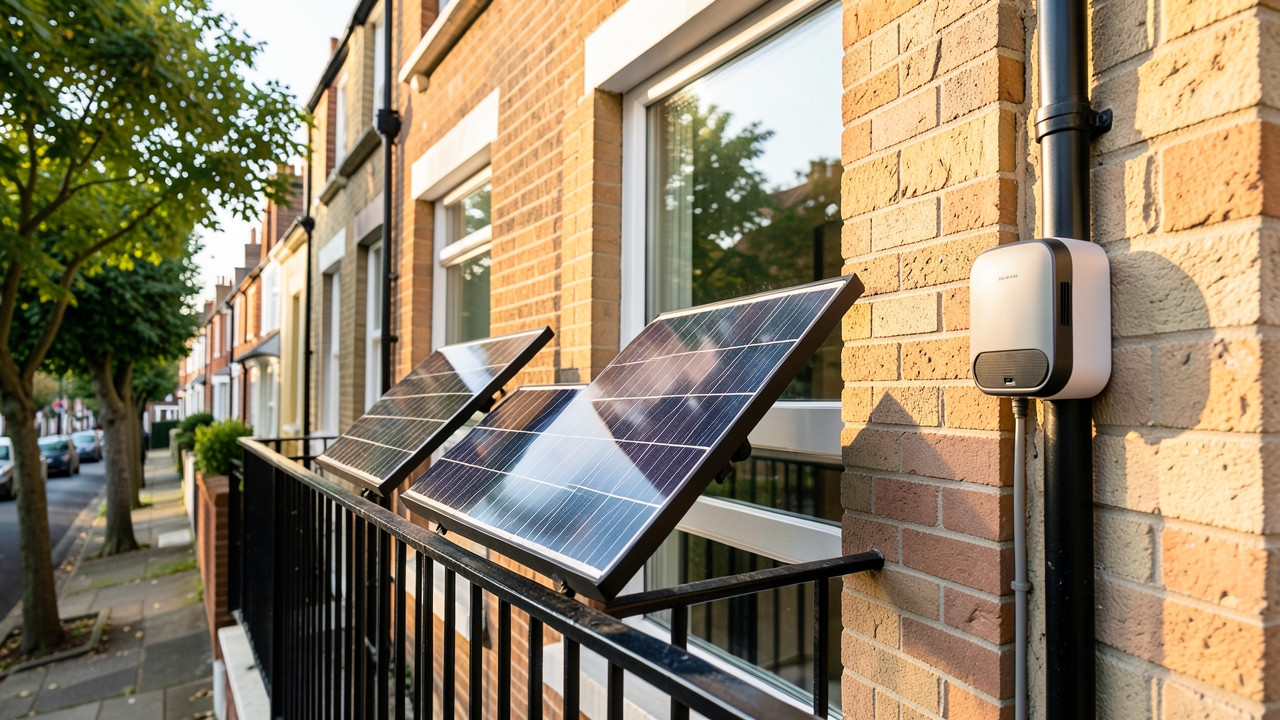
The plug-in solar panels UK households are buying in record numbers are no longer a niche experiment. However, the legal picture in 2026 is more complex than the adverts suggest. In short, a plug-in kit is legal to buy, own and use, but where you live, who owns your building and how you wire it up all change what you must do.
Are Plug-in Solar Panels UK Legal in 2026? The Short Answer
Yes. There is no law that bans plug-in solar panels anywhere in the UK. You can buy a kit online or from a British retailer today, plug it into a suitable socket and start generating your own electricity. Furthermore, no special licence or installer certification is needed just to use one.
Nevertheless, legal does not mean unregulated. Three separate sets of rules apply: electrical safety law, grid connection rules and property law. That last one trips up more people than the other two combined.
What Counts as a Plug-in Solar Kit?
A typical kit includes one to four photovoltaic panels, a micro-inverter and a cable fitted with a standard UK 13 amp plug. Most kits sold in Britain in 2026 sit between 400W and 800W. In addition, most are designed to hang from a balcony railing or rest on a flat roof, shed or garden frame.
The key difference from a traditional rooftop array is simple. You plug it in rather than wiring it into your consumer unit through an installer. For a wider comparison, see our guide to balcony solar panels for UK flats.
Grid Connection Rules: G98, G99 and the 800W Ceiling
Any device that generates electricity and connects to the public network falls under the Distribution Code. For small systems, the relevant standard is G98, which covers generation up to 16 amps per phase. That is roughly 3.68kW. Consequently, an 800W balcony kit sits comfortably inside G98.
However, G98 is not optional. You must notify your distribution network operator (DNO) within 28 days of commissioning. That means contacting UK Power Networks, National Grid Electricity Distribution, SP Energy Networks or SSEN, depending on your region. Most now accept notification through an online form.
On the other hand, G99 applies to larger systems. If you link several kits together and exceed 16A per phase, you need prior approval rather than a simple notification.
Why 800 Watts Is the Practical Limit
Germany and Austria cap plug-in systems at 800VA, and UK policymakers have leaned heavily on that figure. The reason is our ring final circuits. A standard UK ring main is protected by a 32A breaker, and a 13A plug delivers a maximum of about 3kW. An 800W inverter adds roughly 3.5A, which stays within safe limits.
Therefore, a 1,600W kit pushed through a single plug is risky. As a result, most reputable manufacturers split larger systems across two inverters and two separate sockets.
Safety Standards to Check Before You Buy
UK law requires electrical equipment sold here to meet the Electrical Equipment (Safety) Regulations 2016 and to carry UKCA marking. In addition, a decent micro-inverter should meet BS EN 62109-1 and BS EN 62109-2, while the panels themselves should meet BS EN IEC 61730.
Furthermore, look for an IP65 rating or better if the inverter lives outdoors. Cheap imports without UKCA marking are common on marketplace sites, and they are the single biggest concern raised by safety campaigners. The Energy Saving Trust also advises buying from a seller with a UK address and warranty.
One technical wrinkle remains. BS 7671, the IET Wiring Regulations, does not yet describe a plug-in connection method for micro-generation. Consequently, many UK electricians will only sign off a dedicated outdoor socket on its own RCBO rather than a shared ring main. Budget £150 to £300 for that work. It is money well spent.
What the Government Proposed in 2026
The Department for Energy Security and Net Zero ran a call for evidence on plug-in solar in 2025. Its formal response landed in 2026 and signalled three clear directions of travel.
- A dedicated product standard. Work with BSI on certifying kits for safe 13A plug connection, rather than leaving buyers to guess.
- A simpler notification route. A single national portal instead of four regional DNO forms.
- New rights for renters and leaseholders. Proposals so landlords and freeholders cannot unreasonably refuse a small balcony system.
Meanwhile, ministers confirmed they will consult on amending standard tenancy agreements and leasehold covenants. You can read the original GOV.UK call for evidence for the full detail. Planning, however, remains devolved, so Scotland and Wales set their own rules.
Rules for Flats vs Terraced Houses
Flats and Apartments
Flats are the hardest case. If you own your flat leasehold, your lease almost certainly restricts alterations to the external appearance of the building. A panel bolted to a balcony railing may count as an alteration, even though the balcony is yours to use.
In addition, flats have very limited permitted development rights. Therefore, if the panel is visible from outside and your building sits in a conservation area, you may need planning permission. Ask your managing agent in writing first, and keep the reply.
Renters have it slightly easier in 2026. The proposed right to plug in would let tenants install a balcony kit with written landlord consent, which cannot be unreasonably withheld.
Terraced Houses
Terraced homes usually have more freedom. Roof-mounted solar panels are permitted development under Part 14 of the General Permitted Development Order, provided they do not protrude more than 200mm from the roof slope.
However, terraces bring their own complications. Many face a highway, and in a conservation area panels must not be fitted to a wall or roof slope that fronts the road. Consequently, a rear garden ground-mount or a shed roof is often the smarter choice.
Party walls matter too. In practice, a panel on your own side of a shared chimney stack is fine, but scaffolding for the install may need a party wall agreement.
Listed Buildings and Conservation Areas
Listed building consent is required for almost any external alteration. On the other hand, a freestanding panel in a back garden that is not fixed to the listed structure is sometimes acceptable. Always ask your local planning authority before you buy anything.
What Do Plug-in Solar Panels Cost in 2026?
Prices have fallen sharply over the past two years. Expect to pay roughly the following figures:
- A 400W single-panel starter kit: £280 to £450
- An 800W two-panel kit with balcony brackets: £550 to £900
- A 1,600W dual-inverter set-up: £1,100 to £1,700
- Professional outdoor socket installation: £150 to £300
Running costs are close to zero, and there is no inverter replacement bill for the first decade. In addition, most kits now carry a 10 to 12 year inverter warranty and a 25 year panel performance guarantee. Our round-up of the best plug-in solar kits compares current models on price and output.
How Much Can You Actually Save?
An 800W balcony system in southern England generates roughly 650 to 750 kWh a year when well angled. With the Ofgem price cap unit rate sitting near 24.5p per kWh in late 2026, that electricity is worth about £160 if you use every unit yourself.
Realistically, you will self-consume 60 to 80 per cent. Therefore, expect annual savings of £100 to £150 and a payback period of five to seven years. Just remember that these kits are not MCS certified, so you cannot claim Smart Export Guarantee payments. For a longer comparison, read our guide to solar panel payback in the UK.
How to Install Plug-in Solar Panels Legally
- Check your lease, tenancy agreement or freehold title for restrictions.
- Confirm planning status if you are in a conservation area or a listed building.
- Buy a UKCA-marked kit with a BS EN 62109 compliant inverter.
- Have a qualified electrician fit a dedicated outdoor socket on its own RCBO.
- Notify your DNO under G98 within 28 days of commissioning.
- Tell your home insurer and add the kit to your policy.
- Never daisy-chain extension leads or share a socket with high-draw appliances.
The Bottom Line for Renters and Leaseholders
Plug-in solar panels are legal across the UK in 2026. However, the practical barriers are property-related rather than electrical. If you own a terraced house with a rear garden, you could install a kit this weekend with almost no paperwork. If you rent a flat in a conservation area, expect to wait for landlord consent and possibly planning permission.
The direction of travel is clear, though. With product standards due and new rights for tenants on the table, 2027 should be easier than 2026. Meanwhile, millions of UK households with a sunny balcony now have a genuine route into home-generated power.
Are you planning a balcony set-up this autumn, or has a managing agent already said no? Share your experience in the comments below, because it helps other readers know exactly what to expect.