
What Are Balcony Solar Panels?
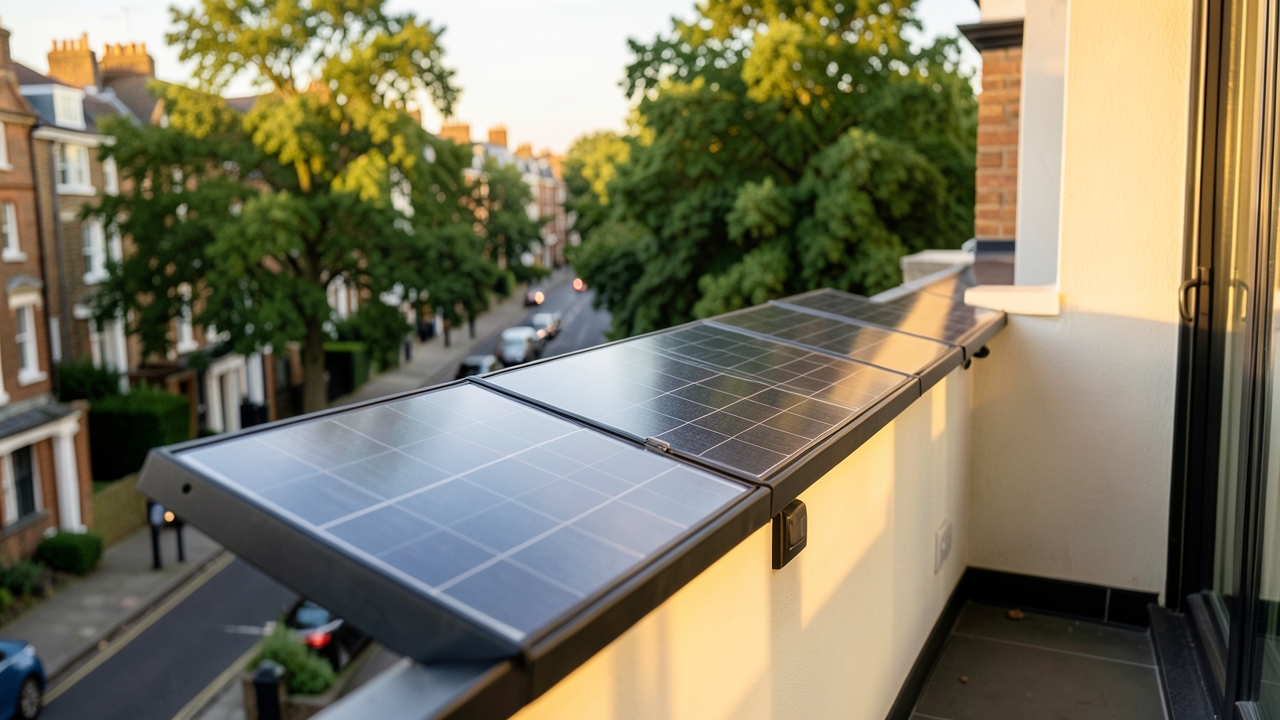
Balcony solar panels are compact photovoltaic modules designed for small spaces. Unlike traditional rooftop systems, they attach to railings, walls, or freestanding frames on a balcony. Most models connect directly to your home socket using a micro-inverter and a standard 3-pin plug. This plug-and-play design makes them incredibly accessible. You do not need scaffolding, a roofer, or complex wiring.
Typical balcony solar kits in the UK produce between 300W and 800W. For context, a 600W system generates roughly 500–600 kWh per year under UK conditions. That translates to savings of approximately £150–£200 annually, based on the 2026 Ofgem price cap. Furthermore, prices for a complete kit range from £200 to £600 depending on wattage and panel quality. For a deeper look at available systems, check out our guide to the best balcony solar panels in the UK.
UK Balcony Solar Regulations in 2026: What Has Changed?
The regulatory landscape for balcony solar has shifted in recent years. The UK government has actively encouraged small-scale solar adoption as part of its net zero strategy. However, planning rules have not always kept pace. In 2023, the Levelling Up and Regeneration Act introduced several amendments to the Town and Country Planning Act 1990. These changes aimed to streamline renewable energy installations on domestic buildings.
By 2025, additional guidance was published clarifying how permitted development rights apply to solar panels on flats. The key point remains this: permitted development rights for solar panels do not automatically extend to flats and apartments. This means that in many cases, flat owners still need planning permission before installing balcony solar panels. However, the rules are nuanced. Let us unpack them in detail.
When Do You Need Planning Permission for Balcony Solar?
Planning permission requirements depend on your specific circumstances. Below, we outline the main scenarios where UK balcony solar regulations apply most directly.
Flats and Apartments (Non-Dwelling Houses)
If you live in a flat, your property is not classified as a dwelling house under planning law. Therefore, the permitted development rights that allow houses to install solar panels without planning permission do not apply to you. Consequently, you will almost certainly need planning permission to install balcony solar panels. This applies even if the panels sit entirely within your balcony space and do not extend beyond it.
That said, some local authorities exercise discretion. For example, minor installations that are fully contained within an existing balcony structure may not trigger enforcement action. However, relying on this is risky. The safest approach is to apply for a Lawful Development Certificate or full planning permission.
Leasehold Properties
Most flats in England and Wales are leasehold. This adds another layer of complexity. Even if planning permission were not required, you would still need your freeholder’s written consent. In addition, your lease may contain specific clauses about alterations to the property. Installing solar panels on a balcony could be classed as an alteration.
Before purchasing any equipment, request a copy of your lease and check for restrictions. Many freeholders now welcome green upgrades. Some managing agents have even introduced standardised solar panel agreements to make the process smoother. Furthermore, under the Commonhold and Leasehold Reform Act 2002, leaseholders have rights to make improvements, though solar panels on balconies fall into a grey area.
Houses with Balconies or Roof Terraces
If you own a house, the rules are considerably more straightforward. Houses benefit from permitted development rights under Schedule 2, Part 12 of the Town and Country Planning (General Permitted Development) (England) Order 2015, as amended. Solar panels on houses generally do not need planning permission, provided they meet certain conditions. These include a maximum projection of 200mm from the roof or wall surface and placement below the highest point of the roof.
For houses, balcony-mounted panels may qualify as wall-mounted installations. As long as they stay within the permitted development limits, you should not need to apply for planning permission. However, if your property is in a Conservation Area or is listed, different rules apply. You should always check with your local planning authority.
Building Regulations vs Planning Permission
Many people confuse planning permission with building regulations. They are two separate things. Planning permission concerns the appearance and impact of a structure on its surroundings. Building regulations, on the other hand, deal with safety, structural integrity, and electrical standards.
For most plug-in balcony solar kits, building regulations are unlikely to apply. The panels are lightweight, attach to existing structures, and connect via a standard plug. However, if your installation involves hardwiring into your consumer unit or mounting panels on load-bearing structures, you may need building regulation approval. Additionally, the electrical work must comply with Part P of the Building Regulations. Always use a qualified electrician for any hardwired installation.
The GOV.UK website provides detailed guidance on the distinction between planning permission and building regulations. We recommend reading this before starting any installation.
Safety Standards and Certification
UK balcony solar regulations also overlap with product safety requirements. All solar panels and micro-inverters sold in the UK must carry a CE or UKCA mark. In addition, micro-inverters must be certified under the G98 or G99 regulations for grid connection. These standards ensure your system is safe and compatible with the UK electricity grid.
As of 2026, the IEC 62109 standard is mandatory for all solar inverters used in the UK. Furthermore, the Electrical Safety First organisation recommends annual inspections for fixed solar installations. While plug-in balcony kits are generally low-risk, it pays to choose reputable manufacturers. Look for products backed by a minimum 25-year performance warranty and a 10-year inverter warranty.
How to Apply for Planning Permission
If you determine that you need planning permission, the process is relatively straightforward. Here is a step-by-step overview:
- Contact your local planning authority to confirm requirements.
- Complete the planning application form (available on the Planning Portal).
- Submit scaled drawings showing the proposed panel locations.
- Pay the application fee — currently £206 for householder applications in England (2026 rate).
- Wait for a decision, typically within 8 weeks.
Many applications are decided under delegated authority. This means a planning officer reviews your case without a committee. The approval rate for minor domestic solar installations is high. However, if your property is in a Conservation Area or is near a listed building, expect additional scrutiny. In some cases, you may also need Listed Building Consent.
What About Right to Light and Party Wall Issues?
Balcony solar panels are unlikely to affect your neighbours’ right to light. They sit within your own balcony space and do not project outward. However, if your panels are angled steeply or positioned near a boundary, it is worth considering this factor. The Party Wall etc. Act 1996 may apply if your panels attach to a shared wall.
In practice, this is rarely an issue for lightweight balcony solar kits. Most installations simply hook onto existing railings or sit on the balcony floor. Nevertheless, maintaining a good relationship with your neighbours is always wise. Inform them of your plans before you begin.
Practical Tips for Flat Owners in 2026
Navigating UK balcony solar regulations can feel daunting. Here are some practical tips to make the process smoother:
- Start with your lease — check for restrictions before anything else.
- Contact your freeholder early — many now have clear policies on solar installations.
- Use plug-in systems where possible — these are less likely to require building regulations approval.
- Document everything — keep records of all communications with your freeholder and local authority.
- Choose certified products only — look for UKCA marking and G98 certification.
- Consider community energy schemes — some housing associations now offer group purchasing discounts.
For a complete walkthrough of the installation process, including mounting options for different balcony types, read our balcony solar panel installation guide.
The Bigger Picture: Energy Independence in 2026
UK balcony solar regulations may present hurdles, but the benefits are substantial. The average UK household spent approximately £1,400 on electricity in 2025. A well-placed balcony solar kit can offset 10–15% of that bill. Furthermore, pairing your solar panels with a small home battery — such as the EcoFlow River 2 Pro, retailing at around £449 — maximises your self-consumption.
The UK government’s ambition to reach net zero by 2050 depends on widespread adoption of small-scale renewables. According to the Energy Saving Trust, domestic solar generation could contribute up to 10GW of capacity by 2035. Every balcony panel installed brings that target closer. Meanwhile, battery storage technology continues to improve, making balcony solar even more practical year after year.
Interestingly, the trend towards electrification is not limited to solar. Many flat owners are also exploring other green technologies. If you are curious about pairing your solar setup with electric vehicle charging, our article on home EV chargers provides useful context.
Frequently Asked Questions About UK Balcony Solar Regulations
Can I install balcony solar panels without telling my freeholder?
No. Most leases require written consent for any external alterations. Installing panels without permission could breach your lease terms. This may lead to legal action or a requirement to remove the panels. Always obtain consent in writing first.
How much does planning permission cost in the UK?
A householder planning application in England costs £206 as of 2026. Fees may vary slightly in Scotland, Wales, and Northern Ireland. Processing typically takes eight weeks for minor applications.
Do plug-in solar kits need building regulations approval?
Generally, no. Plug-in kits that connect via a standard 3-pin socket and do not alter the building’s structure typically fall outside building regulations. However, if your installation involves hardwiring, you should seek approval.
Are balcony solar panels worth it in the UK climate?
Yes. Modern panels perform well even in overcast UK conditions. A south-facing balcony panel can generate meaningful electricity year-round. Even north-facing panels produce some power, though output drops by roughly 30–40%.
Final Thoughts
UK balcony solar regulations in 2026 remain a patchwork of planning law, leasehold rules, and product safety standards. The good news is that awareness is growing. Local authorities and freeholders are becoming more receptive to small-scale solar. Flat owners face more hurdles than house owners, but the path is navigable with the right preparation. Start by checking your lease, contact your freeholder, and research your local planning authority’s stance. With a little effort, you could be generating clean electricity from your balcony within weeks.
Have you installed balcony solar panels in a flat? Or are you planning to do so? We would love to hear about your experience. Share your thoughts or questions in the comments below — and let us help you go solar in 2026.
Balcony Solar Savings Calculator
See your annual savings, export income and payback time — free, no sign-up.